


Mangaluru: Hostels sending back students; hotels too hit by water crisis

[email protected] (CD Network)
May 3, 2016

Mangaluru, May 3: Hostels, hotels and restaurants have started feeling the pinch of water crisis in Mangaluru as the City Corporation has resorted to supply water once in three days.
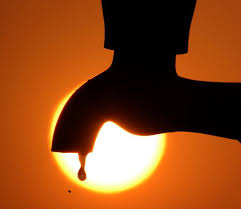
waterMany hostels and hotels in the city are mainly depend on the Netravati waters supplied from the Thumbe vented dam, where the storage levels have fallen to 5.8 ft against a maximum 13 ft. Though they have borewells and open wells, the water table in them has gone very low.

Already, two prominent medical colleges in this educational hub have partially shut down their hostels and sent hundreds of students their homes till the situation improves.

It is learnt that Kasturba Medical College (KMC) has sent back about 400 MBBS students of second and third year batches from their hostels till May 15 and Father Muller Medical College has sent back about 75 per cent of the students.

The KMC has about 2,000 students, including some day scholars in eight hostels, while Father Muller Medical College has about 2,500 students from medical, para medical and nursing streams in eight hostels.

On the other hand many hotels in the city do not even have water to wash the vessels. Some hotels serving snacks and sweets on paper plate

Swarna Sunder, vice-president, Dakshina Kannada Hotels and Restaurants' Association said that some hotels had introduced eco-friendly bio-plates made from areca-nut sheaths or areca-nut leaf plates. But this did not go down well with many customers who are yet to get accustomed to it.

Mr. Sunder said river Netravathi drying up has hit hotels and lodges in Mangaluru, with the owners of middle-class hotels and restaurants worst hit. Many of them can't even depend on private tankers anymore as many of them are either getting too many requests or have been hired by MCC to supply water.

Meanwhile, the flow of customers to hotels has also increased with the tourist season beginning. Moreover, people who are unable to cook at home due to water shortage also come to hotels, Mr. Sunder said.

Comments

Hasan Yusuf
 - 
Tuesday, 3 May 2016

This is the right time that our Government has to set up water DESALINIZATION PLANTS in Mangalore and other parts of Karnataka / India to solve the water crisis.

Rikaz
 - 
Tuesday, 3 May 2016

Put up a desalination plant around Mangalore, that would solve most of water crisis during summer season....India is of course a rich country...it can afford to spend money required for it....

whoever came to power after independence they made people very poor....

Sharabjeeth singh
 - 
Tuesday, 3 May 2016

Scenes of water shortage in various parts of country are so scary, everytime I open a tap and water comes out, I feel so much gratitude.
18 retweets 20 likes

Afzal
 - 
Tuesday, 3 May 2016

Prepare yourself, Mangalore. We ignored the villages. Now water shortage is at our door.

Dawood
 - 
Tuesday, 3 May 2016

Bad weather and bad policy aggravate an awful drought

Fahad
 - 
Tuesday, 3 May 2016

1 wasted drop of water/sec adds up to 8400 litres/month, 100,000 litres/year. FIX THE LEAK SOLVE THE WATER SHORTAGE

Ranchith
 - 
Tuesday, 3 May 2016

Never ever seen such water shortage in Mangalore. No tap water, dry wells/borewells this time. Most dependent on water tankers. 1K a day.

Manisha Kamath
 - 
Tuesday, 3 May 2016

So apt .... Be it Water Shortage Food woes Pollution Terrorism This defines our thinking..sad

SK
 - 
Tuesday, 3 May 2016

Let the situation worsen.... During mob attacks, only weaker section people used to run away..... Now people from all categories has to run away.... I am also one amongst them.... Let us taste / face the real difficulties of life..... on behalf of the oppressed people.....

Gowraw
 - 
Tuesday, 3 May 2016

All students must boycott the college and plant the trees .

Add new comment

  • Coastaldigest.com reserves the right to delete or block any comments.
  • Coastaldigset.com is not responsible for its readers’ comments.
  • Comments that are abusive, incendiary or irrelevant are strictly prohibited.
  • Please use a genuine email ID and provide your name to avoid reject.
News Network
March 19,2020

Bengaluru, Mar 19: The Karnataka government has extended the statewide coronavirus shutdown till March 31 as the number of positive cases rose to 14, of whom 11 are those who came in from foreign countries.

In an emergency Cabinet meeting, the state government set up a task force of four ministers to lead the defence against the virus. This core team will have Rs 200 crore to orchestrate the combat.

When chief minister B S Yediyurappa announced the shutdown last week, it was to be in force until March 21, but it was always unlikely that the Covid-19 scare would have waned by then.

Several more restrictions were announced today. Quarantine will be mandatory for all passengers arriving from foreign countries. While schools, colleges and business establishments will continue to be closed, restrictions have been extended to marriages, fairs and social functions as well.

Public entry to Vidhana Soudha, Vikas Soudha and the M.S. Building has been barred till March 31.

While setting up the task force, the government has earmarked Rs 200 crore for the coronavirus campaign. The chief minister said there is no dearth of funds for fighting the virus.

The task force will have deputy chief minister Ashwathnarayana, home minister Basavaraj Bommai, medical education minister Sudhakar, health and family welfare minister B Sreeramulu and chief secretary T M Vijaybhaskar.  Sreeramulu will head the task force.

The task force will monitor coronavirus cases on a daily basis and orchestrate the response of all stakeholders. It will issue a daily bulletin on the epidemic and also run awareness campaigns.

With quarantine now mandatory for passengers coming in foreign countries, community centres, hotels, convention centres, resorts and even PGs will be rented to accommodate the new arrivals.

The compulsory quarantine will be for 15 days.

A quarantine stamp will be imprinted on the right hand of passengers coming in from foreign countries.

Since the Centre has relaxed the rules for using SDRF funds, the state government will draw from it to contain the pandemic; therefore, there will be more funds available to all districts, chief minister B S Yediyurappa said in the Assembly.

In further measures, all passengers and suspected Covid-19 cases will be tracked by their mobile phones.

Primary stage

“We are in the first and second stages of the epidemic. The virus is still at a primary stage and has not spread to community level," medical education minister Sudhakar said in the Assembly.

"It is important that we do not let the epidemic enter the third stage. It is possible if we implement stringent measures. People have responded positively to the state government’s measures and are cooperating with our decisions," Sudhakar said.

Comments

Add new comment

  • Coastaldigest.com reserves the right to delete or block any comments.
  • Coastaldigset.com is not responsible for its readers’ comments.
  • Comments that are abusive, incendiary or irrelevant are strictly prohibited.
  • Please use a genuine email ID and provide your name to avoid reject.
News Network
March 4,2020

New Delhi, Mar 4: Tech giant Intel has said one of its employees in Bengaluru has "potentially been exposed" to coronavirus and is currently under quarantine.

The company also said it has implemented precautionary measures like travel restrictions, increased frequency of office sanitisation, and work-from-home provisions in India.

"An Intel employee in Bangalore has potentially been exposed and is currently under quarantine in accordance with government requirements," Intel said in a late night statement on Tuesday.

The company said it is monitoring the coronavirus situation closely and working to ensure that its employees have the information and resources they need to stay safe and informed.

In India, we have implemented precautionary measures such as travel and event restrictions, visitor screenings at all our offices, increased frequency of office sanitisation, and work-from-home provisions," it said.

The virus outbreak, which has seen cases being registered across the world including South Korea, Iran, Italy and Japan, has had a significant impact on businesses across industries.

Microblogging platform Twitter has asked its employees to work from home while other tech giants like Tata Consultancy Services and HCL Technologies instructed staff to avoid non-essential travel as IT firms put in place measures to safeguard workers against the deadly coronavirus.

The coronavirus outbreak claimed over 3,000 lives globally, and fresh cases being reported in India.

The government has stepped up its efforts to detect and check the virus outbreak whose epicentre was in China.

Comments

Add new comment

  • Coastaldigest.com reserves the right to delete or block any comments.
  • Coastaldigset.com is not responsible for its readers’ comments.
  • Comments that are abusive, incendiary or irrelevant are strictly prohibited.
  • Please use a genuine email ID and provide your name to avoid reject.
News Network
April 2,2020

The current physical distancing guidelines provided by the World Health Organisation (WHO) and by the US Centers for Disease Control and Prevention (CDC) may not be adequate to curb the coronavirus spread, according to a research which says the gas cloud from a cough or sneeze may help virus particles travel up to 8 metres. The research, published in the Journal of the American Medical Association, noted that the the current guidelines issued by the WHO and CDC are based on outdated models from the 1930s of how gas clouds from a cough, sneeze, or exhalation spread.

Study author, MIT associate professor Lydia Bourouiba, warned that droplets of all sizes can travel 23 to 27 feet, or 7-8 metres, carrying the pathogen.

According to Bourouiba, the current guidelines are based on "arbitrary" assumptions of droplet size, "overly simplified", and "may limit the effectiveness of the proposed interventions" against the deadly pandemic.

 She explained that the old guidelines assume droplets to be one of two categories, small or large, taking short-range semi-ballistic trajectories when a person exhales, coughs, or sneezes.

However based on more recent discoveries, the MIT scientist said, sneezes and coughs are made of a puff cloud that carries ambient air, transporting within it clusters of droplets of a wide range of sizes.

Bourouiba warned that this puff cloud, with ambient air entrapped in it, can offer the droplets moisture and warmth that can prevent it from evaporation in the outer environment.

"The locally moist and warm atmosphere within the turbulent gas cloud allows the contained droplets to evade evaporation for much longer than occurs with isolated droplets," she said.

"Under these conditions, the lifetime of a droplet could be considerably extended by a factor of up to 1000, from a fraction of a second to minutes," the researcher explained in the study.

The MIT scientist, who has researched the dynamics of coughs and sneezes for years, added that these droplets settle along the trajectory of a cough or sneeze contaminating surfaces, with their residues staying suspended in the air for hours.

"Even when maximum containment policies were enforced, the rapid international spread of COVID-19 suggests that using arbitrary droplet size cutoffs may not accurately reflect what actually occurs with respiratory emissions, possibly contributing to the ineffectiveness of some procedures used to limit the spread of respiratory disease," Bourouiba wrote in the study

Comments

Add new comment

  • Coastaldigest.com reserves the right to delete or block any comments.
  • Coastaldigset.com is not responsible for its readers’ comments.
  • Comments that are abusive, incendiary or irrelevant are strictly prohibited.
  • Please use a genuine email ID and provide your name to avoid reject.