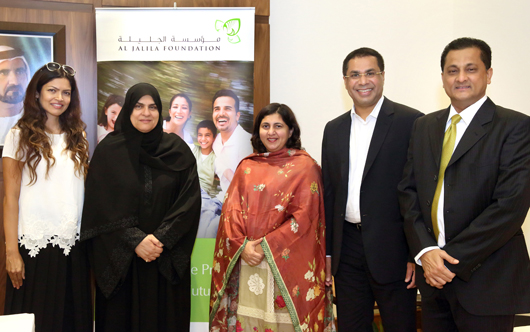
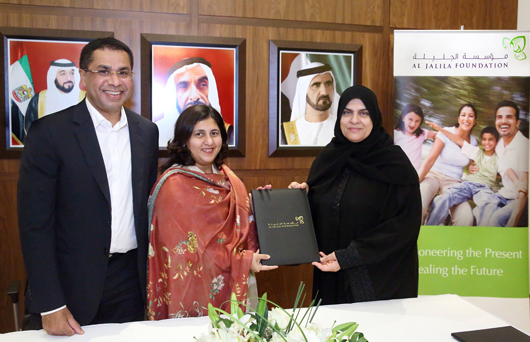
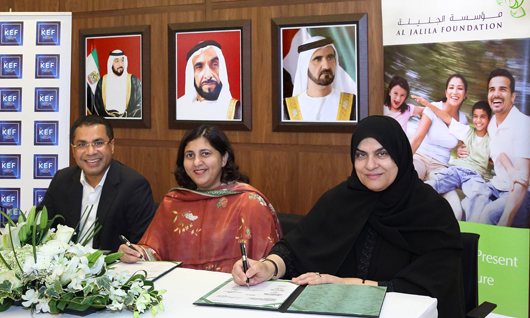
Faizal & Shabana Foundation donates AED 10 million to aid medical research

[email protected] (CD Network)
November 12, 2015

Dubai, Nov 12: In recognition of various philanthropic work conducted by the Faizal & Shabana Foundation – their Vice Chairperson Mrs. Shabana Faizal, daughter of Mr. B. Ahmed Hajee Mohiudeen, who hails from Thumbay, Mangalore was granted an audience with HRH Princess Haya bint Hussein, at her palace in Dubai.

faizal 3

This comes just after the Faizal & Shabana Foundation and KEF Company Limited announced a landmark donation of AED 10 Million which was granted to Al Jalila Foundation to aid medical research on cancer, obesity, cardiovascular conditions, diabetes and mental health. In addition, the two entities will collaborate to exchange know-how from their respective global networks, and share the outcomes and findings of new research on health and wellness.
The KEF Company Ltd. is a new era social enterprise founded by Faizal E. Kottikollon, the company operates across India, the Middle East and Singapore. The company has six business verticals – KEF Infra, KEF Health, KEF Education, KEF Agri, KEF Metals and KEF Investments – that focus on the infrastructure, healthcare, education, agriculture, metals and investment sectors respectively. KEF’s industrial forte lies in its ability to create integrated business processes and deliver cutting-edge off-site construction technology and solutions, including precast, prefabricated bathrooms, joinery and aluminum glazing. The company applies this expertise to the creation and upgrades for essential infrastructure, such as educational, healthcare, hospitality, commercial and residential facilities.

KEF Holdings is guided by the philanthropic vision of its founder and Chairman Faizal E. Kottikollon and his wife Shabana Faizal, Vice Chairperson. The company, in close collaboration with stakeholders in the public and private sectors, actively drives, funds and supports high-impact social activities undertaken by the Faizal & Shabana Foundation.

KEF Holdings does this through providing innovative industrial technologies, products and processes designed to create shared value by increasing productivity, quality and sustainability.

faizal 1

faizal 2

faizal 4

Comments

Firos Ahmed
 - 
Monday, 5 Dec 2016

Al Hamdullilah,Lot of people have rich but same time they are misers too,but its seems Mr.Faizal Kootikolan doing things from his heart which leads him success here and hearafter in sha allah.Do things for allah's sake not for public show off.I believe you are doing charity for allah's sake

Tanisha
 - 
Friday, 6 May 2016

I see your website needs some unique articles.
Writing manually is time consuming, there is tool for this task.

Just search in g00gle for : rilkim's tips

my blog post - CassiedtOper: http://twitter.com/Ann

Add new comment

  • Coastaldigest.com reserves the right to delete or block any comments.
  • Coastaldigset.com is not responsible for its readers’ comments.
  • Comments that are abusive, incendiary or irrelevant are strictly prohibited.
  • Please use a genuine email ID and provide your name to avoid reject.
News Network
February 29,2020

Mysuru, Feb 29: More than 7,000 industrialists and entrepreneurs have left the country due to a deficit of trust, and incidents like the violence that rocked northeast Delhi will only affect the economy further, Sri Sri Ravi Shankar, founder of Art of Living Foundation, said on Friday.

Sri Sri was speaking at a corporate wellness conference on the theme, 'Wellness and Wellbeing for a Progressive Nation', hosted by CII in Mysuru. He said an atmosphere of fear and mistrust pervades the country and does not augur well for the economy.

"Bankers, too, are suspicious of everyone and not extending loans to industrialists. This has posed lots of problems," he said. "This attitude among bank officials should go as life depends on trust. When there is a deficiency of trust, there is a possibility of the economy slowing down," Sri Sri added

He said society is now facing two important issues - aggression and depression. "Some people stage protests and pelt stones which happened recently in Delhi. This is really unfortunate," he said, adding, "Fear lurks in the nation's capital, which is being used by many to create terror. This will affect the economy. No country will prosper without peace."

Wellness is the need of the hour, he said, adding, "Corporates used to spend half their health to gain wealth and spend half their wealth to regain their health. This isn't good economics. We have to talk and convince people to invest in wellness."

Comments

Add new comment

  • Coastaldigest.com reserves the right to delete or block any comments.
  • Coastaldigset.com is not responsible for its readers’ comments.
  • Comments that are abusive, incendiary or irrelevant are strictly prohibited.
  • Please use a genuine email ID and provide your name to avoid reject.
News Network
June 3,2020

Bengaluru, Jun 3: The Karnataka Institute of Medical Sciences at Hubballi has successfully treated a COVID-19 patient through plasma therapy, state medical education minister K Sudhakar said today.

"Karnataka achieves yet another milestone in battle against #COVID19. KIMS Hubli has successfully treated a Covid19 patient through Plasma Therapy & is the first institute in the state to accomplish this. Congrats to KIMS doctors & staff for this feat!" Mr Sudhakar tweeted.

In plasma therapy treatment, plasma cells from a COVID-19 patient, who has recovered from the disease, is transfused to a coronavirus patient who is in critical condition to treat him.

Plasma therapy was effectively used in the past during Ebola and the Spanish flu pandemic.

Comments

Add new comment

  • Coastaldigest.com reserves the right to delete or block any comments.
  • Coastaldigset.com is not responsible for its readers’ comments.
  • Comments that are abusive, incendiary or irrelevant are strictly prohibited.
  • Please use a genuine email ID and provide your name to avoid reject.
Agencies
February 20,2020

India ranked 77th on a sustainability index that takes into account per capita carbon emissions and ability of children in a nation to live healthy lives and secures 131st spot on a flourishing ranking that measures the best chance at survival and well-being for children, according to a UN-backed report.

The report was released on Wednesday by a commission of over 40 child and adolescent health experts from around the world. It was commissioned by the World Health Organization (WHO), UN Children's Fund (UNICEF) and The Lancet medical journal.

In the report assessing the capacity of 180 countries to ensure that their youngsters can survive and thrive, India ranks 77th on the Sustainability Index and 131 on the Flourishing Index, it said.

Flourishing is the geometric mean of Surviving and Thriving. For Surviving, the authors selected maternal survival, survival in children younger than 5 years old, suicide, access to maternal and child health services, basic hygiene and sanitation, and lack of extreme poverty.

For Thriving, the domains were educational achievement, growth and nutrition, reproductive freedom, and protection from violence.

Under the Sustainability Index, the authors noted that promoting today's national conditions for children to survive and thrive must not come at the cost of eroding future global conditions for children's ability to flourish.

The Sustainability Index ranks countries on excess carbon emissions compared with the 2030 target. This provides a convenient and available proxy for a country's contribution to sustainability in future.

The report noted that under realistic assumptions about possible trajectories towards sustainable greenhouse gas emissions, models predict that global carbon emissions need to be reduced from 39·7 giga­ tonnes to 22·8 gigatonnes per year by 2030 to maintain even a 66 per cent chance of keeping global warming below 1·5°C.

It said that the world's survival depended on children being able to flourish, but no country is doing enough to give them a sustainable future.

"No country in the world is currently providing the conditions we need to support every child to grow up and have a healthy future," said Anthony Costello, Professor of Global Health and Sustainability at University College London, one of the lead authors of the report.

"Especially, they're under immediate threat from climate change and from commercial marketing, which has grown hugely in the last decade," said Costello – former WHO Director of Mother, Child and Adolescent health.

Norway leads the table for survival, health, education and nutrition rates - followed by South Korea and the Netherlands. Central African Republic, Chad and Somalia come at the bottom.

However, when taking into account per capita CO2 emissions, these top countries trail behind, with Norway 156th, the Republic of Korea 166th and the Netherlands 160th.

Each of the three emits 210 per cent more CO2 per capita than their 2030 target, the data shows, while the US, Australia, and Saudi Arabia are among the 10 worst emitters. The lowest emitters are Burundi, Chad and Somalia.

According to the report, the only countries on track to beat CO2 emission per capita targets by 2030, while also performing fairly – within the top 70 – on child flourishing measures are: Albania, Armenia, Grenada, Jordan, Moldova, Sri Lanka, Tunisia, Uruguay and Vietnam.

"More than 2 billion people live in countries where development is hampered by humanitarian crises, conflicts, and natural disasters, problems increasingly linked with climate change," said Minister Awa Coll-Seck from Senegal, Co-Chair of the commission.

The report also highlights the distinct threat posed to children from harmful marketing.

Evidence suggests that children in some countries see as many as 30,000 advertisements on television alone in a single year, while youth exposure to vaping (e-cigarettes) advertisements increased by more than 250 per cent in the US over two years, reaching more than 24 million young people.

Studies in Australia, Canada, Mexico, New Zealand and the US – among many others – have shown that self-regulation has not hampered commercial ability to advertise to children.

Children's exposure to commercial marketing of junk food and sugary beverages is associated with purchase of unhealthy foods and overweight and obesity, linking predatory marketing to the alarming rise in childhood obesity, it said.

The number of obese children and adolescents increased from 11 million in 1975 to 124 million in 2016 – an 11-fold increase, with dire individual and societal costs, the report said.

To protect children, the authors call for a new global movement driven by and for children.

Specific recommendations include stopping CO2 emissions with the utmost urgency, to ensure children have a future on this planet; placing children and adolescents at the centre of global efforts to achieve sustainable development, the report said.

New policies and investment in all sectors to work towards child health and rights; incorporating children's voices into policy decisions and tightening national regulation of harmful commercial marketing, supported by a new Optional Protocol to the UN Convention on the Rights of the Child, it said.


Comments

Add new comment

  • Coastaldigest.com reserves the right to delete or block any comments.
  • Coastaldigset.com is not responsible for its readers’ comments.
  • Comments that are abusive, incendiary or irrelevant are strictly prohibited.
  • Please use a genuine email ID and provide your name to avoid reject.