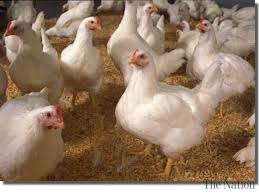
Poultry demand dips in Karnataka as people wary of bird flu

May 10, 2016

Bengaluru, May 10: The demand for poultry dropped slightly in Bengaluru on Monday, a day after thousands of chickens died of bird flu (H5N1) in Bidar district. Chicken eaters are taking precaution and asking sellers where the birds have been sourced from.

poulM Sheikh, who runs a poultry shop, said people had become cautious, though there was no drastic drop in sales. “People are enquiring about bird flu but we have few answers,” he said.

Nadir A, who works in a chicken store, said there was a slight decline in sales. “The sales are low in summer, but today was unusual,” he said but claimed that he wasn't aware of bird flu. Bhuvan, a resident, said he would better take precaution. “Even the last time when there was bird flu, I was cautious,” he said.

Doctors and poultry sellers, however, say there is no need to panic. H N Nagabhushan, general secretary, Karnataka Poultry Farmers' and Breeders' Association, said the current bird flu was noticed only in a layer poultry (egg production) farm in Humnabad taluk, Bidar, where poultry population was low. According to him, the government has started culling the birds and around 1.5 lakh chickens in one-kilometre radius of the farm would be culled.

Restrictions have been put on the movement of poultry, eggs and other input from the affected areas. Hence, there is no need to panic as the disease is localised, Nagabhushan said, adding that it was “perfectly safe” to consume chicken and egg across Karnataka.

Chickens sold in Bengaluru are sourced from Mysuru and bred on the outskirts of the city. They are not brought from other parts of Karnataka, he said. Poultry farmers have been advised to take appropriate bio-security measures and approach the Animal Husbandry Department for any assistance, he added.

Dr Mahesh P S, director of Central Poultry Development Organisation, said that whenever bird flu was reported, the chickens were being culled as per the standard procedure.

According to him, Indians were less likely to contract the H5N1 virus because of their distinct cooking culture. The virus dies at temperature above 60 degrees Celsius. Since the Indian food is cooked at a higher temperature and is even boiled, the virus likely dies down, he said. Outside of India, chicken and egg are eaten raw or half-cooked, increasing the chances of the virus spread, he added.

Comments

Swathi
 - 
Tuesday, 10 May 2016

in our place we eat chicken eveyday, no matter what will be.

Add new comment

  • Coastaldigest.com reserves the right to delete or block any comments.
  • Coastaldigset.com is not responsible for its readers’ comments.
  • Comments that are abusive, incendiary or irrelevant are strictly prohibited.
  • Please use a genuine email ID and provide your name to avoid reject.
Ram Puniyani
June 29,2020

In Minneapolis, US an African American, George Floyd lost his life as the white policeman, Derek Chauvin, caught hold of him and put his knee on his neck. This is a technique developed by Israel police. For nine long minutes the knee of the while policeman was on the neck of George, who kept shouting, I can’t breathe.

Following this gruesome murder America erupted with protests, ‘Black lives matter’. The protestors were not just African Americans but also a large section of whites. Within US one police Chief apologized for the act of this. In a touching gesture of apology the police force came on its knees. This had reverberations in different parts of the World.

The act was the outcome of the remnants of the racial hatred against blacks by the whites. It is the hatred and the perceptions which are the roots of such acts of violence. What was also touching that the state of democracy in US is so deep that even the police apologized, the nation, whites and blacks, stood up as a sensitive collective against this violence.

US is not the only country where the brutal acts of violence torment the marginalized sections of society. In India there is a list of dalits, minorities and adivasis who are regularly subjected to such acts. But the reaction is very different. We have witnessed the case of Tabrez Ansari, who was tied to the pole by the mob and beaten ruthlessly. When he was taken to police station, police took enough time to take him to hospital and Tabrez died.

Mohsin Sheikh, a Pune techie was murdered by Hindu Rashtra Sena mob, the day Modi came to power in 2014. Afrazul was killed by Shambhulal Regar, videotaped the act released on social media. Regar believed that Muslims are indulging in love Jihad, so deserve such a fate. Mohammad Akhlaq is one among many names who were mob lynched on the issue of beef cow. The list can fill pages after pages.

Recently a young dalit boy was shot dead for the crime of entering a temple. In Una four dalits were stripped above waste and beaten mercilessly. Commenting on this act the Union Minister Ramvilas Paswan commented that it is a minor incident. Again the list of atrocities against dalits is long enough. The question is what Paswan is saying is the typical response to such gruesome murders and tortures. In US loss of one black life, created the democratic and humane response. In India there is a general silence in response to these atrocities. Some times after a good lapse of time, the Prime Minister will utter, ‘Mother Bharati has lost a son’. Most of the time victim is blamed. Some social groups raise their voice in some fora but by and large the deafening silence from the country is the norm.

India is regarded as the largest democracy. Democracy is the rule of law, and the ground on which the injustices are opposed. In America though the present President is insensitive person, but its institutions and processes of democratic articulations are strong. The institutions have deepened their roots and though prejudices may be guiding the actions of some of the officers like the killer of George, there are also police officers who can tell their President to shut up if he has nothing meaningful to say on the issue. The prejudices against Blacks may be prevalent and deep in character, still there are large average sections of society, who on the principles of ‘Black lives matter’. There are large sections of vocal population who can protest the violation of basic norms of democracy and humanism.

In India by contrast there are multiple reasons as to why the lives of Tabrez Ansari, Mohammad Akhlaq, Una dalit victims and their likes don’t matter. Though we claim that we are a democracy, insensitivity to injustices is on the rise. The strong propaganda against the people from margins has become so vicious during last few decades that any violence against them has become sort of a new normal. The large populace, though disturbed by such brutalities, is also fed the strong dose of biases against the victims. The communal forces have a great command over effective section of media and large section of social media, which generates Hate against these disadvantaged groups, thereby the response is muted, if at all.

As such also the process of deepening of our democracy has been weak. Democracy is a dynamic process; it’s not a fixed entity. Decades ago workers and dalits could protest for their rights. Now even if peasants make strong protests, dominant media presents it as blocking of traffic! How the roots of democracy are eroded and are visible in the form where the criticism of the ruling dispensation is labelled as anti National..

Our institutions have been eroded over a period of time, and these institutions coming to the rescue of the marginalized sections have been now become unthinkable. The outreach of communal, divisive ideology, the ideology which looks down on minorities, dalits and Adivasis has risen by leaps and bounds.

The democracy in India is gradually being turned in to a hollow shell, the rule of law being converted in to rule of an ideology, which does not have faith in Indian Constitution, which looks down upon pluralism and diversity of this country, which is more concerned for the privileges of the upper caste, rich and affluent. The crux of the matter is the weak nature of democracy, which was on way to become strong, but from decades of 1980s, as emotive issues took over, the strength of democracy started dwindling, and that’s when the murders of the types of George Floyd, become passé. One does complement the deeper roots of American democracy and its ability to protect the democratic institutions, which is not the case in India, where protests of the type, which were witnessed after George Floyd’s murder may be unthinkable, at least in the present times. 

Comments

Add new comment

  • Coastaldigest.com reserves the right to delete or block any comments.
  • Coastaldigset.com is not responsible for its readers’ comments.
  • Comments that are abusive, incendiary or irrelevant are strictly prohibited.
  • Please use a genuine email ID and provide your name to avoid reject.
News Network
April 4,2020

New Delhi, Apr 4: The Supreme Court on Friday urged Karnataka and Kerala to amicably resolve their issues concerning a border blockade that has choked the free flow of vehicles carrying essential items and patients in the midst of the COVID-19 outbreak.

Karnataka, which imposed the blockade, justified that its border was sealed to “combat the spread of the pandemic by preventing the movement of people from the bordering districts of Kerala to Karnataka”.

The State had moved the Supreme Court, challenging a Kerala High Court order on April 1 to open the border. Kerala has countered that patients from the State cannot be denied access to health care. Besides, the blockade has severely affected the supply of essential items, from medicines to food, to Kerala.

On Friday, a Supreme Court Bench of Justices L. Nageswara Rao and Deepak Gupta urged the States to not confront each other in the midst of an unprecedented public health crisis. Instead, it asked the Chief Secretaries of both States to sit with the Union Health Secretary and iron out a solution. Meanwhile, the apex court urged Kerala not to take any precipitative action based on the High Court order.

The court issued notice to Kerala on the appeal filed by Karnataka, represented by advocate Shubhranshu Padhi. It listed the case for further hearing on April 7.

Karnataka, in its appeal against the High Court order, said the blockade was put in place in the interest of public health. The situation regarding Coronavirus was “really dire”, it said. It warned that opening the blockade would cause a law and order issue as its local population wanted the border to remain sealed.

Karnataka argued that Kerala was the “worst-affected” State in the country with nearly 194 coronavirus cases. In this, Kasaragod, adjoining Karnataka, was the “worst affected” district of Kerala with over a 100 positive cases.

MP’s plea

The court also separately considered a writ petition by Kasaragod MP Rajmohan Unnithan for an order to forthwith open the State border.

The parliamentarian, represented by advocates Haris Beeran and Pallavi Pratap, urged the court to issue an ex-parte stay on the operation of the blockade imposed by Karnataka with its border States.

Mr. Unnithan said Karnataka’s blockade was “ill-planned and dangerous” and had led to loss of lives. Two patients from Kerala, in need of urgent medical care, died after their ambulances were denied entry at the border by the Karnataka authorities. 

Comments

Add new comment

  • Coastaldigest.com reserves the right to delete or block any comments.
  • Coastaldigset.com is not responsible for its readers’ comments.
  • Comments that are abusive, incendiary or irrelevant are strictly prohibited.
  • Please use a genuine email ID and provide your name to avoid reject.
News Network
February 23,2020

Bengaluru, Feb 23: The sleuths of Custom Department have seized ephedrine worth Rs 5 Crore in courier terminal of Air Cargo complex in Kempegowda International Airport (KIA), the department said on Sunday.

Customs Joint Commissioner M J Chethan, in a statement, said that Central Intelligence Unit, Air Cargo Complex, scanned the package while verifying export consignments and found concealment of some powder. 5.04 kg of Ephedrine worth Rs 5 crore was packed in polythene pouches and concealed between cardboard layers of wedding invitation cards.

Detailed examination of the Wedding cards revealed banned drugs hidden between 43 wedding invitation cards in the package that also contained a few clothes.

Comments

Add new comment

  • Coastaldigest.com reserves the right to delete or block any comments.
  • Coastaldigset.com is not responsible for its readers’ comments.
  • Comments that are abusive, incendiary or irrelevant are strictly prohibited.
  • Please use a genuine email ID and provide your name to avoid reject.