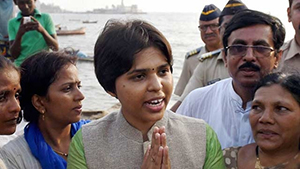
Trupti Desai finally enters Haji Ali Dargah, offers prayers

May 12, 2016

Mumbai, May 12: Rights activist Trupti Desai today entered Mumbai's Haji Ali Dargah to offer prayers amid tight security, saying her struggle was for gender equality.haji-ali

"At the Dargah, I prayed that women be allowed to enter the inner sanctum, as was the case till 2011," Bhumata Ranragini Brigade chief Desai said, after coming out of the Dargah.

"Police cooperated with us this time. This is a fight for gender equality. We will try to visit the inner sanctum next time," she said.

Desai and other women activists were earlier denied entry to the Dargah last month.

After campaign for entry of women in Shani Shingnapur and Trimbakeshwar temples in Maharashtra, Desai had taken her movement for gender equality to the famous Dargah in Mumbai.

She was stopped short of going into the shrine on April 28 by protestors.

Comments

Rikaz
 - 
Thursday, 12 May 2016

It is not a big deal....in Darga you wont find any God.....LOL...

shahid
 - 
Thursday, 12 May 2016

Temple or dargah both are same which leads to shirk..... both believers of temple and dargah has lack of religious knowledge, instead of reading their religious books this people are believing this fraud baba, tantrik, swami, tangal, koya etc.... may Allah give hidaya to all the human beings in this earth to know the truth

shaji
 - 
Thursday, 12 May 2016

I am sure that Trupti Desai is doing such unwanted acts only to get popularity. Is she really concerned about women, she should fight agaisnt dowry, killings of woman in the name of dowry, rape, misbehave by immoral police etc etc. In the same time, Desai should know that Dargah is not a holy place for Muslims and there is no need of any Muslim to pray in the Dargah. Muslim women are given freedom to pray in their home. Instead of praying at home why are they so eager to visit Dargah or Masjid. Does they want to show their beauty? why are they interested in unnecessary activities which is being supported by Desai whereas she is not interested in actual and important things. Does Desai has no other job?

NOOR
 - 
Thursday, 12 May 2016

Think Brothers Think ... and PONDER, is DARGAH culture allowed in ISLAM? Y are we encouraging this system of worship... which is close to the cultures of pagan worshipers...

WORSHIP ALLAH the way Prophet Muhammad pbuh taught us and follow the Sahabas RA .. When U follow the last and final prophet of ALLAH, U will not be trapped with such humiliation. When we follow our own desire... then expect such treatment ...

mohdalthaf
 - 
Thursday, 12 May 2016

Prayer of the Mushriks.. There is no Darga concept in islam.

Nasir
 - 
Thursday, 12 May 2016

Dear Desai,

Just for your information it is one and the same, if you pray in darga or in temple it will go nowhere. worship the creator not his creation.

Add new comment

  • Coastaldigest.com reserves the right to delete or block any comments.
  • Coastaldigset.com is not responsible for its readers’ comments.
  • Comments that are abusive, incendiary or irrelevant are strictly prohibited.
  • Please use a genuine email ID and provide your name to avoid reject.
Agencies
April 15,2020

San Diego, Apr 15: Several people lost their sense of smell or taste weeks ago globally and are still waiting for it to come back and now, researchers have identified an association between sensory loss and novel coronavirus 2019 (COVID-19) infection, indicating that loss of smell and taste may be considered as early symptoms of the deadly disease.

Interestingly, the study also found that persons who reported experiencing a sore throat more often tested negative for COVID-19.

The team from University of California-San Diego found high prevalence and unique presentation of certain sensory impairments in patients positive with COVID-19.

Of those who reported a loss of smell and taste, the loss was typically profound, not mild.

"Based on our study, if you have smell and taste loss, you are more than 10 times more likely to have COVID-19 infection than other causes of infection. The most common first sign of a COVID-19 infection remains fever, but fatigue and loss of smell and taste follow as other very common initial symptoms," explained study researcher Carol Yan from UC San Diego.

"We know COVID-19 is an extremely contagious virus. This study supports the need to be aware of smell and taste loss as early signs of COVID-19," Yan added.

For the findings, published in the journal International Forum of Allergy and Rhinology, the research team surveyed 1,480 patients with flu-like symptoms and concerns regarding potential COVID-19 infection who underwent testing at UC San Diego Health from March 3 through March 29, 2020.

Within that total, 102 patients tested positive for the virus and 1,378 tested negatives. The study included responses from 59 COVID-19-positive patients and 203 COVID-19-negative patients.

Encouragingly, the rate of recovery of smell and taste was high and occurred usually within two to four weeks of infection.

"Our study not only showed that the high incidence of smell and taste is specific to COVID-19 infection but we fortunately also found that for the majority of people sensory recovery was generally rapid," said Yan.

"Among the COVID-19 patients with smell loss, more than 70 per cent had reported improvement of smell at the time of the survey and of those who hadn't reported improvement, many had only been diagnosed recently," she added.

Sensory return typically matched the timing of disease recovery.

In an effort to decrease the risk of virus transmission, UC San Diego Health now includes loss of smell and taste as a screening requirement for visitors and staff, as well as a marker for testing patients who may be positive for the virus.

"It is our hope that with these findings other institutions will follow suit and not only list smell and taste loss as a symptom of COVID-19, but use it as a screening measure for the virus across the world," Yan said.

Comments

Add new comment

  • Coastaldigest.com reserves the right to delete or block any comments.
  • Coastaldigset.com is not responsible for its readers’ comments.
  • Comments that are abusive, incendiary or irrelevant are strictly prohibited.
  • Please use a genuine email ID and provide your name to avoid reject.
Agencies
July 8,2020

The Central Board of Secondary Education (CBSE) has rationalised by up to 30 per cent the syllabus for classes 9 to 12 for the academic year 2020-21 to reduce course load on students amid the COVID-19 crisis, Union HRD Minister Ramesh Pokhriyal 'Nishank' announced on Tuesday.

The curriculum has been rationalised while retaining the core elements, the Human Resource Development said.

Among the chapters dropped after the rationalisation exercise are lessons on democracy and diversity, demonetisation, nationalism, secularism, India's relations with its neighbours and growth of local governments in India, among others.

"Looking at the extraordinary situation prevailing in the country and the world, CBSE was advised to revise the curriculum and reduce course load for the students of classes 9 to 12.

"To aid the decision, a few weeks back I also invited suggestions from all educationists on the reduction of syllabus for students and I am glad to share that we received more than 1.5K suggestions. Thank you, everyone, for the overwhelming response," Nishank tweeted.

"Considering the importance of learning achievement, it has been decided to rationalise syllabus up to 30 per cent by retaining the core concepts," he added.

The Union minister said the changes made in the syllabi have been finalised by the respective course committees with the approval of the curriculum committee and the Governing Body of the Board.

"The heads of schools and teachers have been advised by the board to ensure that the topics that have been reduced are also explained to the students to the extent required to connect different topics. However, the reduced syllabus will not be part of the topics for internal assessment and year-end board examination.

"Alternative academic calendar and inputs from the NCERT on transacting the curriculum using different strategies shall also be part of the teaching pedagogy in the affiliated schools," a senior official of the HRD ministry said.

For classes 1 to 8, the National Council of Education Research and Training (NCERT) has already notified an alternative calendar and learning outcomes.

According to the updated curriculum, among the chapters deleted from class 10 syllabus are-- democracy and diversity, gender, religion and caste, popular struggles and movement, challenges to democracy

For class 11, the deleted portions included chapters on federalism, citizenship, nationalism, secularism, growth of local governments in India.

Similarly, class 12 students will not be required to study chapters on India's relations with its neighbours, changing nature of India's economic development, social movements in India and demonetisation, among others.

Universities and schools across the country have been closed since March 16 when the central government announced a nationwide classroom shutdown as one of the measures to contain the COVID-19 outbreak.

A nationwide lockdown was announced on March 24, which came into effect the next day. While the government has eased several restrictions, schools and colleges continue to remain closed.


Comments

Add new comment

  • Coastaldigest.com reserves the right to delete or block any comments.
  • Coastaldigset.com is not responsible for its readers’ comments.
  • Comments that are abusive, incendiary or irrelevant are strictly prohibited.
  • Please use a genuine email ID and provide your name to avoid reject.
News Network
June 3,2020

Bengaluru, Jun 3: Lack of awareness on rail travel norms led to a tense situation on a Karnataka train as a female passenger was forced to disembark midway after her fellow passengers raised a hue and cry on seeing her knuckle stamped, mistaking it for a quarantine stamp, an official said on Tuesday.

"Many passengers on the train with the woman raised a hue and cry on seeing her stamped and complained to the TTE. She was later disembarked at Tumkur," a South Western Railway (SWR) zone official said.

The woman was travelling from Bengaluru to Belagavi as a transit passenger. Her status as such a passenger was stamped on her knuckle.

However, after some time, her fellow passengers observed her stamped hand and misunderstood that she was violating the quarantine norms.

Without realising that she was just a transit passenger who will be quarantined on reaching her destination, they created pandemonium and complained to the travelling ticket inspector.

"Following the public pressure, she was forcibly disembarked in Tumkur station," said the official.

Incidentally, the railways allows transit passengers to travel.

The official said the TTE would not have been aware of the rules and must have yielded to the passengers' pressure.

Later, the woman was allowed to board another train and reach her destination, the official said.

Comments

Add new comment

  • Coastaldigest.com reserves the right to delete or block any comments.
  • Coastaldigset.com is not responsible for its readers’ comments.
  • Comments that are abusive, incendiary or irrelevant are strictly prohibited.
  • Please use a genuine email ID and provide your name to avoid reject.