Rains continue to lash Mangaluru, other parts of Karnataka

[email protected] (CD Network)
May 13, 2016

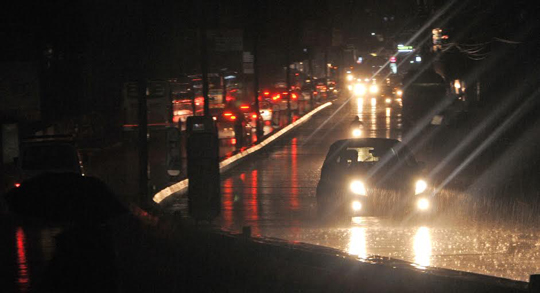
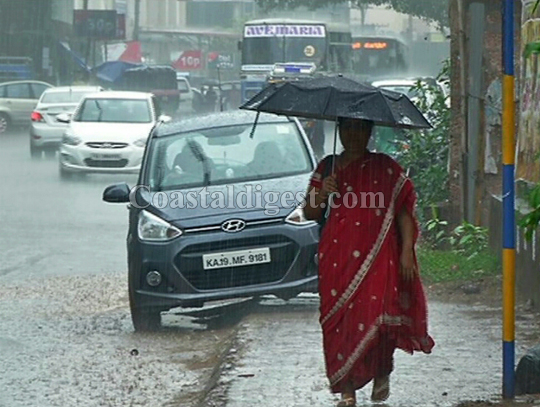
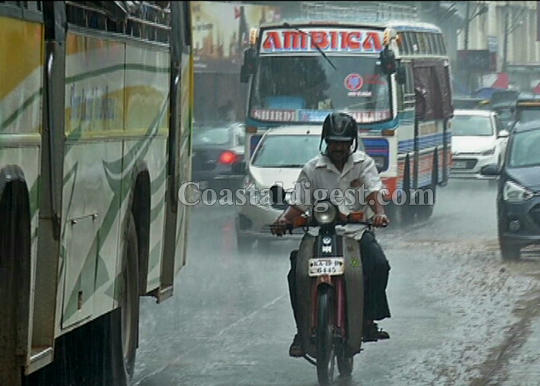
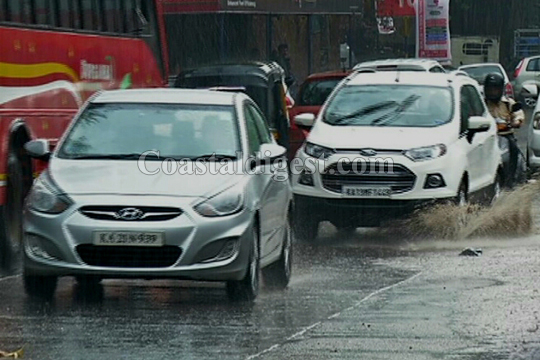
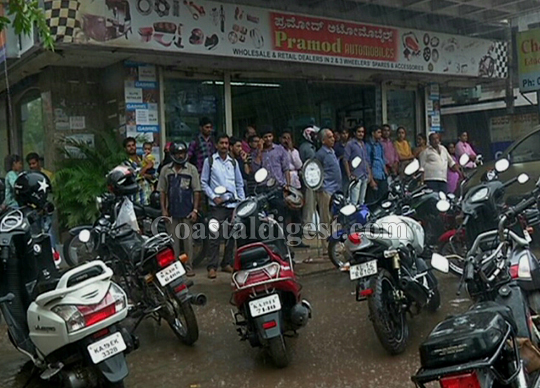
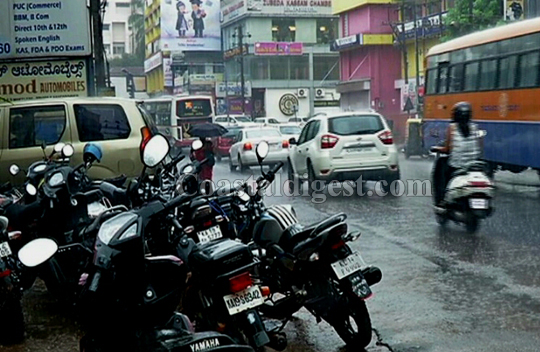
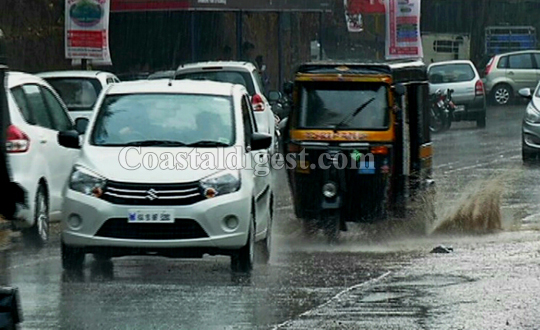
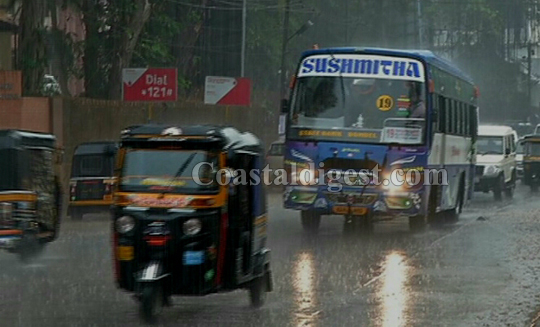
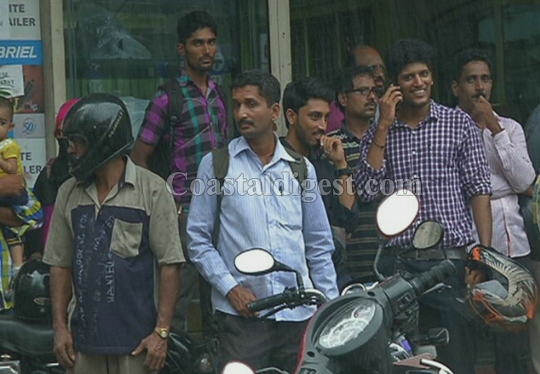
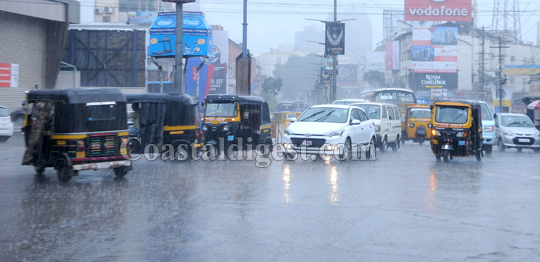
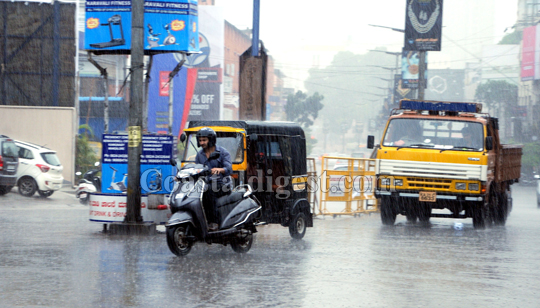
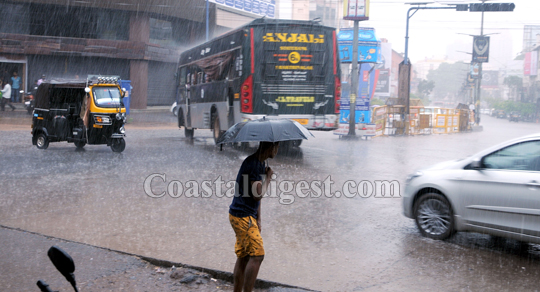
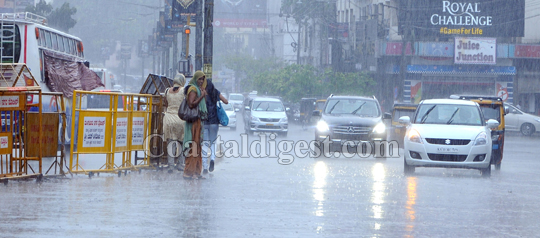
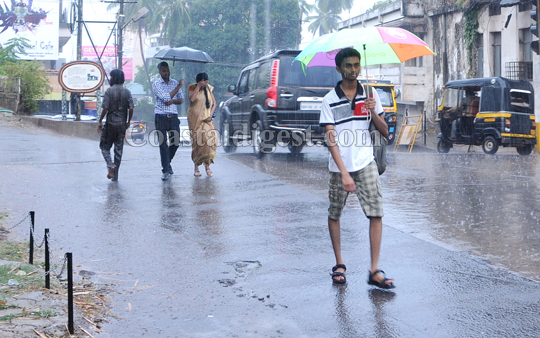
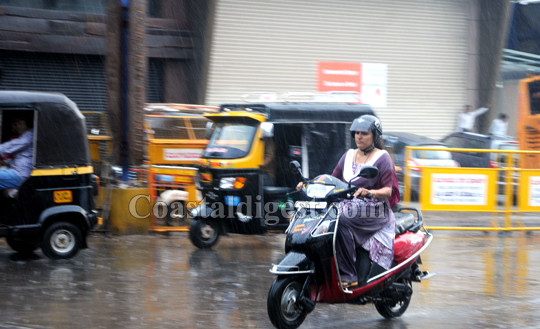
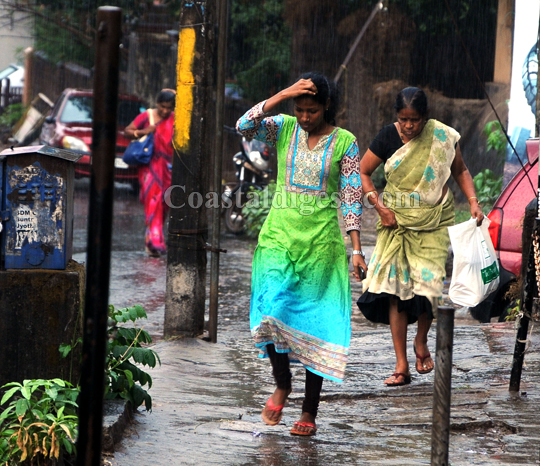
Mangaluru, May 12: Moderate to heavy rains coupled with lighting and thunders continued to lash Mangaluru and other parts of Dakashina Kannada district for the second consecutive day on Thursday.

rain

The pre-monsoon showers have brought a great relief to the people in coastal Karnataka.

The rains accompanied with lightning and thunder lashed Belthangady, Sullia and Puttur taluks too. Though power supply was disrupted in many areas, the rains have brought hope of water reaching Thumbe dam, which supplies drinking water to Mangaluru.

According to a press release issued by mayor on Wednesday, the water-level at Thumbe dam is enough only for a day.

Other parts of Karnataka

Several districts in Karnataka state also continued to receive good rainfall on Thursday.

Stray incidents of rain-related damages have been reported from various parts of the state. Heavy rains lashed Belagavi city and the surrounding villages in Belagavi taluk and at M K Hubli town and the surrounding villages in Bailhongal taluk for about an hour on Thursday evening. Downpour also provided respite from scorching heat, bringing down day-time temperatures.

Rains combined with winds and thunders resulted in crop loss and roof tiles of a few houses blew away at M K Hubli, causing huge losses.

Cloudy environs prevailed in Belagavi taluk since noon and the skies opened up in the evening for about an hour. Strong winds and thunders accompanied the downpour. City and most of the villages received heavy rains bringing the temperature down. There were no reports of damages related to rainfall.

At M K Hubli, a woman suffered injuries after the roof tiles of a few houses blew away in the heavy downpour that was accompanied by winds. Banana plantains cultivated by farmers in M K Hubli and the surrounding areas were damaged.

Mundgod, Yellapur, Sirsi and Siddapur taluks in Uttar Kannada district received good rainfall on Thursday.

Banana plantations cultivated on at least 50 acres of land have been destroyed in the rains, accompanied by gusty winds.

Various taluk places in the district, including Shivamogga city, received moderate rainfall, accompanied by thunder and lightning. Sagar, Bhadravathi, Hosanagar and Thirthahalli taluks have received good rainfall.

Lighting claims a life

A daily wage labourer lost her life and three others suffered injuries after lightning struck them on Thursday in Chikkamagaluru.

The deceased, Rathnamma (52), was a resident of Sintikere village in Arsikere taluk. The injured are Ratna, Sharada and Basamma, all from the same village. All of them were working in a coffee plantation and were taking shelter under a tree after lunch when the lightning struck them. The rains lashed for about an hour in Mudigere and surrounding areas too.

rainm 1

rainm 2

rainm 3

rainm 4

rainm 5

rainm 6

rainm 7

rainm 8

rainm 9

rainm 10

rainm 11

rainm 12

rainm 13

rainm 14

rainm 15

rainm 16

Comments

Mohan K S
 - 
Friday, 13 May 2016

wow enjoyed alot, now we are facing heavy heat here, 12.59pm

Gowrav
 - 
Friday, 13 May 2016

missed it, will be coming to mangalore next month. rainy season in mangalore is just awesome.

Chinthamani
 - 
Friday, 13 May 2016

finally water crises came to an end i suppose.

gyan
 - 
Friday, 13 May 2016

wow love the mangalore rain.

Shiva
 - 
Friday, 13 May 2016

wow cold shower. thanks to mother rain,

Add new comment

  • Coastaldigest.com reserves the right to delete or block any comments.
  • Coastaldigset.com is not responsible for its readers’ comments.
  • Comments that are abusive, incendiary or irrelevant are strictly prohibited.
  • Please use a genuine email ID and provide your name to avoid reject.
News Network
March 26,2020

Mangaluru, Mar 26: The district Wenlock hospital in

the city will be turned into a dedicated hospital for the treatment of COVID-19 patients, Dakshina Kannada district-in- charge Minister Kota Srinivas Poojary said on Thursday.

Addressing reporters here, he said the 250-bed super speciality wing at Wenlock would be converted to a dedicated hospital to treat coronavirus patients in view of the prevailing situation.

The 20-bed Ayush block will be used for the treatment of suspected cases.

The patients currently being treated for various other ailments at the hospital will be shifted to private hospitals within three days.

The expenses for their treatment will be borne by the government, he said.

The 705 beds available at the hospital wards will be used for coronavirus cases in a phased manner.

The patients visiting the outpatient ward will be directed to go to nearby medical colleges for treatment, he said.

A total of 140 children being treated at the regional advanced paediatric care centre at the hospital will be shifted to nearby medical college hospitals.

The centre will also be used for covid-19 treatment.

Poojary said at present five COVID-19 patients and 140 suspected cases are being treated at the Wenlock hospital.

Comments

Add new comment

  • Coastaldigest.com reserves the right to delete or block any comments.
  • Coastaldigset.com is not responsible for its readers’ comments.
  • Comments that are abusive, incendiary or irrelevant are strictly prohibited.
  • Please use a genuine email ID and provide your name to avoid reject.
Ram Puniyani
January 14,2020

In the beginning of January 2020 two very disturbing events were reported from Pakistan. One was the attack on Nankana Sahib, the holy shrine where Sant Guru Nanak was born. While one report said that the place has been desecrated, the other stated that it was a fight between two Muslim groups. Prime Minister of Pakistan Imran Khan condemned the incident and the main accused Imran Chisti was arrested. The matter related to abduction and conversion of a Sikh girl Jagjit Kaur, daughter of Pathi (One who reads Holy Guru Granth Sahib in Gurudwara) of the Gurudwara. In another incident one Sikh youth Ravinder Singh, who was out on shopping for his marriage, was shot dead in Peshawar.

While these condemnable attacks took place on the Sikh minority in Pakistan, BJP was quick enough to jump to state that it is events like this which justify the Citizenship Amendment Act (CAA). Incidentally CAA is the Act which is discriminatory and relates to citizenship with Religion, which is not as per the norms of Indian constitution. There are constant debates and propaganda that population of Hindus has come down drastically in Pakistan and Bangla Desh. Amit Shah, the Home minister stated that in Pakistan the population of Hindus has come down from 23% at the time of partition to 3.7% at present. And in Bangla Desh it has come down from 22% to present 8%.

While not denying the fact that the religious minorities are getting a rough deal in both these countries, the figures which are presented are totally off the mark. These figures don’t take into consideration the painful migrations, which took place at the time of partition and formation of Bangla Desh later. Pakistan census figures tell a different tale. Their first census was held in 1951. As per this census the overall percentage of Non Muslim in Pakistan (East and West together) was 14.2%, of this in West Pakistan (Now Pakistan) it was 3.44 and in Eat Pakistan it was 23.2. In the census held in Pakistan 1998 it became 3.72%. As far as Bangla Desh is concerned the share of Non Muslims has gone down from 23.2 (1951) to 9.6% in 2011.

The largest minority of Pakistan is Ahmadis, (https://minorityrights.org/country/pakistan/) who are close to 4 Million and are not recognised as Muslims in Pakistan. In Bangla Desh the major migrations of Hindus from Bangla Desh took place in the backdrop of Pakistan army’s atrocities in the then East Pakistan.

As far as UN data on refugees in India it went up by 17% between 2016-2019 and largest numbers were from Tibet and Sri Lanka.  (https://www.un.org/en/development/desa/population/migration/publication…)

The state of minorities is in a way the index of strength of democracy. Most South Asian Countries have not been able to sustain democratic values properly. In Pakistan, the Republic began with Jinnah’s classic speech where secularism was to be central credo of Pakistan. This 11th August speech was in a way what the state policy should be, as per which people of all faiths are free to practice their religion. Soon enough the logic of ‘Two Nation theory” and formation of Pakistan, a separate state for Muslim took over. Army stepped in and dictatorship was to reign there intermittently. Democratic elements were suppressed and the worst came when Zia Ul Haq Islamized the state in collusion with Maulanas. The army was already a strong presence in Pakistan. The popular formulation for Pakistan was that it is ruled by three A’s, Army, America and Allah (Mullah).

Bangla Desh had a different trajectory. Its very formation was a nail in the coffin of ‘two nation theory’; that religion can be the basis of a state. Bangla Desh did begin as a secular republic but communal forces and secular forces kept struggling for their dominance and in 1988 it also became Islamic republic. At another level Myanmar, in the grip of military dictatorship, with democratic elements trying to retain their presence is also seeing a hard battle. Democracy or not, the army and Sanghas (Buddhist Sang has) are strong, in Myanmar as well. The most visible result is persecution of Rohingya Muslims.

Similar phenomenon is dominating in Sri Lanka also where Budhhist Sanghas and army have strong say in the political affairs, irrespective of which Government is ruling. Muslim and Christian minorities are a big victim there, while Tamils (Hindus, Christians etc.) suffered the biggest damage as ethnic and religious minorities. India had the best prospect of democracy, pluralism and secularism flourishing here. The secular constitution, the outcome of India’s freedom struggle, the leadership of Gandhi and Nehru did ensure the rooting of democracy and secularism in a strong way.

India so far had best democratic credentials amongst all the south Asian countries. Despite that though the population of minorities rose mainly due to poverty and illiteracy, their overall marginalisation was order of the day, it went on worsening with the rise of communal forces, with communal forces resorting to identity issues, and indulging in propaganda against minorities.

While other South Asian countries should had followed India to focus more on infrastructure and political culture of liberalism, today India is following the footsteps of Pakistan. The retrograde march of India is most visible in the issues which have dominated the political space during last few years. Issues like Ram Temple, Ghar Wapasi, Love Jihad, Beef-Cow are now finding their peak in CAA.

India’s reversal towards a polity with religion’s identity dominating the political scene was nicely presented by the late Pakistani poetess Fahmida Riaz in her poem, Tum bhi Hum Jaise Nikle (You also turned out to be like us). While trying to resist communal forces has been an arduous task, it is becoming more difficult by the day. This phenomenon has been variously called, Fundamentalism, Communalism or religious nationalism among others. Surely it has nothing to do with the religion as practiced by the great Saint and Sufi traditions of India; it resorts mainly to political mobilization by using religion as a tool.


Comments

Ashi
 - 
Tuesday, 14 Jan 2020

If Malaysia implement similar NRC/CAA, India and China are the loser.

Add new comment

  • Coastaldigest.com reserves the right to delete or block any comments.
  • Coastaldigset.com is not responsible for its readers’ comments.
  • Comments that are abusive, incendiary or irrelevant are strictly prohibited.
  • Please use a genuine email ID and provide your name to avoid reject.
coastaldigest.com news network
June 16,2020

New Delhi, Jun 16: The class 10 and 12 students of the CICSE board can choose not to appear for pending board exams and be marked as per their performance in pre-board exams or internal assessment, according to top officials.

The board had also submitted the proposal before the Bombay High Court on Monday in response to a petition filed by a parent seeking directions to the authorities to cancel exams in view of the spike in COVID-19 cases.

According to Gerry Arathoon, Chief Executive and Secretary, Council for the Indian School Certificate Examinations (CISCE), the students will have to communicate their option to their respective schools by June 22.

For latest updates on coronavirus outbreak, click here

The exams which were postponed due to the lockdown to contain the spread of coronavirus, are now scheduled to be conducted from July 1 to 14. However, several parents have been demanding the exams be scrapped.

"The students will be given two options---they either appear for the rescheduled exams or choose to have their results based on their performance in the pre-board exams or internal assessment. The option will be available only for the pending exams, the result of the subjects for which exams were already conducted, will be calculated as per performance in the exam only," Arathoon said.

The board also clarified that the students will not be entitled to make a subject-wise choice between the two options for pending exams.

Unlike the Central Board of Secondary Education (CBSE), which will only be conducting exams in 29 subjects crucial for promotion and admission to higher educational institutions, the CISCE will be conducting all pending exams.

The pending CBSE exams are scheduled from July 1 to 15. The schedule for the board exams has been decided in order to ensure that they are completed before competitive examinations. While the engineering entrance exam JEE-Mains is scheduled to be held from July 18 to 23, the medical entrance exam NEET is scheduled for July 26.

While the CBSE has given the option to not appear for pending board exams for differently-abled students, it has canceled the examinations for its around 250 schools situated abroad and has adopted the criteria of awarding marks on the basis of either practical exams conducted or the internal assessment marks.

Coronavirus India update: State-wise total number of confirmed cases, deaths on June 16

A group of parents has filed a petition in the Supreme Court seeking a direction to the CBSE to declare results on the basis of tests already conducted, and calculate the total on an average basis with internal assessment marks of the remaining subjects.

Universities and schools across the country have been shut since March 16, when the Centre announced a countrywide classroom shut down as part of measures to contain the COVID-19 outbreak. A nationwide lockdown was announced on March 24, which came into effect the next day.

While the government has eased several restrictions, schools and colleges continue to remain closed.

According to Home Ministry guidelines, there will be no exam centres in containment zones.

"Wearing of face masks by teachers, staff and students will be mandatory. There shall be provisions of thermal screening and sanitiser at the centres and social distancing rules will have to be followed at exam centres. Special buses may be arranged by states and UTs for transportation of students to exam centres," the Home Ministry has said.

Comments

Add new comment

  • Coastaldigest.com reserves the right to delete or block any comments.
  • Coastaldigset.com is not responsible for its readers’ comments.
  • Comments that are abusive, incendiary or irrelevant are strictly prohibited.
  • Please use a genuine email ID and provide your name to avoid reject.