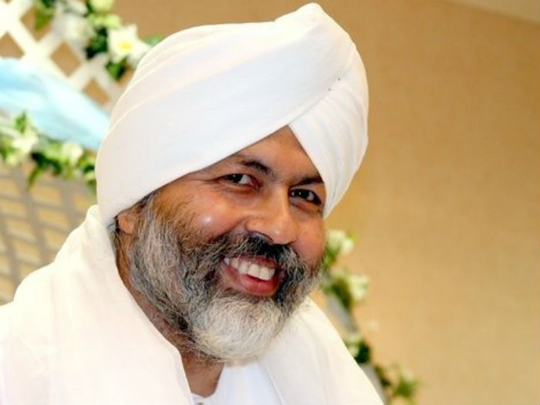
Nirankari sect head Baba Hardev Singh killed in Canada accident: reports

May 13, 2016

New Delhi, May 13: Indian spiritual leader and Nirankari sect head Baba Hardev Singh was reportedly killed in a car accident in Canada on Friday.

Narsingh copy

BJP leader Shahnawaz Hussain confirmed the development on Twitter.

Baba Hardev Singh was the chief priest of the spiritual organization Sant Nirankari Mission. He was born to the previous Satguru of Sant Nirankari Mission, Gurbachan Singh and his wife Kulwant Kaur.

The Sant Nirankari Movement or Universal Brotherhood Movement, which was started by Baba Buta Singh in early 19th century, believes in the importance of a living leader. Sikhism, on the other hand, believed in the Sikh scriptures as their final guru. It was this difference that caused the Sant Nirankari movement, which separated from mainstream Sikhism in 1929.

Satguru Gurbachan Singh was assassinated by fundamentalist Sikhs belonging to Akhand Kirtani Jatha who were wary of the growing power of the Nirankari Mission.

After the assassination, Baba Hardev Singh succeeded his father as the Satguru of the mission and continued to provide teachings to the believers.

The mission has grown to be a global entity with over 2000 centres around the world.

Comments

Sanjay kumar
 - 
Thursday, 19 Jul 2018

In reply to by Sadhu Maharaj

Interesting how the first leader was his grand father and then his father and then him, after his death, his wife and then his daughter. Is this the first ‘family’ of spirituality? Seems more like a family business. 

Sadhu Maharaj
 - 
Friday, 13 May 2016

Deeply saddened to learn the demise of Baba Hardev Singh ji. Baba Hardev Singh's demise is a huge loss to the Nirankari Mission.

Ram charan
 - 
Friday, 13 May 2016

Saddened to hear about the demise of #nirankari Baba. Hardev Singh. RIP

Priyanka Chopra
 - 
Friday, 13 May 2016

Deeply pained by the untimely death of the Nirankari Baba Hardev Singh Ji Maharaj

Umanath Kotian
 - 
Friday, 13 May 2016

Singh's demise is a huge loss to the Nirankari society. May God give his followers the strength to bear the pain of his death.

Add new comment

  • Coastaldigest.com reserves the right to delete or block any comments.
  • Coastaldigset.com is not responsible for its readers’ comments.
  • Comments that are abusive, incendiary or irrelevant are strictly prohibited.
  • Please use a genuine email ID and provide your name to avoid reject.
Agencies
August 7,2020

Russia boasts that it's about to become the first country to approve a Covid-19 vaccine, with mass vaccinations planned as early as October using shots that are yet to complete clinical trials -- and scientists worldwide are sounding the alarm that the headlong rush could backfire.

Moscow sees a Sputnik-like propaganda victory, recalling the Soviet Union's launch of the world's first satellite in 1957.

But the experimental Covid-19 shots began first-in-human testing on a few dozen people less than two months ago, and there's no published scientific evidence yet backing Russia's late entry to the global vaccine race, much less explaining why it should be considered a front-runner.

“I'm worried that Russia is cutting corners so that the vaccine that will come out may be not just ineffective, but also unsafe,” said Lawrence Gostin, a global public health law expert at Georgetown University. “It doesn't work that way... Trials come first. That's really important.”

According to Kirill Dmitriev, head of Russia's Direct Investment Fund that bankrolled the effort, a vaccine developed by the Gamaleya research institute in Moscow may be approved in days, before scientists complete what's called a Phase 3 study.

That final-stage study, usually involving tens of thousands of people, is the only way to prove if an experimental vaccine is safe and really works.

Health Minister Mikhail Murashko said members of “risk groups,” such as medical workers, may be offered the vaccine this month.

He didn't clarify whether they would be part of the Phase 3 study that is said to be completed after the vaccine receives “conditional approval.”

Deputy Prime Minister Tatyana Golikova promised to start “industrial production” in September, and Murashko said mass vaccination may begin as early as October.

Dr Anthony Fauci, the top US infectious disease specialist, questioned the fast-track approach last week.

“I do hope that the Chinese and the Russians are actually testing a vaccine before they are administering the vaccine to anyone, because claims of having a vaccine ready to distribute before you do testing I think is problematic at best," he said.

Questions about this vaccine candidate come after the US, Britain and Canada last month accused Russia of using hackers to steal vaccine research from Western labs.

Delivering a vaccine first is a matter of national prestige for the Kremlin as it tries to assert the image of Russia as a global power capable of competing with the US and China.

The notion of being “the first in the world” dominated state news coverage of the effort, with government officials praising reports of the first-step testing.

In April, President Vladimir Putin ordered state officials to shorten the time of clinical trials for a variety of drugs, including potential coronavirus vaccines.

According to Russia's Association of Clinical Trials Organizations, the order set “an unattainable bar” for scientists who, as a result, "joined in on the mad race, hoping to please those at power.”

The association first raised concern in late May, when professor Alexander Gintsburg, head of the Gamaleya institute, said he and other researchers tried the vaccine on themselves.

The move was a “crude violation of the very foundations of clinical research, Russian law and universally accepted international regulations" the group said in an open letter to the government, urging scientists and health officials to adhere to clinical research standards.

But a month later, the Health Ministry authorized clinical trials of the Gamaleya product, with what appeared to be another ethical issue.

Human studies started June 17 among 76 volunteers. Half were injected with a vaccine in liquid form and the other half with a vaccine that came as soluble powder.

Some in the first half were recruited from the military, which raised concerns that servicemen may have been pressured to participate.

Some experts said their desire to perform well would affect the findings. “It's no coincidence media reports we see about the trials among the military said no one had any side effects, while the (other group) reported some," said Vasily Vlassov, a public health expert with Moscow's Higher School of Economics.

As the trials were declared completed and looming regulatory approval was announced last week, questions arose about the vaccine's safety and effectiveness.

Government assurances the drug produced the desired immune response and caused no significant side effects were hardly convincing without published scientific data describing the findings.

The World Health Organization said all vaccine candidates should go through full stages of testing before being rolled out.

“There are established practices and there are guidelines out,” WHO spokesman Christian Lindmeier said Tuesday.

“Between finding or having a clue of maybe having a vaccine that works, and having gone through all the stages, is a big difference.”

Offering an unsafe compound to medical workers on the front lines of the outbreak could make things worse, Georgetown's Gostin said, adding: “What if the vaccine started killing them or making them very ill?”

Vaccines that are not properly tested can cause harm in many ways — from a negative impact on health to creating a false sense of security or undermining trust in vaccinations, said Thomas Bollyky, director of the global health program at the Council on Foreign Relations. 

Comments

Add new comment

  • Coastaldigest.com reserves the right to delete or block any comments.
  • Coastaldigset.com is not responsible for its readers’ comments.
  • Comments that are abusive, incendiary or irrelevant are strictly prohibited.
  • Please use a genuine email ID and provide your name to avoid reject.
News Network
March 3,2020

Mar 3: Just hours after the ending of a week-long “reduction” in violence that was crucial for Donald Trump’s peace deal in Afghanistan, the Taliban struck again: On Monday, they killed three people and injured about a dozen at a football match in Khost province. This resumption of violence will not surprise anyone actually invested in peace for that troubled country. The point of the U.S.-Taliban deal was never peace. It was to try and cover up an ignominious exit for the U.S., driven by an election-bound president who feels no responsibility toward that country or to the broader region.

Seen from South Asia, every point we know about in the agreement is a concession by Trump to the Taliban. Most importantly, it completes a long-term effort by the U.S. to delegitimize the elected government in Kabul — and, by extension, Afghanistan’s constitution. Afghanistan’s president is already balking at releasing 5,000 Taliban prisoners before intra-Afghan talks can begin — a provision that his government did not approve.

One particularly cringe-worthy aspect: The agreement refers to the Taliban throughout  as “the Islamic Emirate of Afghanistan that is not recognized by the United States as a state and is known as the Taliban.” This unwieldy nomenclature validates the Taliban’s claim to be a government equivalent to the one in Kabul, just not the one recognised at the moment by the U.S. When read together with the second part of the agreement, which binds the U.S. to not “intervene in [Afghanistan’s] domestic affairs,” the point is obvious: The Taliban is not interested in peace, but in ensuring that support for its rivals is forbidden, and its path to Kabul is cleared.

All that the U.S. has effectively gotten in return is the Taliban’s assurance that it will not allow the soil of Afghanistan to be used against the “U.S. and its allies.” True, the U.S. under Trump has shown a disturbing willingness to trust solemn assurances from autocrats; but its apparent belief in promises made by a murderous theocratic movement is even more ridiculous. Especially as the Taliban made much the same promise to an Assistant Secretary of State about Osama bin Laden while he was in the country plotting 9/11.

Nobody in the region is pleased with this agreement except for the Taliban and their backers in the Pakistani military. India has consistently held that the legitimate government in Kabul must be the basic anchor of any peace plan. Ordinary Afghans, unsurprisingly, long for peace — but they are, by all accounts, deeply skeptical about how this deal will get them there. The brave activists of the Afghan Women’s Network are worried that intra-Afghan talks will take place without adequate representation of the country’s women — who have, after all, the most to lose from a return to Taliban rule.

But the Pakistani military establishment is not hiding its glee. One retired general tweeted: “Big victory for Afghan Taliban as historic accord signed… Forced Americans to negotiate an accord from the position of parity. Setback for India.” Pakistan’s army, the Taliban’s biggest backer, longs to re-install a friendly Islamist regime in Kabul — and it has correctly estimated that, after being abandoned by Trump, the Afghan government will have sharply reduced bargaining power in any intra-Afghan peace talks. A deal with the Taliban that fails also to include its backers in the Pakistani military is meaningless.

India, meanwhile, will not see this deal as a positive for regional peace or its relationship with the U.S. It comes barely a week after Trump’s India visit, which made it painfully clear that shared strategic concerns are the only thing keeping the countries together. New Delhi remembers that India is not, on paper, a U.S. “ally.” In that respect, an intensification of terrorism targeting India, as happened the last time the U.S. withdrew from the region, would not even be a violation of Trump’s agreement. One possible outcome: Over time the government in New Delhi, which has resolutely sought to keep its ties with Kabul primarily political, may have to step up security cooperation. Nobody knows where that would lead.

The irresponsible concessions made by the U.S. in this agreement will likely disrupt South Asia for years to come, and endanger its own relationship with India going forward. But worst of all, this deal abandons those in Afghanistan who, under the shadow of war, tried to develop, for the first time, institutions that work for all Afghans. No amount of sanctimony about “ending America’s longest war” should obscure the danger and immorality of this sort of exit.

Comments

Add new comment

  • Coastaldigest.com reserves the right to delete or block any comments.
  • Coastaldigset.com is not responsible for its readers’ comments.
  • Comments that are abusive, incendiary or irrelevant are strictly prohibited.
  • Please use a genuine email ID and provide your name to avoid reject.
News Network
June 4,2020

Jun 4: Mahatma Gandhi’s statue outside the Indian Embassy in Washington DC was vandalised with graffiti and spray painting by unknown persons allegedly involved in the ongoing protests in the US against the custodial killing of African-American George Floyd.

This has prompted the mission officials to register a complaint with the local law enforcement agencies.

The incident is reported to have taken place on the intervening night of June 2 and 3 in Washington DC.

The Indian embassy has informed the State Department and registered a complaint with local law enforcement agencies, which are now conducting an investigation into the incident.

On Wednesday, a team of officials from Metropolitan Police in consultation with the Diplomatic Security Service and National Park Police visited the site and are conducting inquiries.

Efforts are on to clean up the site at the earliest.

Vandalism of the statue of the apostle of peace comes during the week of nationwide protests against the custodial killing of African-American George Floyd in Minneapolis on May 25.

Several of these protests have turned violent which many times has resulted in damage of some of the most prestigious and sacred American monuments.

In Washington DC, protestors this week burnt a historic church and damaged some of the prime properties and historic places like the national monument and Lincoln Memorial.

One of the few statues of a foreign leader on a federal land in Washington DC, the statue of Mahatma Gandhi was dedicated by the then Prime Minister Atal Bihari Vajpayee, in the presence of the then US president Bill Clinton on September 16, 2000, during his state visit to the US.

In October 1998, the US Congress had authorised the government of India to establish and maintain a memorial “to honour Mahatma Gandhi on Federal land in the District of Columbia."

According to the Indian Embassy website, the sculpture of Mahatma Gandhi is cast in bronze as a statue to a height of 8 feet 8 inches. It shows Gandhi in stride, as a leader and man of action evoking memories of his 1930 protest march against salt-tax, and the many padyatras (long marches) he undertook throughout the length and breadth of the Indian sub-continent.

The statue, the design of which was created by Gautam Pal, is a gift from the Indian Council for Cultural Relations (ICCR). The pedestal for the statue of Mahatma Gandhi is a block of new Imperial Red also known as Ruby Red a block originally weighing 25 tonnes reduced to a size of 9'x7'x3'4". It now weighs 16 tonnes.

Comments

Add new comment

  • Coastaldigest.com reserves the right to delete or block any comments.
  • Coastaldigset.com is not responsible for its readers’ comments.
  • Comments that are abusive, incendiary or irrelevant are strictly prohibited.
  • Please use a genuine email ID and provide your name to avoid reject.