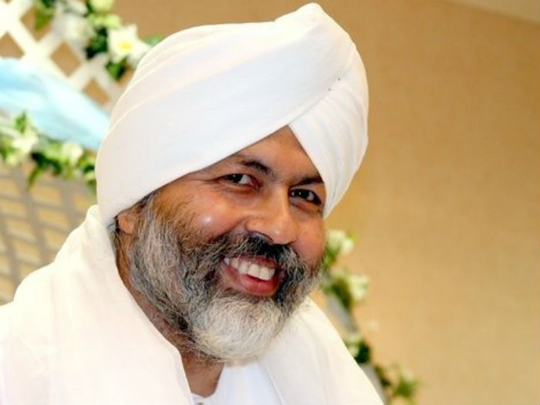
Nirankari sect head Baba Hardev Singh killed in Canada accident: reports

May 13, 2016

New Delhi, May 13: Indian spiritual leader and Nirankari sect head Baba Hardev Singh was reportedly killed in a car accident in Canada on Friday.

Narsingh copy

BJP leader Shahnawaz Hussain confirmed the development on Twitter.

Baba Hardev Singh was the chief priest of the spiritual organization Sant Nirankari Mission. He was born to the previous Satguru of Sant Nirankari Mission, Gurbachan Singh and his wife Kulwant Kaur.

The Sant Nirankari Movement or Universal Brotherhood Movement, which was started by Baba Buta Singh in early 19th century, believes in the importance of a living leader. Sikhism, on the other hand, believed in the Sikh scriptures as their final guru. It was this difference that caused the Sant Nirankari movement, which separated from mainstream Sikhism in 1929.

Satguru Gurbachan Singh was assassinated by fundamentalist Sikhs belonging to Akhand Kirtani Jatha who were wary of the growing power of the Nirankari Mission.

After the assassination, Baba Hardev Singh succeeded his father as the Satguru of the mission and continued to provide teachings to the believers.

The mission has grown to be a global entity with over 2000 centres around the world.

Comments

Sanjay kumar
 - 
Thursday, 19 Jul 2018

In reply to by Sadhu Maharaj

Interesting how the first leader was his grand father and then his father and then him, after his death, his wife and then his daughter. Is this the first ‘family’ of spirituality? Seems more like a family business. 

Sadhu Maharaj
 - 
Friday, 13 May 2016

Deeply saddened to learn the demise of Baba Hardev Singh ji. Baba Hardev Singh's demise is a huge loss to the Nirankari Mission.

Ram charan
 - 
Friday, 13 May 2016

Saddened to hear about the demise of #nirankari Baba. Hardev Singh. RIP

Priyanka Chopra
 - 
Friday, 13 May 2016

Deeply pained by the untimely death of the Nirankari Baba Hardev Singh Ji Maharaj

Umanath Kotian
 - 
Friday, 13 May 2016

Singh's demise is a huge loss to the Nirankari society. May God give his followers the strength to bear the pain of his death.

Add new comment

  • Coastaldigest.com reserves the right to delete or block any comments.
  • Coastaldigset.com is not responsible for its readers’ comments.
  • Comments that are abusive, incendiary or irrelevant are strictly prohibited.
  • Please use a genuine email ID and provide your name to avoid reject.
News Network
April 15,2020

Wuhan, Apr 15: In the six days after top Chinese officials secretly determined they likely were facing a pandemic from a new coronavirus, the city of Wuhan at the epicenter of the disease hosted a mass banquet for tens of thousands of people; millions began traveling through for Lunar New Year celebrations.

President Xi Jinping warned the public on the seventh day, Janaury 20. But by that time, more than 3,000 people had been infected during almost a week of public silence, according to internal documents obtained by The Associated Press and expert estimates based on retrospective infection data.

That delay from Jan 14 to Jan. 20 was neither the first mistake made by Chinese officials at all levels in confronting the outbreak, nor the longest lag, as governments around the world have dragged their feet for weeks and even months in addressing the virus.

But the delay by the first country to face the new coronavirus came at a critical time — the beginning of the outbreak. China's attempt to walk a line between alerting the public and avoiding panic set the stage for a pandemic that has infected almost 2 million people and taken more than 126,000 lives.

A This is tremendous, a said Zuo-Feng Zhang, an epidemiologist at the University of California, Los Angeles. If they took action six days earlier, there would have been much fewer patients and medical facilities would have been sufficient. We might have avoided the collapse of Wuhan's medical system.

Other experts noted that the Chinese government may have waited on warning the public to stave off hysteria, and that it did act quickly in private during that time.

But the six-day delay by China's leaders in Beijing came on top of almost two weeks during which the national Center for Disease Control did not register any cases from local officials, internal bulletins obtained by the AP confirm. Yet during that time, from Jan 5 to Jan 17, hundreds of patients were appearing in hospitals not just in Wuhan but across the country.

It's uncertain whether it was local officials who failed to report cases or national officials who failed to record them. It's also not clear exactly what officials knew at the time in Wuhan, which only opened back up last week with restrictions after its quarantine.

But what is clear, experts say, is that China's rigid controls on information, bureaucratic hurdles and a reluctance to send bad news up the chain of command muffled early warnings. The punishment of eight doctors for rumor-mongering, broadcast on national television on Jan. 2, sent a chill through the city's hospitals.

Doctors in Wuhan were afraid, said Dali Yang, a professor of Chinese politics at the University of Chicago. It was truly intimidation of an entire profession. Without these internal reports, it took the first case outside China, in Thailand on Jan 13, to galvanize leaders in Beijing into recognising the possible pandemic before them. It was only then that they launched a nationwide plan to find cases distributing CDC-sanctioned test kits, easing the criteria for confirming cases and ordering health officials to screen patients, all without telling the public.

The Chinese government has repeatedly denied suppressing information in the early days, saying it immediately reported the outbreak to the World Health Organization.

Allegations of a cover-up or lack of transparency in China are groundless, said foreign ministry spokesman Zhao Lijian at a Thursday press conference.

The documents show that the head of China's National Health Commission, Ma Xiaowei, laid out a grim assessment of the situation on Jan. 14 in a confidential teleconference with provincial health officials.

A memo states that the teleconference was held to convey instructions on the coronavirus from President Xi Jinping, Premier Li Keqiang and Vice Premier Sun Chunlan, but does not specify what those instructions were.

The epidemic situation is still severe and complex, the most severe challenge since SARS in 2003, and is likely to develop into a major public health event, the memo cites Ma as saying.

The National Health Commission is the top medical agency in the country. In a faxed statement, the Commission said it had organised the teleconference because of the case reported in Thailand and the possibility of the virus spreading during New Year travel. It added that China had published information on the outbreak in an open, transparent, responsible and timely manner," in accordance with important instructions repeatedly issued by President Xi.

The documents come from an anonymous source in the medical field who did not want to be named for fear of retribution. The AP confirmed the contents with two other sources in public health familiar with the teleconference. Some of the memo's contents also appeared in a public notice about the teleconference, stripped of key details and published in February.

Under a section titled sober understanding of the situation, the memo said that clustered cases suggest that human-to-human transmission is possible. It singled out the case in Thailand, saying that the situation had changed significantly because of the possible spread of the virus abroad.

With the coming of the Spring Festival, many people will be traveling, and the risk of transmission and spread is high, the memo continued.


Comments

Add new comment

  • Coastaldigest.com reserves the right to delete or block any comments.
  • Coastaldigset.com is not responsible for its readers’ comments.
  • Comments that are abusive, incendiary or irrelevant are strictly prohibited.
  • Please use a genuine email ID and provide your name to avoid reject.
News Network
July 1,2020

Melbourne, July 1: Authorities will lock down around 300,000 people in suburbs north of Melbourne for a month from late on Wednesday to contain the risk of infection after two weeks of double-digit rises in new coronavirus cases in Australia's second-most populous state.

Australia has fared better than many countries in the pandemic, with around 7,830 cases and 104 deaths, but the recent surge has stoked fears of a second wave of COVID-19, echoing concerns expressed in other countries.

Globally, coronavirus cases exceeded 10 million on Sunday, a major milestone in the spread of a disease that has killed more than half a million people in seven months.

From midnight, more than 30 suburbs in Australia's second-biggest city will return to stage three restrictions, the third-strictest level in curbs to control the pandemic. That means residents will be confined to home except for grocery shopping, health appointments, work or caregiving, and exercise.

The restrictions will be accompanied by a testing blitz that authorities hope will extend to half the population of the area affected, and for which borders will be patrolled, authorities said. The measures come as curbs ease across the rest of the state of Victoria, with restaurants, gyms and cinemas reopening in recent weeks.

Victoria recorded 73 fresh cases on Tuesday from 20,682 tests, following an increase of 75 cases on Monday. State premier Daniel Andrews warned on Wednesday that the return of broader restrictions across city remained a possibility.

"If we all stick together these next four weeks, we can regain control of that community transmission ... across metropolitan Melbourne," Andrews said at a briefing. "Ultimately if I didn't shut down those postcodes I'd be shutting down all postcodes. We want to avoid that."

Victoria's spike in cases has been linked to staff members at hotels housing returned travellers for which quarantine protocols were not strictly followed. Victorian state authorities have announced an investigation into the matter.

Some other Australian states and territories are preparing to open borders, but applying limits and quarantine measures to citizens of Victoria as the school holiday season gets under way.

South Australia, the country's fifth most populous state, has had just three new cases in the past month. But citing the spike in coronavirus infections, on Tuesday it cancelled its scheduled reopening to other parts of the nation.

New South Wales (NSW), Australia's most populous state, has stopped short of closing its borders to all Victorians, but those holidaying from hotspot areas - not permitted under NSW rules - can be handed a fine of A$11,000 ($7,596) or jailed if they are detected, state authorities said.

The delays reopening internal borders cast doubts over a federal plan to set up "travel bubble" with neighbouring New Zealand that would allow movement between the two countries.

Comments

Add new comment

  • Coastaldigest.com reserves the right to delete or block any comments.
  • Coastaldigset.com is not responsible for its readers’ comments.
  • Comments that are abusive, incendiary or irrelevant are strictly prohibited.
  • Please use a genuine email ID and provide your name to avoid reject.
News Network
June 10,2020

Islamabad, Jun 10: The World Health Organization has told Pakistan it should implement "intermittent" lockdowns to counter a surge in coronavirus infections that has come as the country loosens restrictions, officials said.

Since the start of Pakistan's outbreak in March, Prime Minister Imran Khan opposed a nationwide lockdown of the sort seen elsewhere, arguing the impoverished country could not afford it.

Instead, Pakistan's four provinces ordered a patchwork of closures, but last week Khan said most of these restrictions would be lifted.

Health officials on Wednesday declared a record number of new cases in the past 24 hours. The country has now confirmed a total of more than 113,000 cases and 2,200 deaths -- though with testing still limited, real rates are thought to be much higher.

"As of today, Pakistan does not meet any of the pre-requisite conditions for opening the lockdown", the WHO said in a letter confirmed by Pakistan officials on Tuesday.

Many people have not adopted behavioural changes such as social distancing and frequent hand-washing, meaning "difficult" decisions will be required including "intermittent lockdowns" in targeted areas, the letter states.

Some 25 percent of tests in Pakistan come back positive for COVID-19, the WHO said, indicating high levels of infection in the general population.

The health body recommended an intermittent lockdown cycle of two weeks on, two weeks off.

Responding to the WHO's letter, Zafar Mirza, the prime minister's special advisor for health, said the country had "consciously but gradually" eased lockdowns while enforcing guidelines in shops, mosques and public transport.

"We have to make tough policy choices to strike a balance between lives and livelihoods," Mirza said Wednesday.

Punjab's provincial health minister Yasmin Rashid, who received the WHO's letter, said the provincial government had already given "orders to take strict action against those violating" virus guidelines.

Hospitals across Pakistan say they are at or near capacity, and some are turning COVID-19 patients away.

WHO Director-General Tedros Adhanom Ghebreyesus said Monday that 136,000 cases had been reported in the previous 24 hours, "the most in a single day so far", with the majority of them in South Asia and the Americas.

Comments

Add new comment

  • Coastaldigest.com reserves the right to delete or block any comments.
  • Coastaldigset.com is not responsible for its readers’ comments.
  • Comments that are abusive, incendiary or irrelevant are strictly prohibited.
  • Please use a genuine email ID and provide your name to avoid reject.