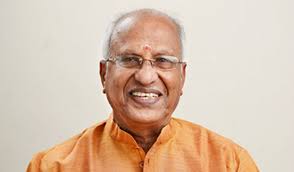
BJP scripts history in Kerala as 86-year-old Rajagopal wins Nemom Seat

[email protected] (CD Network)
May 19, 2016

Thiruvananthapuram, May 19: Scripting a new chapter for the BJP in Kerala, party veteran and former union minister O Rajagopal today won from Nemom constituency here to help the party make its debut in the state assembly.

rajagopalanNemom was one of the segments where the BJP had pinned its hope the most in the present election to open its account in the Assembly.

86-year-old Rajagopal, who had lost by a narrow margin in previous Lok Sabha and Assembly elections, wrested Nemom from sitting MLA and vibrant CPI(M)-LDF leader V Sivankutty defeating him by 8,671 votes

When many of his party colleagues were trailing, Rajagopal, former Union Minister in the A B Vajpayee government, maintained a clear lead since the beginning itself.

The historic victory is a sweet revenge for Rajagopal, as he had lost in the constituency in a photo finish to Sivankutty in the 2011 assembly polls.

Garnering 43,661 votes, he had come second to Sivankutty last time. He had also garnered 50,076 votes in Nemom against Congress's Shashi Tharoor who got 32,639 in the last Lok Sabha elections.

In the last civic polls, of the total 22 wards in Nemom, BJP and LDF got nine seats each and UDF four.

Born on September 15, 1929 to Madhavan Nair and O Kunhikkavu Amma at Pudukkod Panchayath in Palakkad district, he completed Law graduation in Chennai and began practicing law in 1956 at the Palakkad District Court.

In 1980, the Janata Party split and the Bharatiya Janata Party (BJP) was formed and he served as its Kerala president until 1985. He became All India Secretary, General Secretary, and the Vice President of BJP and was elected in 1992 and 1998 to the Rajya Sabha from Madhya Pradesh.

In the year 1999, he became the Minister of State in the Ministry of Law, Justice and Company Affairs and Minister of State in the Ministry of Parliamentary Affairs and then became the Minister of State in the Ministry of Railways between 2000 and 2002.

He later held the positions of Minister of State in the Ministry of Urban Development and Poverty Alleviation, Minister of State in the Ministry of Defence and Minister of State in the Ministry of Parliamentary Affairs.

Having fought several assembly and parliamentary elections from various constituencies in Kerala, Rajagopal had finally managed to win a seat.

Also Read :

After defeat BJP workers turn violent across Kasaragod; CPI MLA attacked

No major surprise in Kasaragod district: Muslim League 2, CPI(M) 2, CPI 1

CPI(M) worker killed in a bomb attack in Kannur amid LDF victory celebrations

Thanks for all the love... It's just a beginning, says Sreesanth after defeat

LDF regains power in Kerala, BJP opens account; CPI(M) focuses on finalising CM

Abdul Razak retains Manjeshwar; BJP loses by 89 votes

No Modi wave in Kasaragod: Muslim League's Nellikkunnu defeats Thantri

Comments

Rikaz
 - 
Thursday, 19 May 2016

Congratulations! Great job!

Ahmed
 - 
Thursday, 19 May 2016

In happy this person may have heart attack thus BJP loose again.

HARRIS
 - 
Thursday, 19 May 2016

FINALLY THIS GREAT POLITICIAN WON HIS LAST BATTLE ...A SALUTE
THIS MOST PROMINENTAND CLEAN POLITICAL PERSONALITY IN BJP, HE IS EDUCATED AND EXPERIANSED NON CONTROVERSIAL POLITICIAN OF DECADES HOPE HE WILL DO HIS BEST ...JAI RAJ GOPAL

\EVERY FAILURE WILL BRING A TASTE OF SUCCESS \""

Kanthappa Chen…
 - 
Thursday, 19 May 2016

This time Modi compared kerala with SOMALIA and fool keralies rewarded him with 1 Seat.
Next time he will compare with BANGALI and same people will reward him with 10 seat.

Jai Somalia Jai ho Somalies.

Add new comment

  • Coastaldigest.com reserves the right to delete or block any comments.
  • Coastaldigset.com is not responsible for its readers’ comments.
  • Comments that are abusive, incendiary or irrelevant are strictly prohibited.
  • Please use a genuine email ID and provide your name to avoid reject.
News Network
April 8,2020

Bengaluru, Apr 8: A 65-year-old man from Kalaburagi district became the fifth COVID-19 fatality in Karnataka, where six new positive cases were confirmed, pushing the tally in the state to 181, the health department said on Wednesday.

The man with Severe Acute Respiratory Infection (SARI), died at a designated hospital in Kalaburagi on Tuesday, a day after being shifted from a private hospital where he was initially treated for two days.

"On April 4, he had got admitted to a private hospital, on April 6 he was shifted to ESI hospital, where he passed away," Primary and Secondary Education Minister Suresh Kumar told reporters here.

The private hospital had been locked and its entire medical team quarantined, he said, adding a notice had been served on it for act of "criminal negligence" (by not referring the patient to designated hospital) and will be followed with a police case.

"He was suffering from SARI, on collecting his sample, tests have revealed that he was positive....investigation is on to find how he got infected," the Minister said.

Noting that the hospital in this case did not refer the patient to the designated hospital and kept treating him for two days, he appealed to all private healthcare facilities to inform authorities if anyone showed any indications for COVID-19.

"As of 5 PM on April 8, cumulatively 181 COVID-19 positive cases have been confirmed in the state, it includes 5 deaths and 28 discharges," the health department said in a bulletin.

Out of the positive cases, 71 are those who had come back from foreign countries, while remaining 110 are contacts and those who had gone to Delhi, the Minister said.

Kumar also said an expert committee comprising Narayana Health founder-chairman Dr Devi Prasad Shetty and Jayadeva Institute of Cardiovascular Sciences director Dr C N Manjunath among others, constitutedto devise an exit strategy for the lockdown, has submitted its reports with various recommendations to Chief Minister B S Yediyurappa.

The chief minister and officials were examining it which was likely to come up before the cabinet meeting on Thursday after which the details will be shared, he added.

The health department said the six fresh cases reported on Wednesday included the elderly man from Kalaburagi who died.

Among the positive cases are a woman from Uttara Kannada with history of SARI and contact of a Dubai returnee, a 72- year-old woman from Kalaburagi, who is mother of a patient that tested positive for the disease; a man from Mandya with contact to two patients.

Others include a man from Chikkaballapura with travel history to Delhi and a woman from Bengaluru also with a travel history to the national capital.

Contact tracing is in progress for all the cases, the bulletin added.

The department said out of 148 active cases in the state, 146 COVID-19 positive patients (including 1 pregnant woman) are in isolation at designated hospitals are stable and two in ICU (one each on oxygen and ventilators).

It said out of total 181 cases in the state, six are transit passengers of Kerala.

Bengaluru accounted for the highest in the state with 63 cases, followed by Mysuru (35), Dakshina Kannada (12) Bidar (ten), Uttara Kannada and Kalaburagi (9 each), Chikkaballapur (8) Belagavi (7), Ballari (6), Bagalkote (5), Mandya (4) Davangere, Bengaluru Rural and Udupi (three each), and Kodagu, Tumakuru, Gadag and Dharwad one each.

Those discharged include 16 from Bengaluru, four from Dakshina Kannada, two each from Uttara Kannada, Kalaburagi and Davangere, and one from Bengaluru Rural; while among those dead are two from Kalaburgari and one each are reported from Bengaluru, Bagalkote and Tumakuru.

Comments

Add new comment

  • Coastaldigest.com reserves the right to delete or block any comments.
  • Coastaldigset.com is not responsible for its readers’ comments.
  • Comments that are abusive, incendiary or irrelevant are strictly prohibited.
  • Please use a genuine email ID and provide your name to avoid reject.
Agencies
January 1,2020

For many Indian tycoons, 2019 turned woeful as lenders -- empowered by the nation’s recent bankruptcy law and desperate to clean up soured debt from their books -- started seizing assets of delinquent firms or dragged them into insolvency.

Indian banks wrote off a record $39 billion of loans in the 18 months through September in a bid to repair their balance sheets as they battled the world’s worst bad debt pile. Making matters worse, a shadow banking crisis led to a funding squeeze, crushing debt-laden businesses that were critically dependent on rollover financing.

“Life has come a full circle for tycoons that had enjoyed debt-fueled growth,” said Nirmal Gangwal, founder of distress and debt restructuring advisory firm Brescon & Allied Partners LLP. “Many firms collapsed like a house of cards. The downfall was rather unprecedented.”
The government has also been cracking down on economic crime to assuage public anger over absconding businessmen. It’s even barred some from traveling overseas if they were deemed a flight risk.

Here are some of the country’s biggest and most-storied businessmen who saw their fortunes fade. Spokespersons for none of these tycoons, except Essar, immediately replied to emails and text messages seeking comments.

Anil Ambani

The chairman of Reliance Group, which makes movies to metro lines, had a close shave with jail time in March before his elder brother and Asia’s richest man, Mukesh Ambani, bailed him out at the last minute. The woes of the ex-billionaire came to the fore when India’s top court asked him to pay Ericsson AB’s India unit about $77 million of past dues or go to jail since Anil Ambani, 60, had given a personal guarantee. His telecom carrier slipped into insolvency this year, while unprofitable Reliance Naval & Engineering Ltd. faced a cash crunch. Reliance Capital Ltd. is selling assets to pare debt. Ambani is also fending off Chinese lenders in a London court.

Malvinder & Shivinder Singh

Karma caught up with ex-billionaires and brothers Malvinder Singh, 47, and Shivinder Singh, 44, and how. Scions of a prominent business family, they once helmed India’s top drug maker and second-largest hospital chain. In October, the two were arrested on charges of fraudulently diverting nearly $337 million from a lender they controlled. India’s market regulator found in 2018 that the brothers had defrauded their hospital company of about $56 million. The collapse of the $2 billion empire turned brother against brother, prompting their mother to broker a peace deal that was short-lived. In February, Malvinder accused Shivinder and their spiritual guru of fraud.

Shashikant & Ravikant Ruia

After a hard-fought battle to keep their flagship steel mill, the first-generation entrepreneurs finally saw the bankrupt Essar Steel India Ltd. pass on to ArcelorMittal last month. The $5.9 billion takeover was almost two years in the making with multiple legal wrangles. The group, controlled by Shashikant Ruia, 76, and Ravikant Ruia, 70, were also reprimanded by a U.K. judge in March this year for concealing documents. Started in 1969 as a construction firm, Essar Group diversified, investing about $18 billion between 2008 and 2012, and piled on debt. In 2017, the group had sold another prized asset, Essar Oil.

Selling an asset to pare a liability shouldn’t be seen as a “lost asset,” an Essar spokesman said, adding that the group remains a diversified conglomerate.

VG Siddhartha

Before jumping off a bridge into a river in July in an apparent suicide, the founder of India’s biggest coffee chain Cafe Coffee Day had penned a letter that spoke of pressure from lenders, a private equity firm and harassment by tax officials. He had spent much of the last two years pledging ever more of Coffee Day Enterprises Ltd. shares to refinance loans for ever shorter periods, at ever higher interest rates. “I would like to say I gave it my all,” V.G. Siddhartha, 60, wrote in the letter. “I fought for a long time but today I gave up.”

Naresh Goyal

The former ticketing agent who built India’s largest airline by value, stepped down as chairman of Jet Airways India Ltd. in March, caving in to pressure from banks who took over the company. Cut-throat price wars and surging costs pushed Jet deeper into loss. The airline stopped flying in April and went into bankruptcy two months later as lenders failed to find a buyer. In July, an Indian court barred Naresh Goyal from flying overseas after the government said it was investigating an alleged $2.6 billion fraud involving Jet Airways.

Rana Kapoor

The founder of Yes Bank Ltd., which became India’s fourth-largest non-state lender, tweeted in September 2018 that his shares were invaluable and requested his children never to sell them upon inheritance. But trouble was brewing. The nation’s banking regulator, which found the lender had repeatedly under-reported its bad loans, refused to extend his tenure as chief executive officer. This forced Rana Kapoor, 62, to step down by end-January. Kapoor, who has pledged some of his Yes Bank shares in July, sold almost his entire stake in the lender by October.

Subhash Chandra

The rice trader-turned-media mogul, 69, who brought cable television into Indian homes in the early 1990s with his ZEE TV, resigned as chairman of Zee Entertainment Enterprises Ltd. in November and lost control of his crown jewel. Subhash Chandra has been selling stake in Zee Entertainment in the past few months to repay group’s debt.

Gautam Thapar

A default by Gautam Thapar, founder of the paper mill-to-power transmission Avantha Group, on pledged shares made Yes Bank Ltd. the biggest shareholder in CG Power and Industrial Solutions Ltd. In August, the firm was hit by an accounting scandal forcing the board to remove Thapar, 59, from the chairman’s post. A month later, the market regulator ordered a forensic audit of the firm and barred Thapar from accessing securities market.

Comments

Add new comment

  • Coastaldigest.com reserves the right to delete or block any comments.
  • Coastaldigset.com is not responsible for its readers’ comments.
  • Comments that are abusive, incendiary or irrelevant are strictly prohibited.
  • Please use a genuine email ID and provide your name to avoid reject.
News Network
July 28,2020

Hounde, Jul 28: Coronavirus and its restrictions are pushing already hungry communities over the edge, killing an estimated 10,000 more young children a month as meager farms are cut off from markets and villages are isolated from food and medical aid, the United Nations warned Monday.

In the call to action shared with The Associated Press ahead of publication, four UN agencies warned that growing malnutrition would have long-term consequences, transforming individual tragedies into a generational catastrophe.

Hunger is already stalking Haboue Solange Boue, an infant from Burkina Faso who lost half her former body weight of 5.5 pounds (2.5 kilograms) in just a month. Coronavirus restrictions closed the markets, and her family sold fewer vegetables. Her mother was too malnourished to nurse.

“My child,” Danssanin Lanizou whispered, choking back tears as she unwrapped a blanket to reveal her baby's protruding ribs.

More than 550,000 additional children each month are being struck by what is called wasting, according to the UN — malnutrition that manifests in spindly limbs and distended bellies. Over a year, that's up 6.7 million from last year's total of 47 million. Wasting and stunting can permanently damage children physically and mentally.

“The food security effects of the COVID crisis are going to reflect many years from now,” said Dr. Francesco Branca, the WHO head of nutrition. “There is going to be a societal effect.”

From Latin America to South Asia to sub-Saharan Africa, more poor families than ever are staring down a future without enough food.

In April, World Food Program head David Beasley warned that the coronavirus economy would cause global famines “of biblical proportions” this year. There are different stages of what is known as food insecurity; famine is officially declared when, along with other measures, 30% of the population suffers from wasting.

The World Food Program estimated in February that one Venezuelan in three was already going hungry, as inflation rendered salaries nearly worthless and forced millions to flee abroad. Then the virus arrived.

“Every day we receive a malnourished child,” said Dr. Francisco Nieto, who works in a hospital in the border state of Tachira.

In May, Nieto recalled, after two months of quarantine, 18-month-old twins arrived with bodies bloated from malnutrition. The children's mother was jobless and living with her own mother. She told the doctor she fed them only a simple drink made with boiled bananas.

“Not even a cracker? Some chicken?” he asked.

“Nothing,” the children's grandmother responded. By the time the doctor saw them, it was too late: One boy died eight days later.

The leaders of four international agencies — the World Health Organization, UNICEF, the World Food Program and the Food and Agriculture Organization — have called for at least dollar 2.4 billion immediately to address global hunger.

But even more than lack of money, restrictions on movement have prevented families from seeking treatment, said Victor Aguayo, the head of UNICEF's nutrition program.

“By having schools closed, by having primary health care services disrupted, by having nutritional programs dysfunctional, we are also creating harm,” Aguayo said. He cited as an example the near-global suspension of Vitamin A supplements, which are a crucial way to bolster developing immune systems.

In Afghanistan, movement restrictions prevent families from bringing their malnourished children to hospitals for food and aid just when they need it most. The Indira Gandhi hospital in the capital, Kabul, has seen only three or four malnourished children, said specialist Nematullah Amiri. Last year, there were 10 times as many.

Because the children don't come in, there's no way to know for certain the scale of the problem, but a recent study by Johns Hopkins University indicated an additional 13,000 Afghans younger than 5 could die.

Afghanistan is now in a red zone of hunger, with severe childhood malnutrition spiking from 690,000 in January to 780,000 — a 13% increase, according to UNICEF.

In Yemen, restrictions on movement have blocked aid distribution, along with the stalling of salaries and price hikes. The Arab world's poorest country is suffering further from a fall in remittances and a drop in funding from humanitarian agencies.

Yemen is now on the brink of famine, according to the Famine Early Warning Systems Network, which uses surveys, satellite data and weather mapping to pinpoint places most in need.

Some of the worst hunger still occurs in sub-Saharan Africa. In Sudan, 9.6 million people live from one meal to the next — a 65% increase from the same time last year.

Lockdowns across Sudanese provinces, as around the world, have dried up work and incomes for millions. With inflation hitting 136%, prices for basic goods have more than tripled.

“It has never been easy but now we are starving, eating grass, weeds, just plants from the earth,” said Ibrahim Youssef, director of the Kalma camp for internally displaced people in war-ravaged south Darfur.

Adam Haroun, an official in the Krinding camp in west Darfur, recorded nine deaths linked with malnutrition, otherwise a rare occurrence, over the past two months — five newborns and four older adults, he said.

Before the pandemic and lockdown, the Abdullah family ate three meals a day, sometimes with bread, or they'd add butter to porridge. Now they are down to just one meal of “millet porridge” — water mixed with grain. Zakaria Yehia Abdullah, a farmer now at Krinding, said the hunger is showing “in my children's faces.”

“I don't have the basics I need to survive,” said the 67-year-old, who who hasn't worked the fields since April. “That means the 10 people counting on me can't survive either.”


Comments

Add new comment

  • Coastaldigest.com reserves the right to delete or block any comments.
  • Coastaldigset.com is not responsible for its readers’ comments.
  • Comments that are abusive, incendiary or irrelevant are strictly prohibited.
  • Please use a genuine email ID and provide your name to avoid reject.