


Post poll result violence: Muslim youth stabbed by BJP worker in Uppala

[email protected] (CD Network)
May 22, 2016

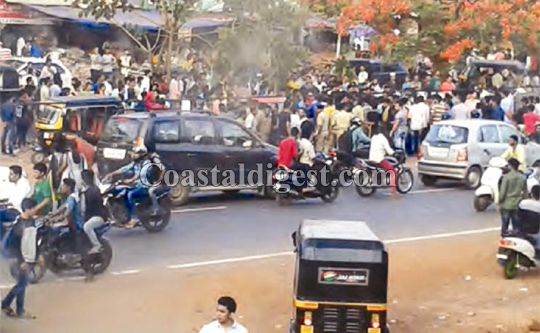
Manjeshwar, May 22: The Sangh Parivar activists, who are indulging in violence across Kasaragod district after the announcement of Assembly poll results earlier this week, attacked a Muslim youth at Uppalla, near here on Saturday.
uppalaviolence

Muneer (24), son of Abdullah, a resident of Uppala, was waylaid and stabbed when he was returning home from Cherugoli village, police sources said. The assailant has been identified as Rajesh, a local BJP activist.

A critically injured Muneer is undergoing treatment at the intensive care unit of a private hospital in Mangaluru.

Enraged over the attack on an innocent youth, the local residents staged protest in Uppala town and damaged to motorbike belonging to the accused.

Police had to resort to baton charge thrice to disperse the mob and bring the situation under control. Security has been stepped up in the area following the violence.

The Sangh Parivar activists had staged violent protests and targeted individuals in Kasargod, Majeshwar, Kanhangad and other parts of Kasaragod district on Thursday after the announcement of poll results.

Kanhangad MLA E Chandrasekharan also suffered injuries on his hand after some BJP workers threw stones at him at Mavungal near Kanhangad when he was taking part in a road show following his victory.

Comments

Mohan Marakada
 - 
Sunday, 22 May 2016

Election over now Skelton of jealous ego heads

Kushwant Bhat
 - 
Sunday, 22 May 2016

Wa Wa Congratulations winners, but RSS Criminal Looters totally defeated no way, they are tried several Hundred short cut roots at least win a seat in Holiest Kasargod, their main agenda was \Divide a particular community vote and Win\" utterly defeated, afterwards no other way to fight, sending \"Rajesh\" like innocent youngster's telling many amny promises, really Rajesh Like Innocent is becoming Victims, you see Now Rajesh Life is gone, If he read this article Understand, Master Minded Criminal 'Surendra\" who organised this type of Terrorism he is safe, but Rajesh in front of Gunpoint. this is the RSS agenda.
Understand you people good for your feature life, Kasargodians Voters knows very well.
Jai Hoo Bharath Math Ki."

Add new comment

  • Coastaldigest.com reserves the right to delete or block any comments.
  • Coastaldigset.com is not responsible for its readers’ comments.
  • Comments that are abusive, incendiary or irrelevant are strictly prohibited.
  • Please use a genuine email ID and provide your name to avoid reject.
News Network
January 13,2020

Bengaluru, Jan 13: Right-wing organisations, along with BJP and RSS workers, will take out a massive padayatra in Kanakapura on Monday, protesting against the construction of a Jesus Christ statue.

The event organised by the Hindu Jagarana Vedike (HJV) will witness a rally from the Aiyappa temple in Kanakapura to the taluk panchayat office, where a memorandum will be submitted to the authorities following a public meeting.

Ahead of the event, Congress leader D K Shivakumar, in a video message released on Sunday, urged the people of Kanakapura to maintain calm. The former minister cast apprehensions over the event scheduled on Monday and said provocative statements may be made to disturb peace and harmony in Kanakapura.

Shivakumar, who represents the Kanakapura constituency, said the motive of the meeting by the leaders and workers of the BJP and the RSS, along with seers of mutts, was to defame his constituency.

“If any remarks are made against me, my brother (D K Suresh) or people of different faiths in Kanakapura constituency, do not be provoked,” he urged.

“Members of the (Christian) community have prayed at the site for 400 years and are trying to install a statue of Jesus Christ. I have helped the community like I aided hundreds of temples and educational institutions,” he said.

Appealing to maintain peace, Shivakumar said that BJP and RSS leaders were free to petition anybody.  

The BJP and right-wing organisations have objected to the construction of the statue at Kapala Betta, with the BJP government ordering a probe into how road, power supply and other facilities were provided to the hill. Recently, Christian leaders had petitioned Chief Minister B S Yediyurappa to remove any impediments to the construction of the statue.

Comments

Add new comment

  • Coastaldigest.com reserves the right to delete or block any comments.
  • Coastaldigset.com is not responsible for its readers’ comments.
  • Comments that are abusive, incendiary or irrelevant are strictly prohibited.
  • Please use a genuine email ID and provide your name to avoid reject.
Ram Puniyani
January 14,2020

In the beginning of January 2020 two very disturbing events were reported from Pakistan. One was the attack on Nankana Sahib, the holy shrine where Sant Guru Nanak was born. While one report said that the place has been desecrated, the other stated that it was a fight between two Muslim groups. Prime Minister of Pakistan Imran Khan condemned the incident and the main accused Imran Chisti was arrested. The matter related to abduction and conversion of a Sikh girl Jagjit Kaur, daughter of Pathi (One who reads Holy Guru Granth Sahib in Gurudwara) of the Gurudwara. In another incident one Sikh youth Ravinder Singh, who was out on shopping for his marriage, was shot dead in Peshawar.

While these condemnable attacks took place on the Sikh minority in Pakistan, BJP was quick enough to jump to state that it is events like this which justify the Citizenship Amendment Act (CAA). Incidentally CAA is the Act which is discriminatory and relates to citizenship with Religion, which is not as per the norms of Indian constitution. There are constant debates and propaganda that population of Hindus has come down drastically in Pakistan and Bangla Desh. Amit Shah, the Home minister stated that in Pakistan the population of Hindus has come down from 23% at the time of partition to 3.7% at present. And in Bangla Desh it has come down from 22% to present 8%.

While not denying the fact that the religious minorities are getting a rough deal in both these countries, the figures which are presented are totally off the mark. These figures don’t take into consideration the painful migrations, which took place at the time of partition and formation of Bangla Desh later. Pakistan census figures tell a different tale. Their first census was held in 1951. As per this census the overall percentage of Non Muslim in Pakistan (East and West together) was 14.2%, of this in West Pakistan (Now Pakistan) it was 3.44 and in Eat Pakistan it was 23.2. In the census held in Pakistan 1998 it became 3.72%. As far as Bangla Desh is concerned the share of Non Muslims has gone down from 23.2 (1951) to 9.6% in 2011.

The largest minority of Pakistan is Ahmadis, (https://minorityrights.org/country/pakistan/) who are close to 4 Million and are not recognised as Muslims in Pakistan. In Bangla Desh the major migrations of Hindus from Bangla Desh took place in the backdrop of Pakistan army’s atrocities in the then East Pakistan.

As far as UN data on refugees in India it went up by 17% between 2016-2019 and largest numbers were from Tibet and Sri Lanka.  (https://www.un.org/en/development/desa/population/migration/publication…)

The state of minorities is in a way the index of strength of democracy. Most South Asian Countries have not been able to sustain democratic values properly. In Pakistan, the Republic began with Jinnah’s classic speech where secularism was to be central credo of Pakistan. This 11th August speech was in a way what the state policy should be, as per which people of all faiths are free to practice their religion. Soon enough the logic of ‘Two Nation theory” and formation of Pakistan, a separate state for Muslim took over. Army stepped in and dictatorship was to reign there intermittently. Democratic elements were suppressed and the worst came when Zia Ul Haq Islamized the state in collusion with Maulanas. The army was already a strong presence in Pakistan. The popular formulation for Pakistan was that it is ruled by three A’s, Army, America and Allah (Mullah).

Bangla Desh had a different trajectory. Its very formation was a nail in the coffin of ‘two nation theory’; that religion can be the basis of a state. Bangla Desh did begin as a secular republic but communal forces and secular forces kept struggling for their dominance and in 1988 it also became Islamic republic. At another level Myanmar, in the grip of military dictatorship, with democratic elements trying to retain their presence is also seeing a hard battle. Democracy or not, the army and Sanghas (Buddhist Sang has) are strong, in Myanmar as well. The most visible result is persecution of Rohingya Muslims.

Similar phenomenon is dominating in Sri Lanka also where Budhhist Sanghas and army have strong say in the political affairs, irrespective of which Government is ruling. Muslim and Christian minorities are a big victim there, while Tamils (Hindus, Christians etc.) suffered the biggest damage as ethnic and religious minorities. India had the best prospect of democracy, pluralism and secularism flourishing here. The secular constitution, the outcome of India’s freedom struggle, the leadership of Gandhi and Nehru did ensure the rooting of democracy and secularism in a strong way.

India so far had best democratic credentials amongst all the south Asian countries. Despite that though the population of minorities rose mainly due to poverty and illiteracy, their overall marginalisation was order of the day, it went on worsening with the rise of communal forces, with communal forces resorting to identity issues, and indulging in propaganda against minorities.

While other South Asian countries should had followed India to focus more on infrastructure and political culture of liberalism, today India is following the footsteps of Pakistan. The retrograde march of India is most visible in the issues which have dominated the political space during last few years. Issues like Ram Temple, Ghar Wapasi, Love Jihad, Beef-Cow are now finding their peak in CAA.

India’s reversal towards a polity with religion’s identity dominating the political scene was nicely presented by the late Pakistani poetess Fahmida Riaz in her poem, Tum bhi Hum Jaise Nikle (You also turned out to be like us). While trying to resist communal forces has been an arduous task, it is becoming more difficult by the day. This phenomenon has been variously called, Fundamentalism, Communalism or religious nationalism among others. Surely it has nothing to do with the religion as practiced by the great Saint and Sufi traditions of India; it resorts mainly to political mobilization by using religion as a tool.

Comments

Ashi
 - 
Tuesday, 14 Jan 2020

If Malaysia implement similar NRC/CAA, India and China are the loser.

Add new comment

  • Coastaldigest.com reserves the right to delete or block any comments.
  • Coastaldigset.com is not responsible for its readers’ comments.
  • Comments that are abusive, incendiary or irrelevant are strictly prohibited.
  • Please use a genuine email ID and provide your name to avoid reject.
News Network
July 12,2020

Bosnia, Jul 12: Bosnians commemorated on Saturday the massacre of about 8,000 Muslim men and boys in Srebrenica, marking the 25th anniversary of killings that shocked the world and have stood out as Europe's only atrocity since World War Two constituting genocide.

Nine newly identified victims were buried at a flower-shaped cemetery near the town, where tall white tombstones mark the graves of 6,643 other victims.

"After 25 years we succeeded in finding his mortal remains, so they can be laid to their final rest," said Fikret Pezic, who buried his father Hasan.

The remains of some 1,000 victims of the massacre in the eastern town during Bosnia's 1992-1995 war are still missing.

Ifeta Hasanovic decided to bury incomplete remains of her husband, saying: "We were aware they cannot be complete after 25 years, at least there are some, I did not want to make any new delays."

World leaders addressed the ceremony by video link, unable to attend because of coronavirus epidemic. Instead of the tens of thousands visitors who typically attend the commemoration each year, only a few thousand came after organisers banned organised visits.

During the Bosnian war, Bosnian Serb forces pushed non-Serbs out of territories they sought for their Serb statelet. Fleeing Muslims took shelter in several eastern towns, including Srebrenica, that were designated as United Nations "safe zones".

On July 11, 1995, the Serb forces commanded by General Ratko Mladic overran Srebrenica, which was protected by lightly armed Dutch peacekeepers.

They sent women and children away and captured and executed the men and boys they found. The bodies were dumped into mass graves and later exhumed by U.N. investigators and used as evidence in war crimes trials of Bosnian Serb leaders.

"We grieve with the families that tirelessly seek justice for the 8,000 innocent lives lost, all these years later," said U.S. Secretary of State Mike Pompeo. Washington brokered Bosnia's peace deal months after the massacre.

Most people at the commemoration were Muslim Bosniaks, reflecting conflicting narratives about the bloodshed - which hinders reconciliation nearly 25 years after the end of war in which about 100,000 people were killed.

The U.N. war crimes tribunal for the former Yugoslavia convicted Mladic and his political chief Radovan Karadzic over Srebrenica genocide but they remained heroes for Serbs, many of whom deny that genocide happened.

On Saturday, the Serbs in the nearby town of Bratunac organised an event marking July 11 as the "Srebrenica Liberation Day".

Sefik Dzaferovic, the Bosniak chairman of Bosnia's tripartite presidency, called for legislation that would ban denial of genocide.

"There can be no trust as long as we witness attacks on the truth, denial of genocide and glorification and celebration of executors," Dzaferovic told the commemoration gathering.

Comments

Add new comment

  • Coastaldigest.com reserves the right to delete or block any comments.
  • Coastaldigset.com is not responsible for its readers’ comments.
  • Comments that are abusive, incendiary or irrelevant are strictly prohibited.
  • Please use a genuine email ID and provide your name to avoid reject.