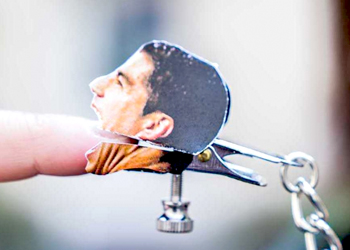
Chinese website sells 'Suarez bite' bottle openers

July 6, 2014

Suarez bite bottleBeijing, Jul 6: Chinese online stores are cheekily trying to cash in on Uruguay striker Luis Suarez's notorious bite of an opponent at the World Cup by selling bottle openers with his image.

Liverpool forward Suarez was given a four month ban from football for sinking his teeth into Italy defender Giorgio Chiellini during their final group match in Brazil last month.

He was also suspended for nine internationals and fined 100,000 Swiss francs (112,000 dollars) for what was his third offence of biting an opposition player.

Popular Chinese retail website Taobao has retailers offering bottle openers in a cartoon image of Suarez, looking angry with his mouth wide open, for 16.80 yuan ($2.70).

The China Daily newspaper reported that the products were proving popular.

"I came up with the idea the night I watched the game and saw the bite," Wang Lin, who owns an e-shop on Taobao.com, told the paper.

"It has been a good sales idea, the only problem being that the manufacturing process cannot keep up with demand," he added.

The bottle openers are not the first fun response to Suarez's bite -- an online Swedish sex shop unveiled a "Suarez nipple clamp" in the form of the footballer's head, teeth bared, for 33 euros ($45).

Uruguay have lodged an appeal against the ban on Suarez who later apologised for his actions.

Comments

Add new comment

  • Coastaldigest.com reserves the right to delete or block any comments.
  • Coastaldigset.com is not responsible for its readers’ comments.
  • Comments that are abusive, incendiary or irrelevant are strictly prohibited.
  • Please use a genuine email ID and provide your name to avoid reject.
Agencies
July 19,2020

New Delhi, Jul 19: Three of the 10 most valued companies added a total of Rs 98,622.89 crore to their market valuation last week, led by stellar gains in IT major Infosys.

Seven companies from the coveted list witnessed a decline in their market valuation last week, but their cumulative loss of Rs 37,701.1 crore was less than the total gain made by three firms -- Reliance Industries Limited, Hindustan Unilever Limited and Infosys.

The market capitalisation of Infosys zoomed Rs 52,046.87 crore to Rs 3,85,027.58 crore. Shares of Infosys had rallied over 9 per cent on Thursday after the company posted a stronger-than-expected 12.4 per cent rise in the first quarter consolidated net profit.

Hindustan Unilever Limited added Rs 25,751.07 crore in its market valuation which stood at Rs 5,48,232.26 crore at close on Friday. Reliance Industries' m-cap jumped Rs 20,824.95 crore to Rs 12,11,682.08 crore.

In contrast, HDFC's valuation plunged Rs 13,920.21 crore to Rs 3,13,269.70 crore and that of Tata Consultancy Services (TCS) declined Rs 7,617.34 crore to Rs 8,26,031.21 crore.

The valuation of ICICI Bank tumbled Rs 4,205.71 crore to Rs 2,29,156.24 crore and that of Kotak Mahindra Bank by Rs 4,175.28 crore to Rs 2,62,864.37 crore.

Bharti Airtel's m-cap dipped Rs 4,009.83 crore to Rs 3,09,521.05 crore and HDFC Bank's by Rs 3,403.97 crore to Rs 6,03,463.97 crore.

The valuation of ITC declined by Rs 368.76 crore to Rs 2,38,469.29 crore.

In the ranking of top-10 firms, RIL was at the number one rank followed by TCS, HDFC Bank, HUL, Infosys, HDFC, Bharti Airtel, Kotak Mahindra Bank, ITC and ICICI Bank.

During the last week, the 30-share BSE index advanced 425.81 points or 1.16 per cent.

Comments

Add new comment

  • Coastaldigest.com reserves the right to delete or block any comments.
  • Coastaldigset.com is not responsible for its readers’ comments.
  • Comments that are abusive, incendiary or irrelevant are strictly prohibited.
  • Please use a genuine email ID and provide your name to avoid reject.
Agencies
May 17,2020

As millions of people get hooked to online dating platforms, their proliferation has led to online romance scams becoming a modern form of fraud that have spread in several societies along with the development of social media like Facebook Dating, warn researchers.

For example, extra-marital dating app Gleeden has crossed 10 lakh users in India in COVID-19 times while dating apps like Tinder and Bumble have gained immense popularity.

According to researchers from University of Siena and Scotte University Hospital led by Dr Andrea Pozza, via a fictitious Internet profile, the scammer develops a romantic relationship with the victim for 6-8 months, building a deep emotional bond to extort economic resources in a manipulative dynamic.

"There are two notable features: on the one hand, the double trauma of losing money and a relationship, on the other, the victim's shame upon discovery of the scam, an aspect that might lead to underestimation of the number of cases," the authors wrote in a paper published in the journal Clinical Practice & Epidemiology in Mental Health.

Around 1,400 dating sites/chats have been created over the last decade in North America alone. In the UK, 23 per cent of Internet users have met someone online with whom they had a romantic relationship for a certain period and even 6 per cent of married couples met through the web.

"The online dating industry has given rise to new forms of pathologies and crime, said the authors.

The results showed that 63 per cent of social media users and 3 per cent of the general population reported having been a victim at least once.

Women, middle-aged people, and individuals with higher tendencies to anxiety, romantic idealization of affective relations, impulsiveness and susceptibility to relational addiction are at higher risk of being victims of the scam.

Online romance scams are, in other words, relationships constructed through websites for the purpose of deceiving unsuspecting victims in order to extort money from them.

The scammer always acts empathetically and attempts to create the impression in the victim that the two are perfectly synced in their shared view of life.

"The declarations of the scammer become increasingly affectionate and according to some authors, a declaration of love is made within two weeks from initial contact," the study elaborated.

After this hookup phase, the scammer starts talking about the possibility of actually meeting up, which will be postponed several times due to apparently urgent problems or desperate situations such as accidents, deaths, surgeries or sudden hospitalizations for which the unwitting victim will be manipulated into sending money to cover the momentary emergency.

Using the strategy of "testing-the-water", the scammer asks the victim for small gifts, usually to ensure the continuance of the relationship, such as a webcam, which, if successful, leads to increasingly expensive gifts up to large sums of money.

When the money arrives from the victim, the scammer proposes a new encounter.

The request for money can also be made to cover the travel costs involved in the illusory meeting. In this phase, the victim may start having second thoughts or showing doubt about the intentions of the partner and gradually decide to break off the relationship.

"In other cases, the fraudulent relationship continues or even reinforces itself as the victim, under the influence of ambivalent emotions of ardor and fear of abandonment and deception, denies or rationalizes doubts to manage their feelings," said the study.

In some cases, the scammer may ask the victim to send intimate body photos that will be used as a sort of implicit blackmail to further bind the victim to the scammer.

Once the scam is discovered, the emotional reaction of the victim may go through various phases: feelings of shock, anger or shame, the perception of having been emotionally violated (a kind of emotional rape), loss of trust in people, a sensation of disgust towards oneself or the perpetrator of the crime and a feeling of mourning.

"Understanding the psychological characteristics of victims and scammers will allow at-risk personality profiles to be identified and prevention strategies to be developed," the authors suggested.


Comments

Add new comment

  • Coastaldigest.com reserves the right to delete or block any comments.
  • Coastaldigset.com is not responsible for its readers’ comments.
  • Comments that are abusive, incendiary or irrelevant are strictly prohibited.
  • Please use a genuine email ID and provide your name to avoid reject.
Agencies
January 16,2020

Claiming that e-commerce giants like Amazon import as much as 80 per cent of the items sold on their platforms, small manufacturers' body has said that their business models do not benefit local industry and are creating jobs of delivery boys only.

"Neither manufacturers nor traders are getting any benefit from the business models of Amazon and Flipkart because they largely import their products from China and Korea and sell here. Nearly 80 per cent of their products are imported," said Anil Bhardwaj, Secretary General, Federation of Indian Micro and Small & Medium Enterprises (FISME).

Bhardwaj said that the global e-commerce players generally source and sell products through their own preferred suppliers and as a result a large number of local manufacturers and traders get crowded out.

He listed out deep discounting and buying products from preferred companies as unfair practices.

"Even if they buy products from local suppliers the commission charged is very high," Bhardwaj said adding that the issues related to unfair practices have been raised with Commerce Ministry on multiple occasions.

FISME maintains that the technology-driven retail is way forward and one cannot be oblivious of the benefits it brings to consumers but at the same time the local industry can also not be ignored given its role in job creation.

"If both traders and local manufacturers are crowded out then how would the local industry survive and employment be generated?" asked Bhardwaj.

As Amazon Founder and CEO Jeff Bezos is currently on his three-day visit to India, the local traders are up in arms against the "unfair" trade practices of the tech giant. Delhi-based Confederation of All India Traders (CAIT) has launched a countrywide protest against the company and has organised protests across 300 cities.

In a setback to Amazon and Walmart-backed Flipkart, the fair market watchdog Competition Commission of India (CCI) has ordered probe into the business operations of both the companies on multiple counts including deep-discounts and exclusive tie-up with preferred sellers.

"For the first time some concrete step has been taken against Amazon and Flipkart who are continuously violating the FDI policy in indulging in a vicious racket of controlling and monopolising not only the e-commerce but even the retail trade as well," CAIT National Secretary General Praveen Khandelwal said after the CCI order.

Comments

Add new comment

  • Coastaldigest.com reserves the right to delete or block any comments.
  • Coastaldigset.com is not responsible for its readers’ comments.
  • Comments that are abusive, incendiary or irrelevant are strictly prohibited.
  • Please use a genuine email ID and provide your name to avoid reject.