


India tops global slavery index with 18.35 mn people enslaved

May 31, 2016

Melbourne, May 31: India has the dubious distinction of having the highest number of people in the world trapped in modern slavery with 18.35 million victims of forced labour, ranging from prostitution and begging, according to a new report, which estimated that nearly 46 million people are enslaved globally.
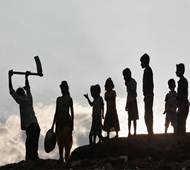
slavery copy copyAccording to the 2016 Global Slavery Index released by Australia-based human rights group Walk Free Foundation today, an estimated 45.8 million people, including women and children, are subject to some form of modern slavery in the world, compared to 35.8 million in 2014.

The report said India has the highest absolute numbers of people trapped in slavery with 18.35 million slaves among its 1.3 billion population while North Korea has the highest incidence (4.37 per cent of the population) and the weakest government response to deal with it.

In the last report in 2014, India had nearly 14.3 million people enslaved.
Incidences of slavery were found in all 167 countries in the index, with Asian countries occupy the top five for people trapped in slavery.

Behind India was China (3.39 million), Pakistan (2.13 million), Bangladesh (1.53 million) and Uzbekistan (1.23 million).

The index said that these five countries combined accounted for almost 58 per cent of the world's enslaved, or 26.6 million people.

The Index presents a ranking of 167 countries based on the proportion of the population that is estimated to be in modern slavery.

Modern slavery refers to situations of exploitation that a person cannot leave because of threats, violence, coercion, abuse of power or deception.

The research included over 42,000 interviews conducted in 53 languages across 25 countries, including 15 state-level surveys in India. These representative surveys covered 44 per cent of the global population.

The countries with the highest estimated prevalence of modern slavery by the proportion of their population are North Korea, Uzbekistan, Cambodia, Cambodia, India, and Qatar.

The countries with the lowest estimated prevalence of modern slavery by the proportion of their population are Luxembourg, Ireland, Norway, Denmark, Switzerland, Austria, Sweden and Belgium, the United States and Canada, and Australia and New Zealand.

The study also tracked the government actions and responses to the modern slavery and of the 161 assessed, 124 nations had criminalised human trafficking in line with the UN trafficking Protocol and 96 nations had developed national action plans to coordinate government response.

It noted that while India had more people enslaved than any other country, it had made significant progress in introducing measures to tackle the problem.

"It has criminalised trafficking, slavery, forced labour, child prostitution and forced marriage. The Indian government is currently tightening legislation against human trafficking, with tougher punishment for repeat offenders. It will offer victims protection and recovery support," it said.

It said that in addition to economic growth in India, ambitious programmes of legal and social reform are being undertaken right across the board, from regulation of labour relations to systems of social insurance for the most vulnerable.

Those governments taking the least action to combat modern slavery are North Korea, Iran, Eritrea, Equatorial Guinea, Hong Kong, Central African Republic, Papua New Guinea, Guinea, the Democratic Republic of the Congo and South Sudan.

The governments that have the strongest response to modern slavery are The Netherlands, the United States of America, the United Kingdom, Sweden, Australia, Portugal, Croatia, Spain, Belgium and Norway.

Seeking strong laws to abolish slavery, Andrew Forrest, Chairman and Founder of Walk Free Foundation, said eradicating slavery makes sense, morally, politically, logically and economically, and called on the governments of the world's leading economies to provide an example to others by enacting and implementing robust anti-slavery measures.

"We call on governments of the top 10 economies of the world to enact laws, at least as strong as the UK Modern Slavery Act 2015, with a budget and capability to ensure organisations are held to account for modern slavery in their supply chains, and to empower independent oversight."

Forrest said leaders of the world's major economies must bring the power of business to this issue, by requiring a focus on supply chain transparency.

"I believe in the critical role of leaders in government, business and civil society. Through our responsible use of power, strength of conviction, determination and collective will, we all can lead the world to end slavery," he said.

Forrest emphasised the key role that business needs to play in eradicating slavery.

"Businesses that don't actively look for forced labour within their supply chains are standing on a burning platform. Business leaders who refuse to look into the realities of their own supply chains are misguided and irresponsible," he said.

Comments

SK
 - 
Thursday, 2 Jun 2016

Since India is facing slavery, Naren has run away to Singapore to enjoy snake/ dog/cat/beef dishes......

Naren kotian
 - 
Tuesday, 31 May 2016

In that mostly 75% are from Muslim community as they enslave women as per their cult following .they have not changed since 6th century ...che papa ...ummah gang ge pitta netti geriruthe ..feku Anthe kumda ...for Muslims he might be feku ..but for nationalist Indians he is true hero who is transforming India .

Add new comment

  • Coastaldigest.com reserves the right to delete or block any comments.
  • Coastaldigset.com is not responsible for its readers’ comments.
  • Comments that are abusive, incendiary or irrelevant are strictly prohibited.
  • Please use a genuine email ID and provide your name to avoid reject.
News Network
April 14,2020

Thiruvananthapuram, Apr 14: Amid Covid-19 lockdown,

Keralites celebrated a low key "Vishu" ,the Malayalam new year, on Tuesday, hoping that days of plenty, prosperity and peace will return.

People woke up in the early hours to see the auspicious "Vishu kani", symbolising hope, promise and fine prospects they wish to have in the year ahead.

The ritual comprises arranging on platters auspicious articles like seasonal fruits, vegetables, flower, gold and clothes which together form the first sight when the family members wake up on the Vishu day.

Normally, Keralites dressed in their traditional attire throng temples across the state.

However, this year due to the lockdown restrictions, temple visits were given a go by.

The famed Sri Krishna temple at Guruvayur and the Lord Ayyappa shrine at Sabarimala witnesses heavy rush of devotees during the vishu day.

But pilgrims were not allowed inside and only temple officials and security personnel were present for the"Vishu kani".

Rehaman, a small time trader, said very few people have come out for vishu purchases due to the restricitons.

It is fine as it is for a good cause, while Radha, a young woman said she could not celebrate the festival.

"We have no money, no job. With whatever little we have, we are celebrating the festival", she said.

87-year-old Vilasini Nambiar, a retired college professor, said vishu has visited the state during a most bewildering time.

"It should however remind us that every mountain must have its valley, desert its oasis, every storm cloud its rainbow, every night its day.

We are prepared to believe that we will overcome this misfortune", she said.

President Ram Nath Kovind, Prime Minister, Narendra Modi, Home minister, Amit Shah, Kerala Governor, Arif Mohammed Khan and Chief Minister, Pinarayi Vijayan, were among those who greeted people on the occasion of Vishu.

Comments

Add new comment

  • Coastaldigest.com reserves the right to delete or block any comments.
  • Coastaldigset.com is not responsible for its readers’ comments.
  • Comments that are abusive, incendiary or irrelevant are strictly prohibited.
  • Please use a genuine email ID and provide your name to avoid reject.
News Network
March 28,2020

Thiruvananthapuram, Mar 28: Kerala Chief Minister Pinarayi Vijayan has sought Prime Minister Narendra Modi's intervention to remove the blocking of roads including state highway along the border of Karnataka in view of lock down to contain the spread of COVID-19.

In a letter sent to the Prime Minister on Friday evening, the Chief Minister said certain actions by the Karnataka Police have resulted in the blocking the Thalassery-Coorg State Highway-30. This road connects Kerala with Coorg in Karnataka via Veerajapettah. This route is a lifeline for flow of essential commodities to Kerala."

"If this is blocked, vehicles carrying essential commodities will have to travel a much longer route to reach our state. Given the situation of national lock down, this will add much more hardship to people," it said.

"You will naturally agree with me that no action impeding the movement of essential commodities should be initiated at this moment of crisis," he hoped.

Comments

Add new comment

  • Coastaldigest.com reserves the right to delete or block any comments.
  • Coastaldigset.com is not responsible for its readers’ comments.
  • Comments that are abusive, incendiary or irrelevant are strictly prohibited.
  • Please use a genuine email ID and provide your name to avoid reject.
News Network
July 16,2020

Bengaluru, Jul 16: Karnataka Medical Education Minister K Sudhakar on Thursday paid a surprise visit to the C V Raman Hospital in Bengaluru and urged the administration to follow COVID-19 guidelines properly. He also took stock of the hospital's preparedness to fight the deadly virus.

The minister noticed a number of flaws and warned the hospital to go strictly by the guidelines. He saw that despite 15 high-flow oxygen beds lay vacant, only two patients were admitted. He then asked the hospital to send asymptomatic and mildly symptomatic patients to COVID-19 care centres so that beds were available to those who need these.

"Doctors' profession is a noble one and in a situation like this everyone should perform their duty with utmost humanity and compassion. During this crisis, we should all be kind and empathetic," the minister said. He also ordered the suspension of two officials for not following the guidelines and not giving the right treatment to patients.

He noticed that the hospital lab collected less number of swabs and instructed them to collect a minimum of 500 swabs per day. Pointing out the under-utilised beds and ICUs, he observed that because of such negligence by officials, the government is being blamed despite working day and night for the past four-five months.
During this visit, the minister also interacted with the patients through video call and enquired about the services provided to them by the hospital.

"Surprise visits will continue. I will be in touch with every lab and get the right number of tests done on a daily basis," the minister said while speaking to the media.

He also urged the people who have recovered from COVID-19 to donate their plasma to save other lives, adding that donors will receive a reward of Rs 5000 as a token of appreciation.

Comments

Add new comment

  • Coastaldigest.com reserves the right to delete or block any comments.
  • Coastaldigset.com is not responsible for its readers’ comments.
  • Comments that are abusive, incendiary or irrelevant are strictly prohibited.
  • Please use a genuine email ID and provide your name to avoid reject.