


India tops global slavery index with 18.35 mn people enslaved

May 31, 2016

Melbourne, May 31: India has the dubious distinction of having the highest number of people in the world trapped in modern slavery with 18.35 million victims of forced labour, ranging from prostitution and begging, according to a new report, which estimated that nearly 46 million people are enslaved globally.
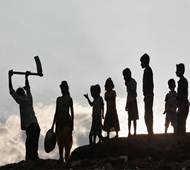
slavery copy copyAccording to the 2016 Global Slavery Index released by Australia-based human rights group Walk Free Foundation today, an estimated 45.8 million people, including women and children, are subject to some form of modern slavery in the world, compared to 35.8 million in 2014.

The report said India has the highest absolute numbers of people trapped in slavery with 18.35 million slaves among its 1.3 billion population while North Korea has the highest incidence (4.37 per cent of the population) and the weakest government response to deal with it.

In the last report in 2014, India had nearly 14.3 million people enslaved.
Incidences of slavery were found in all 167 countries in the index, with Asian countries occupy the top five for people trapped in slavery.

Behind India was China (3.39 million), Pakistan (2.13 million), Bangladesh (1.53 million) and Uzbekistan (1.23 million).

The index said that these five countries combined accounted for almost 58 per cent of the world's enslaved, or 26.6 million people.

The Index presents a ranking of 167 countries based on the proportion of the population that is estimated to be in modern slavery.

Modern slavery refers to situations of exploitation that a person cannot leave because of threats, violence, coercion, abuse of power or deception.

The research included over 42,000 interviews conducted in 53 languages across 25 countries, including 15 state-level surveys in India. These representative surveys covered 44 per cent of the global population.

The countries with the highest estimated prevalence of modern slavery by the proportion of their population are North Korea, Uzbekistan, Cambodia, Cambodia, India, and Qatar.

The countries with the lowest estimated prevalence of modern slavery by the proportion of their population are Luxembourg, Ireland, Norway, Denmark, Switzerland, Austria, Sweden and Belgium, the United States and Canada, and Australia and New Zealand.

The study also tracked the government actions and responses to the modern slavery and of the 161 assessed, 124 nations had criminalised human trafficking in line with the UN trafficking Protocol and 96 nations had developed national action plans to coordinate government response.

It noted that while India had more people enslaved than any other country, it had made significant progress in introducing measures to tackle the problem.

"It has criminalised trafficking, slavery, forced labour, child prostitution and forced marriage. The Indian government is currently tightening legislation against human trafficking, with tougher punishment for repeat offenders. It will offer victims protection and recovery support," it said.

It said that in addition to economic growth in India, ambitious programmes of legal and social reform are being undertaken right across the board, from regulation of labour relations to systems of social insurance for the most vulnerable.

Those governments taking the least action to combat modern slavery are North Korea, Iran, Eritrea, Equatorial Guinea, Hong Kong, Central African Republic, Papua New Guinea, Guinea, the Democratic Republic of the Congo and South Sudan.

The governments that have the strongest response to modern slavery are The Netherlands, the United States of America, the United Kingdom, Sweden, Australia, Portugal, Croatia, Spain, Belgium and Norway.

Seeking strong laws to abolish slavery, Andrew Forrest, Chairman and Founder of Walk Free Foundation, said eradicating slavery makes sense, morally, politically, logically and economically, and called on the governments of the world's leading economies to provide an example to others by enacting and implementing robust anti-slavery measures.

"We call on governments of the top 10 economies of the world to enact laws, at least as strong as the UK Modern Slavery Act 2015, with a budget and capability to ensure organisations are held to account for modern slavery in their supply chains, and to empower independent oversight."

Forrest said leaders of the world's major economies must bring the power of business to this issue, by requiring a focus on supply chain transparency.

"I believe in the critical role of leaders in government, business and civil society. Through our responsible use of power, strength of conviction, determination and collective will, we all can lead the world to end slavery," he said.

Forrest emphasised the key role that business needs to play in eradicating slavery.

"Businesses that don't actively look for forced labour within their supply chains are standing on a burning platform. Business leaders who refuse to look into the realities of their own supply chains are misguided and irresponsible," he said.

Comments

SK
 - 
Thursday, 2 Jun 2016

Since India is facing slavery, Naren has run away to Singapore to enjoy snake/ dog/cat/beef dishes......

Naren kotian
 - 
Tuesday, 31 May 2016

In that mostly 75% are from Muslim community as they enslave women as per their cult following .they have not changed since 6th century ...che papa ...ummah gang ge pitta netti geriruthe ..feku Anthe kumda ...for Muslims he might be feku ..but for nationalist Indians he is true hero who is transforming India .

Add new comment

  • Coastaldigest.com reserves the right to delete or block any comments.
  • Coastaldigset.com is not responsible for its readers’ comments.
  • Comments that are abusive, incendiary or irrelevant are strictly prohibited.
  • Please use a genuine email ID and provide your name to avoid reject.
coastaldigest.com news network
June 30,2020

Bengaluru, Jun 30: In an attempt to tackle unemployment amidst covid-19 crisis, the Karnataka state government has launched a job portal connecting employers and job seekers.

The portal, 'Skill connect' ( https://skillconnect.kaushalkar.com/ ) provides region-wise and sector-wise job listings. An interested candidate can register on the portal and either apply for jobs or can also seek skill training. 

As on Monday, the portal has 25 registered companies with over 2000 jobs available in various sectors. 

The portal works more or less on similar lines as that of any private job portal, except that those posting jobs and candidates searching for employment will have to register with the Skill Development Department. 

Launching the portal on Monday, Chief Minister BS Yediyurappa hoped that the portal would provide an impetus to job creation, as well as the economic revival of the state. 

Deputy Chief Minister Dr. C.N. Ashwath Narayan who is also the skill development Minister added, "All these years, there was no information and communication between job seekers and recruiters. This portal will solve that problem."

Also, until now, there hasn't been comprehensive information either on those seeking jobs or those looking for employees. The skill development efforts have not been in sync with the market. All these issues would be addressed by the portal, he said. 

According to Karnataka Skill Development Authority Managing Director Ashwin Gowda, the portal has already seen a response with about 68 applicants in just a day. 

Officials said even the organisations will have to register with the government while providing all documents concerned. The government aims to avoid any fake job advertisements through this. "We will also enable virtual interviews between the candidate and the employer," sources in the department told DH. 

Recently, the government had also launched a portal exclusively for migrants who had returned to Karnataka from other places. This was meant to work as a skill registry.

However, the portal that was launched on Monday, went a step ahead by connecting both the prospective employers and employees, according to officials in the department.

Comments

Pratibha m Hugar
 - 
Tuesday, 7 Jul 2020

Civil engineering jobs 

Add new comment

  • Coastaldigest.com reserves the right to delete or block any comments.
  • Coastaldigset.com is not responsible for its readers’ comments.
  • Comments that are abusive, incendiary or irrelevant are strictly prohibited.
  • Please use a genuine email ID and provide your name to avoid reject.
News Network
January 10,2020

Dubai, Jan 10: Indian expats in Dubai and the northern Emirates will now be able to get passports issued on the same day under certain conditions, including a higher fee, the Consulate here has announced.

Consul General of India in Dubai Vipul on Thursday announced that the Consulate will start issuing tatkal passports (issued in emergency cases) on the same day, the Gulf News said in a report.

Vipul made the announcement during the Pravasi Bharatiya Divas (Non Resident Indian-NRI Day) celebrations at the consulate.

He said the same day issuance service for tatkal passports can be availed only if the application is submitted before noon at the office of BLS International, the outsourced service provider for Indian passport and visa applications, in Al Khaleej Centre, Bur Dubai.

"We already issue tatkal passports in 24 hours. We are going one step beyond that. We are going to issue tatkal passport on the same day if it is applied for before 12 noon. By evening, we can issue the tatkal passport," the Consul General added.

The mission receives about 850 passport applications daily.

Last year, the consulate issued more than 200,000 passports, over 2500 emergency certificates (one-way travel document), over 2,800 police clearance certificates and provided 72,000 attestation services including registration of births and deaths, according to Vipul.

Comments

Add new comment

  • Coastaldigest.com reserves the right to delete or block any comments.
  • Coastaldigset.com is not responsible for its readers’ comments.
  • Comments that are abusive, incendiary or irrelevant are strictly prohibited.
  • Please use a genuine email ID and provide your name to avoid reject.
News Network
April 24,2020

Bengaluru, Apr 24: Karnataka Chief Minister BS Yediyurappa on Thursday held a meeting with state officials to address the situation in the wake of COVID-19 pandemic.

Due to COVID-19, the prices of the crops have come down. It was instructed to buy those vegetables and keep them in cold storage and then sell. It was also instructed to export fruits, vegetables which cannot be kept for a long time to other states and countries.

Wherever there is a scarcity of drinking water, it was decided to supply water immediately.
Chief Minister Yediyurappa had earlier spoken to Union Minister Sadananda Gowda and took information regarding fertilisers.

As fertilisers' demand is less in the international market, the Union minister for fertilisers said that farmers will be given fertilisers at less than the actual price.

As some of the associations/guilds have violated the lease conditions by not starting the actual work which they have got the land for in Bengaluru, they have been instructed to return the land to the government where the lease conditions have been violated.

As far as the irrigation department is concerned, much water is stored in dams. It was decided to utilise the same for the cultivation of crops and for the purpose of drinking.

As far as the education department is concerned, it was instructed to give online training to students.

With the help of state television channel Doordarshan, it has been decided to teach students about the syllabus and other activities till the reopening of school.

The KSRTC has lost hundreds of crore due to the reduction in bus services due to COVID-19. So, they were instructed to use buses to transport goods to generate revenue.

The government also decided that salary for the doctors, who are working on a contract basis against COVID-19, will be increased significantly.

Comments

Add new comment

  • Coastaldigest.com reserves the right to delete or block any comments.
  • Coastaldigset.com is not responsible for its readers’ comments.
  • Comments that are abusive, incendiary or irrelevant are strictly prohibited.
  • Please use a genuine email ID and provide your name to avoid reject.