


India tops global slavery index with 18.35 mn people enslaved

May 31, 2016

Melbourne, May 31: India has the dubious distinction of having the highest number of people in the world trapped in modern slavery with 18.35 million victims of forced labour, ranging from prostitution and begging, according to a new report, which estimated that nearly 46 million people are enslaved globally.
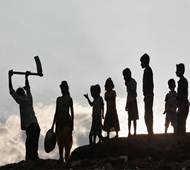
slavery copy copyAccording to the 2016 Global Slavery Index released by Australia-based human rights group Walk Free Foundation today, an estimated 45.8 million people, including women and children, are subject to some form of modern slavery in the world, compared to 35.8 million in 2014.

The report said India has the highest absolute numbers of people trapped in slavery with 18.35 million slaves among its 1.3 billion population while North Korea has the highest incidence (4.37 per cent of the population) and the weakest government response to deal with it.

In the last report in 2014, India had nearly 14.3 million people enslaved.
Incidences of slavery were found in all 167 countries in the index, with Asian countries occupy the top five for people trapped in slavery.

Behind India was China (3.39 million), Pakistan (2.13 million), Bangladesh (1.53 million) and Uzbekistan (1.23 million).

The index said that these five countries combined accounted for almost 58 per cent of the world's enslaved, or 26.6 million people.

The Index presents a ranking of 167 countries based on the proportion of the population that is estimated to be in modern slavery.

Modern slavery refers to situations of exploitation that a person cannot leave because of threats, violence, coercion, abuse of power or deception.

The research included over 42,000 interviews conducted in 53 languages across 25 countries, including 15 state-level surveys in India. These representative surveys covered 44 per cent of the global population.

The countries with the highest estimated prevalence of modern slavery by the proportion of their population are North Korea, Uzbekistan, Cambodia, Cambodia, India, and Qatar.

The countries with the lowest estimated prevalence of modern slavery by the proportion of their population are Luxembourg, Ireland, Norway, Denmark, Switzerland, Austria, Sweden and Belgium, the United States and Canada, and Australia and New Zealand.

The study also tracked the government actions and responses to the modern slavery and of the 161 assessed, 124 nations had criminalised human trafficking in line with the UN trafficking Protocol and 96 nations had developed national action plans to coordinate government response.

It noted that while India had more people enslaved than any other country, it had made significant progress in introducing measures to tackle the problem.

"It has criminalised trafficking, slavery, forced labour, child prostitution and forced marriage. The Indian government is currently tightening legislation against human trafficking, with tougher punishment for repeat offenders. It will offer victims protection and recovery support," it said.

It said that in addition to economic growth in India, ambitious programmes of legal and social reform are being undertaken right across the board, from regulation of labour relations to systems of social insurance for the most vulnerable.

Those governments taking the least action to combat modern slavery are North Korea, Iran, Eritrea, Equatorial Guinea, Hong Kong, Central African Republic, Papua New Guinea, Guinea, the Democratic Republic of the Congo and South Sudan.

The governments that have the strongest response to modern slavery are The Netherlands, the United States of America, the United Kingdom, Sweden, Australia, Portugal, Croatia, Spain, Belgium and Norway.

Seeking strong laws to abolish slavery, Andrew Forrest, Chairman and Founder of Walk Free Foundation, said eradicating slavery makes sense, morally, politically, logically and economically, and called on the governments of the world's leading economies to provide an example to others by enacting and implementing robust anti-slavery measures.

"We call on governments of the top 10 economies of the world to enact laws, at least as strong as the UK Modern Slavery Act 2015, with a budget and capability to ensure organisations are held to account for modern slavery in their supply chains, and to empower independent oversight."

Forrest said leaders of the world's major economies must bring the power of business to this issue, by requiring a focus on supply chain transparency.

"I believe in the critical role of leaders in government, business and civil society. Through our responsible use of power, strength of conviction, determination and collective will, we all can lead the world to end slavery," he said.

Forrest emphasised the key role that business needs to play in eradicating slavery.

"Businesses that don't actively look for forced labour within their supply chains are standing on a burning platform. Business leaders who refuse to look into the realities of their own supply chains are misguided and irresponsible," he said.

Comments

SK
 - 
Thursday, 2 Jun 2016

Since India is facing slavery, Naren has run away to Singapore to enjoy snake/ dog/cat/beef dishes......

Naren kotian
 - 
Tuesday, 31 May 2016

In that mostly 75% are from Muslim community as they enslave women as per their cult following .they have not changed since 6th century ...che papa ...ummah gang ge pitta netti geriruthe ..feku Anthe kumda ...for Muslims he might be feku ..but for nationalist Indians he is true hero who is transforming India .

Add new comment

  • Coastaldigest.com reserves the right to delete or block any comments.
  • Coastaldigset.com is not responsible for its readers’ comments.
  • Comments that are abusive, incendiary or irrelevant are strictly prohibited.
  • Please use a genuine email ID and provide your name to avoid reject.
News Network
May 12,2020

May 12: Children suffering from non-respiratory disease symptoms like diarrhea and fever, or those with a history of exposure to the novel coronavirus, should be suspected of having COVID-19, a new study says.

According to the research, published in the journal Frontiers in Pediatrics, gastrointestinal symptoms first suffered by some children hints at potential infection with SARS-CoV-2 through the digestive tract.

"This case series is the first report to describe the clinical features of COVID-19 with non-respiratory symptoms as the first manifestation in children," the scientists from Tongji Hospital in China wrote in the study.

They explained that the gastrointestinal symptoms could be arising since the type of receptors in lung cells targeted by the virus can also be found in the intestines.

Most children are only mildly affected by COVID-19, and the few severe cases often have underlying health issues, the researchers said.

"It is easy to miss its diagnosis in the early stage, when a child has non-respiratory symptoms, or suffers from another illness," said study co-author Wenbin Li, who works at the Department of Pediatrics, Tongji Hospital.

"Based on our experience of dealing with COVID-19, in regions where this virus is epidemic, children suffering from digestive tract symptoms, especially with fever and/or a history of exposure to this disease, should be suspected of being infected with this virus," Li said.

In the study, the scientists described the clinical features of children admitted to hospital with non-respiratory symptoms, who were subsequently diagnosed with pneumonia and COVID-19.

"These children were seeking medical advice in the emergency department for unrelated problems, for example, one had a kidney stone, another a head trauma," Li said.

The study noted that all the children had pneumonia, which was confirmed by chest X-ray scan before or soon after admission.

These children were then confirmed to have COVID-19.

While their COVID-19 symptoms were initially mild or relatively hidden before their hospital admission, four out of the five cases had digestive tract symptoms as the first manifestation of this disease, the researchers said.

Li hopes that doctors will use the findings to quickly diagnose and isolate patients with similar symptoms, which may aid early treatment and reduce transmission.

According to the researchers, the children's gastrointestinal symptoms, which have also been recorded in adult patients, could be an additional route of infection.

"The gastrointestinal symptoms experienced by these children may be related to the distribution of receptors and the transmission pathway associated with COVID-19 infection in humans," Li explained.

Since the virus infects people via the ACE2 receptor, which can be found in certain cells in the lungs as well as the intestines, COVID-19 might infect patients not only through the respiratory tract in the form of air droplets, but also through the digestive tract by contact or fecal-oral transmission, the study noted.

While COVID-19 tests can occasionally produce false positive readings, Li said all the five children assessed in the study were infected with the disease.

However, he cautioned that more research is needed to confirm their findings.

"We report five cases of COVID-19 in children showing non-respiratory symptoms as the first manifestation after admission to hospital. The incidence and clinical features of similar cases needs further study in more patients," he said.

Comments

Add new comment

  • Coastaldigest.com reserves the right to delete or block any comments.
  • Coastaldigset.com is not responsible for its readers’ comments.
  • Comments that are abusive, incendiary or irrelevant are strictly prohibited.
  • Please use a genuine email ID and provide your name to avoid reject.
News Network
May 1,2020

May 1: India on Thursday called as "propaganda" certain social media posts from the Arab world alleging harassment of Muslims in several parts of the country in the name of containing the spread of coronavirus.

Strongly rebutting the charges, External Affairs Ministry Spokesperson Anurag Srivastava said the Gulf countries are deeply committed to friendly relations with India and they are even seeking bilateral talks on the post-COVID-19 economic recovery.

Talking about India's close and traditional ties with the Arab countries, he said New Delhi is ensuring uninterrupted supply of food and essential commodities to the region during Ramzan as part of its deep-rooted friendship.

Srivastava said the countries in the region do not support any interference in India's internal affairs.

"Much of what you see is propaganda by interested parties. Stray tweets can not be used to characterise our bilateral ties with these countries. The real picture of these relations is very much different," he said during an online media briefing.

There has been a wave of angry reactions on Twitter by leading citizens and rights activists from various Arab countries following allegations that Muslims are being blamed for spreading COVID-19 in several parts of India.

The Organisation of Islamic Cooperation, a powerful bloc of 57 countries, recently accused India of "Islamophobia". India rejected the charges as regrettable.

"We have been making special efforts to ensure uninterrupted supply of food and essential commodities which are required during the Ramzan period in these countries, and this is something which has been greatly appreciated. These countries also want a priority discussion with India on the post-COVID-19 economic recovery," Srivastava said.

Prime Minister Narendra Modi and External Affairs Minister S Jaishankar have been in regular touch with their counterparts from the region in the wake of the coronavirus pandemic.

"In these discussions, there have been requests for sending medicines and medical teams to these countries. We already deployed a Rapid Response Team in Kuwait. There is also a request to send doctors and nurses from India," said Srivastava.

"What comes out clearly is that these countries are deeply committed to friendly relations with India. They also do not support any interference in internal matters of India. It is, therefore, important that the friendly and cooperative nature of our relations is accurately recognised and the misuse of social media is not given credence," he added.

Asked about reports of an order issued by Oman's Finance Ministry asking all state-owned companies to replace foreign workers with qualified local Omanis, Srivastava said it is not aimed at Indians working in the Gulf nation.

"The policy is a decades-old one and not specific to India. It does not target the Indians in any way," he said.

There have been apprehensions that the order will render thousands of Indians working in state-run firms in Oman jobless.

"They greatly value relationship with India. Government of Oman is taking special care of Indians which included free testing for coronavirus, its treatment, providing food," the MEA spokesperson said.

Oman government is also extending certain categories of visas of Indians.

Srivastava said India has been in touch with its friends and partners across the world as part of the collaborative approach to dealing with the pandemic.

Comments

Add new comment

  • Coastaldigest.com reserves the right to delete or block any comments.
  • Coastaldigset.com is not responsible for its readers’ comments.
  • Comments that are abusive, incendiary or irrelevant are strictly prohibited.
  • Please use a genuine email ID and provide your name to avoid reject.
News Network
July 17,2020

Bengaluru, July 17: The government of Karnataka has decided to issue caste and income certificates to Brahmins in the state to reduce the socio-economic inequality faced by the community.

“A notification has been issued to tehsildars in all 30 districts to issue caste and income certificates to Brahmins so that they can also benefit from the government schemes and scholarships,” a Revenue Department official told said.

The notification comes a month after the Karnataka State Brahmin Development Board on June 10 appealed to Chief Minister B.S. Yediyurappa to issue the certificates to the traditionally dominant community, which accounts for 3 per cent of the 7 crore state population.

“Though Brahmins are in ‘minority’ in terms of their population across the state, they need caste and income certificates to benefit from the welfare schemes meant for the economic weaker sections such as SC, ST and OBC groups,” the official said.

The board was set up in March 2019 as a state-run company with Rs 5 crore authorised capital and Rs 5 crore equity and is registered with the Registrar of Companies.

The notification was issued to the local bodies and taluk offices after several members of the community complained to state Revenue Minister R. Ashoka that they were unable to benefit from the welfare schemes in the absence of the certificates.

The certificates will also help students from the community to avail scholarships for higher studies from the state-funded board if their gross annual family income is less than Rs 8 lakh per year.

The board has also urged the state government to implement the 10 per cent quota for its community members under the economically weaker sections, as applicable for Central government jobs and admissions to central institutions.

Noting that every community has people who are forward and backward economically for various reasons, including historical, the official said the board would be empowered to serve the Brahmins.

“The board will provide interest-free loans to the financially weaker sections of the community,” said its Chairman H.S. Sachidananda Murthy.

Comments

Add new comment

  • Coastaldigest.com reserves the right to delete or block any comments.
  • Coastaldigset.com is not responsible for its readers’ comments.
  • Comments that are abusive, incendiary or irrelevant are strictly prohibited.
  • Please use a genuine email ID and provide your name to avoid reject.