


India tops global slavery index with 18.35 mn people enslaved

May 31, 2016

Melbourne, May 31: India has the dubious distinction of having the highest number of people in the world trapped in modern slavery with 18.35 million victims of forced labour, ranging from prostitution and begging, according to a new report, which estimated that nearly 46 million people are enslaved globally.
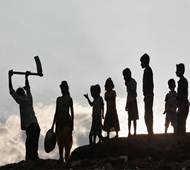
slavery copy copyAccording to the 2016 Global Slavery Index released by Australia-based human rights group Walk Free Foundation today, an estimated 45.8 million people, including women and children, are subject to some form of modern slavery in the world, compared to 35.8 million in 2014.

The report said India has the highest absolute numbers of people trapped in slavery with 18.35 million slaves among its 1.3 billion population while North Korea has the highest incidence (4.37 per cent of the population) and the weakest government response to deal with it.

In the last report in 2014, India had nearly 14.3 million people enslaved.
Incidences of slavery were found in all 167 countries in the index, with Asian countries occupy the top five for people trapped in slavery.

Behind India was China (3.39 million), Pakistan (2.13 million), Bangladesh (1.53 million) and Uzbekistan (1.23 million).

The index said that these five countries combined accounted for almost 58 per cent of the world's enslaved, or 26.6 million people.

The Index presents a ranking of 167 countries based on the proportion of the population that is estimated to be in modern slavery.

Modern slavery refers to situations of exploitation that a person cannot leave because of threats, violence, coercion, abuse of power or deception.

The research included over 42,000 interviews conducted in 53 languages across 25 countries, including 15 state-level surveys in India. These representative surveys covered 44 per cent of the global population.

The countries with the highest estimated prevalence of modern slavery by the proportion of their population are North Korea, Uzbekistan, Cambodia, Cambodia, India, and Qatar.

The countries with the lowest estimated prevalence of modern slavery by the proportion of their population are Luxembourg, Ireland, Norway, Denmark, Switzerland, Austria, Sweden and Belgium, the United States and Canada, and Australia and New Zealand.

The study also tracked the government actions and responses to the modern slavery and of the 161 assessed, 124 nations had criminalised human trafficking in line with the UN trafficking Protocol and 96 nations had developed national action plans to coordinate government response.

It noted that while India had more people enslaved than any other country, it had made significant progress in introducing measures to tackle the problem.

"It has criminalised trafficking, slavery, forced labour, child prostitution and forced marriage. The Indian government is currently tightening legislation against human trafficking, with tougher punishment for repeat offenders. It will offer victims protection and recovery support," it said.

It said that in addition to economic growth in India, ambitious programmes of legal and social reform are being undertaken right across the board, from regulation of labour relations to systems of social insurance for the most vulnerable.

Those governments taking the least action to combat modern slavery are North Korea, Iran, Eritrea, Equatorial Guinea, Hong Kong, Central African Republic, Papua New Guinea, Guinea, the Democratic Republic of the Congo and South Sudan.

The governments that have the strongest response to modern slavery are The Netherlands, the United States of America, the United Kingdom, Sweden, Australia, Portugal, Croatia, Spain, Belgium and Norway.

Seeking strong laws to abolish slavery, Andrew Forrest, Chairman and Founder of Walk Free Foundation, said eradicating slavery makes sense, morally, politically, logically and economically, and called on the governments of the world's leading economies to provide an example to others by enacting and implementing robust anti-slavery measures.

"We call on governments of the top 10 economies of the world to enact laws, at least as strong as the UK Modern Slavery Act 2015, with a budget and capability to ensure organisations are held to account for modern slavery in their supply chains, and to empower independent oversight."

Forrest said leaders of the world's major economies must bring the power of business to this issue, by requiring a focus on supply chain transparency.

"I believe in the critical role of leaders in government, business and civil society. Through our responsible use of power, strength of conviction, determination and collective will, we all can lead the world to end slavery," he said.

Forrest emphasised the key role that business needs to play in eradicating slavery.

"Businesses that don't actively look for forced labour within their supply chains are standing on a burning platform. Business leaders who refuse to look into the realities of their own supply chains are misguided and irresponsible," he said.

Comments

SK
 - 
Thursday, 2 Jun 2016

Since India is facing slavery, Naren has run away to Singapore to enjoy snake/ dog/cat/beef dishes......

Naren kotian
 - 
Tuesday, 31 May 2016

In that mostly 75% are from Muslim community as they enslave women as per their cult following .they have not changed since 6th century ...che papa ...ummah gang ge pitta netti geriruthe ..feku Anthe kumda ...for Muslims he might be feku ..but for nationalist Indians he is true hero who is transforming India .

Add new comment

  • Coastaldigest.com reserves the right to delete or block any comments.
  • Coastaldigset.com is not responsible for its readers’ comments.
  • Comments that are abusive, incendiary or irrelevant are strictly prohibited.
  • Please use a genuine email ID and provide your name to avoid reject.
News Network
May 11,2020

May 11: The Karnataka government appears set to roll out red carpet welcome to foreign companies seeking to move out of China.

The State's Large and Medium Scale Industries Minister Jagadish Shettar said the Government plans to constitute a task force, under the Chairmanship of the Chief Secretary T M Vijay Bhaskar, to spearhead the drive to attract such investment. A proposal to this effect has been sent to the Chief Minister B S Yediyurappa for approval, the Minister told PTI in an interview.

This panel would take feedback and suggestions from a consultative committee to be formed with prominent industrialists from the State and representatives of various countries located here, Shettar said.

In recent days, the Minister held consultations with industrialists such as co-founder and Non-Executive Chairman of Infosys Ltd, Nandan M Nilekani, Executive Chairperson of Biocon Ltd, Kiran Mazumdar-Shaw and Chairman of early-stage startup accelerator and venture fund Axilor Ventures Senapathy (Kris) Gopalakrishnan to fine-tune the States outreach push.

Shettar also held interactions with industry bodies, including Confederation of Indian Industry (CII), the Federation of Karnataka Chambers of Commerce and Industry (FKCCI), Bangalore Chamber of Industry and Commerce (BCIC) and Karnataka Small Scale Industries Association (KASSIA).

Industrialists who took part in the deliberations suggested to the government to focus on ease of doing business and improving the single window clearance system for approvals, as the Minister spelt out government's intent of further improving the investment climate to attract industries to Karnataka.

To boost the industry sentiment in the State, they also stressed the need on easing land acquisition regulations, and leveraging the knowledge base of Bengaluru to promote technology-based manufacturing.

"Given the interest shown by some companies in moving their manufacturing bases out of China, the industry leaders recommended that the State government identify a target list of 100 firms to reach out to for attracting to the State, and work out a strategy to bring them to Karnataka," an Industry department official said.

The industry leaders assured cooperation from the private sector in reaching out to and facilitating interactions with CEOs of these companies.

Shettar said restrictions on acquisition of agriculture land for starting industries have now been relaxed with the passage of an amendment to the land reforms act in the recent Legislature session.

This would facilitate immediate land allotment to industries, he added.

The Minister has also submitted a proposal to the Chief Minister on relaxing labour laws.

Secretary General of industry body ASSOCHAM, Deepak Sood, told news agency recently that there is a broader consensus that the global manufacturing supply chain would be more spread than concentrated in major economies like China.

"If India comes out of the present crisis with minimum of impact, we can be the destination of choice for the global manufacturing giants in different sectors like electronics, computer hardware, pharmaceuticals, including medical devices, automobile, including components and other engineering products," Sood had said.

Gopalakrishnan, also co-founder of Infosys and former CII President, said India has to target companies which have operations in China, reach out to them, understand what their needs are and hold discussions with them.

"We have to make sure that their requirements are addressed, be it with regard to land, office space, faster approvals, and some concessions on local taxes. It depends on the businesses that the companies are in, and if we are able to respond to those requests, I think we will be able to attract them", he told news agency.

"All states will compete for this business (foreign investment)," Gopalakrishnan added.

Comments

Add new comment

  • Coastaldigest.com reserves the right to delete or block any comments.
  • Coastaldigset.com is not responsible for its readers’ comments.
  • Comments that are abusive, incendiary or irrelevant are strictly prohibited.
  • Please use a genuine email ID and provide your name to avoid reject.
News Network
August 4,2020

Bengaluru, Aug 4: With preparations underway for conducting exams for the final semester/ year students in the state, Karnataka Deputy Chief Minister Dr CN Ashwathnarayan on Monday directed the respective universities to conduct exams for the backlog papers as well.

"In the wake of COVID-19, it has been decided to hold exams only for the students of final semester/year courses. It has come to our notice that some universities have decided against conducting exams for final year students who have a backlog to clear from previous semesters. This is unpardonable," the Deputy Chief Minister said.

"Our intention is to see that the final year students finish their course. In the present situation, conducting only final semester exams won't help. We have to help the students in clearing their backlogs," added Ashwathnarayan, directing all universities to compulsorily conduct these exams.

Meanwhile, Ashwathnarayan thanked the staff and officials of various government departments who were responsible for successfully conducting the CET exams even amidst the difficult situation in the wake of COVID-19 pandemic.

"In all, 1,94,419 students had registered for the CET exams, of which 1,75,428 wrote the exams. The percentage of students who took up the exams this year was equivalent to that of the previous years, in normal times," the DCM informed.

"After we successfully conducted the exams, Arunachal Pradesh is going to conduct the Public Service Commission exams on the lines of how we successfully conducted the exams. Likewise, even our KPSC has said it will conduct the exams. We must appreciate the good work of the Karnataka Examination Authority (KEA), which has set an example for others," Ashwathnarayan said.

The deputy chief minister said that 33 colleges in various districts across the state faced shortage of land and that it is the responsibility of the District Commissioners (DCs) to get the lands sanctioned for all these colleges.
In Bagalkot district alone land has not been sanctioned for six degree colleges, he said.

Reacting to this, Bagalkot DC Captain Rajendra assured to look into the matter as soon as he receives the proposal from department officials.

"Similarly, there is shortage of land for five Diploma colleges and 28 ITI colleges in different parts of the state. The DCs must immediately pay attention to this. Once they get the land, buildings will come up within no time," the Karnataka deputy chief minister said.

Comments

Add new comment

  • Coastaldigest.com reserves the right to delete or block any comments.
  • Coastaldigset.com is not responsible for its readers’ comments.
  • Comments that are abusive, incendiary or irrelevant are strictly prohibited.
  • Please use a genuine email ID and provide your name to avoid reject.
News Network
May 18,2020

Bengaluru, May 18: A large number of people in India are planning inter-city bus travel within a month of the lifting of travel restrictions, according to a randomised online survey of over 10,300 customers of redBus, India's largest online bus ticketing platform.

Nearly 57 per cent of the respondents are planning to travel within a month post the lockdown. However, there is a high standard of expectation on the implementation of measures to make buses safe for travel with over 79 per cent wanting deep cleaning and sanitisation of buses after every trip.

Hand sanitisers, mandatory masks and temperature screening for all passengers are next in expectations for bus travel. Over 78 per cent of the respondents want the implementation of hygienic conditions at boarding points and 70 per cent want social distancing protocols to be implemented at boarding points.

"The survey does underscore the fact that given the adherence to safety protocols, bus travel is possibly one of the safest options for travel since the number of travellers are fewer, checks can be done individually and the whole factor of pick up and drop as close to home as possible minimises the number of contacts throughout the journey," said redBus Chief Executive Officer Prakash Sangam.

In addition, online booking further reduces the number of contact points as people can book bus tickets directly from their home. Further, there is a heightened awareness of personal hygiene and safety measures which is important for the travel to be safe.

"The large number of people waiting to travel not only points to the need but also the importance it has for the revival of economic activity as very few of them would be travelling for leisure," said Sangam.

The survey also showed that passengers put a very high consideration on hygiene, sanitation and disinfection -- over 73 per cent -- and social distancing (63 per cent) and much lower consideration to traditional factors such as travel cost (22 per cent), comfort (21 per cent) and punctuality (18 per cent).

The survey was conducted among redBus customers across India. Only 5 per cent of the respondents were willing to postpone their travel to over six months while the rest had plans to travel within that period.

Comments

Add new comment

  • Coastaldigest.com reserves the right to delete or block any comments.
  • Coastaldigset.com is not responsible for its readers’ comments.
  • Comments that are abusive, incendiary or irrelevant are strictly prohibited.
  • Please use a genuine email ID and provide your name to avoid reject.