


India tops global slavery index with 18.35 mn people enslaved

May 31, 2016

Melbourne, May 31: India has the dubious distinction of having the highest number of people in the world trapped in modern slavery with 18.35 million victims of forced labour, ranging from prostitution and begging, according to a new report, which estimated that nearly 46 million people are enslaved globally.
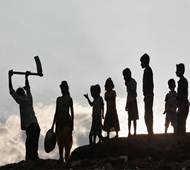
slavery copy copyAccording to the 2016 Global Slavery Index released by Australia-based human rights group Walk Free Foundation today, an estimated 45.8 million people, including women and children, are subject to some form of modern slavery in the world, compared to 35.8 million in 2014.

The report said India has the highest absolute numbers of people trapped in slavery with 18.35 million slaves among its 1.3 billion population while North Korea has the highest incidence (4.37 per cent of the population) and the weakest government response to deal with it.

In the last report in 2014, India had nearly 14.3 million people enslaved.
Incidences of slavery were found in all 167 countries in the index, with Asian countries occupy the top five for people trapped in slavery.

Behind India was China (3.39 million), Pakistan (2.13 million), Bangladesh (1.53 million) and Uzbekistan (1.23 million).

The index said that these five countries combined accounted for almost 58 per cent of the world's enslaved, or 26.6 million people.

The Index presents a ranking of 167 countries based on the proportion of the population that is estimated to be in modern slavery.

Modern slavery refers to situations of exploitation that a person cannot leave because of threats, violence, coercion, abuse of power or deception.

The research included over 42,000 interviews conducted in 53 languages across 25 countries, including 15 state-level surveys in India. These representative surveys covered 44 per cent of the global population.

The countries with the highest estimated prevalence of modern slavery by the proportion of their population are North Korea, Uzbekistan, Cambodia, Cambodia, India, and Qatar.

The countries with the lowest estimated prevalence of modern slavery by the proportion of their population are Luxembourg, Ireland, Norway, Denmark, Switzerland, Austria, Sweden and Belgium, the United States and Canada, and Australia and New Zealand.

The study also tracked the government actions and responses to the modern slavery and of the 161 assessed, 124 nations had criminalised human trafficking in line with the UN trafficking Protocol and 96 nations had developed national action plans to coordinate government response.

It noted that while India had more people enslaved than any other country, it had made significant progress in introducing measures to tackle the problem.

"It has criminalised trafficking, slavery, forced labour, child prostitution and forced marriage. The Indian government is currently tightening legislation against human trafficking, with tougher punishment for repeat offenders. It will offer victims protection and recovery support," it said.

It said that in addition to economic growth in India, ambitious programmes of legal and social reform are being undertaken right across the board, from regulation of labour relations to systems of social insurance for the most vulnerable.

Those governments taking the least action to combat modern slavery are North Korea, Iran, Eritrea, Equatorial Guinea, Hong Kong, Central African Republic, Papua New Guinea, Guinea, the Democratic Republic of the Congo and South Sudan.

The governments that have the strongest response to modern slavery are The Netherlands, the United States of America, the United Kingdom, Sweden, Australia, Portugal, Croatia, Spain, Belgium and Norway.

Seeking strong laws to abolish slavery, Andrew Forrest, Chairman and Founder of Walk Free Foundation, said eradicating slavery makes sense, morally, politically, logically and economically, and called on the governments of the world's leading economies to provide an example to others by enacting and implementing robust anti-slavery measures.

"We call on governments of the top 10 economies of the world to enact laws, at least as strong as the UK Modern Slavery Act 2015, with a budget and capability to ensure organisations are held to account for modern slavery in their supply chains, and to empower independent oversight."

Forrest said leaders of the world's major economies must bring the power of business to this issue, by requiring a focus on supply chain transparency.

"I believe in the critical role of leaders in government, business and civil society. Through our responsible use of power, strength of conviction, determination and collective will, we all can lead the world to end slavery," he said.

Forrest emphasised the key role that business needs to play in eradicating slavery.

"Businesses that don't actively look for forced labour within their supply chains are standing on a burning platform. Business leaders who refuse to look into the realities of their own supply chains are misguided and irresponsible," he said.

Comments

SK
 - 
Thursday, 2 Jun 2016

Since India is facing slavery, Naren has run away to Singapore to enjoy snake/ dog/cat/beef dishes......

Naren kotian
 - 
Tuesday, 31 May 2016

In that mostly 75% are from Muslim community as they enslave women as per their cult following .they have not changed since 6th century ...che papa ...ummah gang ge pitta netti geriruthe ..feku Anthe kumda ...for Muslims he might be feku ..but for nationalist Indians he is true hero who is transforming India .

Add new comment

  • Coastaldigest.com reserves the right to delete or block any comments.
  • Coastaldigset.com is not responsible for its readers’ comments.
  • Comments that are abusive, incendiary or irrelevant are strictly prohibited.
  • Please use a genuine email ID and provide your name to avoid reject.
News Network
April 9,2020

New Delhi, Apr 9: The Delhi Police has traced Tablighi Jamaat leader Maulana Saad Kandhalvi, who has been on the run after an FIR was registered against him for organising a religious gathering last month despite restrictions to combat the coronavirus, sources said on Wednesday.

The cleric has been traced to Zakir Nagar in southeast Delhi, sources said.

His lawyer Tauseef Khan, however, said Saad is under self-quarantine and will join investigation after his quarantine period is over.

On March 31, Delhi Police's Crime Branch lodged an FIR against seven people, including the cleric, on a complaint by Station House Officer Nizamuddin for holding the congregation here allegedly in violation of the orders against large gathering and not maintaining social distancing to contain the spread of coronavirus.

A day later, the Delhi Police's Crime Branch wrote to Saad and others, seeking the details under Section 91 of the Code of Criminal Procedure. A second notice was also issued to him this week.

"Saad is currently under self-quarantine and will join investigation once the period of 14 days gets over," his advocate, Tauseef Khan, told PTI.

Saad's quarantine is expected to end next week.

His lawyer said a reply to the second notice will be given soon.

In an audio message last week, Saad said he was exercising self-quarantine after several hundreds who visited the Tablighi Jamaat's Nizamudddin markaz tested positive for coronavirus.

Visited by thousands last month, the Nizamudddin centre also turned out to be a hotspot for spread of coronavirus not only in national capital and country.

According to the FIR, the Delhi Police contacted the centre on March 21 and reminded them of the government order that prohibited any political or religious gathering of more than 50 people.

However, no one paid any heed to the police's direction, it said. Moreover, an audio recording purportedly of Saad was found in circulation on WhatsApp on March 21, in which he was heard asking his followers to defy the lockdown and social distancing and to attend the religious gathering of the Markaz.

On March 24, the government ordered 21-day nationwide lockdown and restricted any social, political or religious gathering.

The same day a meeting was held at Hazarat Nizamuddin police station between SHO and officer bearers of the centre.

The meeting was attended by Saad, Mohammad Ashraf, Mohammad Salman, Yunus, Mursaleen Saifi, Jishan and Mufti Shehzad and they were informed about lockdown orders.

So far, several hundred cases of COVID-19 cases across the country have been found to be linked to the Tablighi Jamaat congregation held in Delhi last month.

More than 25,500 Tablighi members and their contacts have been quarantined in the country after the Centre and the state governments conducted a "mega operation" to identify them.

At least 9,000 people participated in the religious congregation in Nizamuddin. Later, many of the attendees travelled to various parts of the country.

Comments

Add new comment

  • Coastaldigest.com reserves the right to delete or block any comments.
  • Coastaldigset.com is not responsible for its readers’ comments.
  • Comments that are abusive, incendiary or irrelevant are strictly prohibited.
  • Please use a genuine email ID and provide your name to avoid reject.
News Network
February 2,2020

Kolkata, Feb 2: A protester at Park Circus, known as Shaheen Bagh of Kolkata, died last night after she fell ill during her agitation against CAA, NRC and NPR.

The woman has been identified as Sameeda Khatun (57) who was a resident of Entally area of the city. According to protesters, Khatun who was asthmatic patient died after suffering a cardiac arrest. She is survived by husband and eight children.

Around 250 women from Kolkata have been holding a peaceful sit-in at Park Circus Maidan since January 7 to protest against CAA, NRC and NPR and demanding the withdrawal of the new citizenship law.

Research Scholar at Rabindra Bharati University, Nousheen Baba Khan who has been spearheading the Park Circus protest since the beginning, told the newspaper, “Sameeda Khatun was a regular face at the protest and she was not well as she had asthma.

Last evening she came to me complaining that she is having trouble in breathing. We immediately took her to Chittaranjan Hospital where doctors said she had suffered a cardiac arrest. We later took her to Islamia Hospital where doctors declared her brought dead,” said Khan.

Comments

ABDULAZIZ
 - 
Monday, 3 Feb 2020

Inna Lillahi wa in ilaihi rajivoon.    


Subhaan Allah,   she died for the cause .May Allah Almighty accept her shahada . and bless her with Jannatul Firdous .   Aameen

Add new comment

  • Coastaldigest.com reserves the right to delete or block any comments.
  • Coastaldigset.com is not responsible for its readers’ comments.
  • Comments that are abusive, incendiary or irrelevant are strictly prohibited.
  • Please use a genuine email ID and provide your name to avoid reject.
News Network
February 3,2020

Feb 3: The Karnataka government is probably the only state to have so many nodal agencies to deal with investment proposals. There is the KIADB, Karnataka Udyoga Mitra, State High Level Clearance Committee (SHLCC), State Level Single Window Clearance Committee (SLSWCC) and District Level Single Window Clearance Committee.

While the government claims these have been created to speed up the process of setting up industries, they’re only delaying it. “A four-to-five year delay in acquiring land has become the norm,’’ say industry sources.

“These entities are only adding layers of obstacles to investors and is not really helping industries,” said a senior IAS officer.

While DLSWCCs are headed by deputy commissioners are empowered to clear investment proposals up to Rs 15 crore, SLSWCC, headed by the industries minister, clears proposals more than Rs 15 crore and up to Rs 500 crore. Proposals worth more than Rs 500 crore have to be cleared by SHLCC chaired by the CM. These entities have to meet regularly and clear proposals. But often, these meetings don’t happen as scheduled. “The delay starts from here,” said Vasant Ladava, industrialist and member of Karnataka Industries and Commerce, Bengaluru.

The single-window agencies involving representatives of departments like industries, revenue, pollution control board and forest are supposed to collectively give necessary clearances required for industries. “But, of late, they have become only project approvers without other responsibilities, leaving investors in the lurch,” said Ladava.

Comments

Add new comment

  • Coastaldigest.com reserves the right to delete or block any comments.
  • Coastaldigset.com is not responsible for its readers’ comments.
  • Comments that are abusive, incendiary or irrelevant are strictly prohibited.
  • Please use a genuine email ID and provide your name to avoid reject.