


India tops global slavery index with 18.35 mn people enslaved

May 31, 2016

Melbourne, May 31: India has the dubious distinction of having the highest number of people in the world trapped in modern slavery with 18.35 million victims of forced labour, ranging from prostitution and begging, according to a new report, which estimated that nearly 46 million people are enslaved globally.
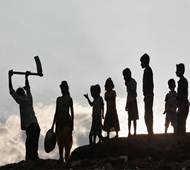
slavery copy copyAccording to the 2016 Global Slavery Index released by Australia-based human rights group Walk Free Foundation today, an estimated 45.8 million people, including women and children, are subject to some form of modern slavery in the world, compared to 35.8 million in 2014.

The report said India has the highest absolute numbers of people trapped in slavery with 18.35 million slaves among its 1.3 billion population while North Korea has the highest incidence (4.37 per cent of the population) and the weakest government response to deal with it.

In the last report in 2014, India had nearly 14.3 million people enslaved.
Incidences of slavery were found in all 167 countries in the index, with Asian countries occupy the top five for people trapped in slavery.

Behind India was China (3.39 million), Pakistan (2.13 million), Bangladesh (1.53 million) and Uzbekistan (1.23 million).

The index said that these five countries combined accounted for almost 58 per cent of the world's enslaved, or 26.6 million people.

The Index presents a ranking of 167 countries based on the proportion of the population that is estimated to be in modern slavery.

Modern slavery refers to situations of exploitation that a person cannot leave because of threats, violence, coercion, abuse of power or deception.

The research included over 42,000 interviews conducted in 53 languages across 25 countries, including 15 state-level surveys in India. These representative surveys covered 44 per cent of the global population.

The countries with the highest estimated prevalence of modern slavery by the proportion of their population are North Korea, Uzbekistan, Cambodia, Cambodia, India, and Qatar.

The countries with the lowest estimated prevalence of modern slavery by the proportion of their population are Luxembourg, Ireland, Norway, Denmark, Switzerland, Austria, Sweden and Belgium, the United States and Canada, and Australia and New Zealand.

The study also tracked the government actions and responses to the modern slavery and of the 161 assessed, 124 nations had criminalised human trafficking in line with the UN trafficking Protocol and 96 nations had developed national action plans to coordinate government response.

It noted that while India had more people enslaved than any other country, it had made significant progress in introducing measures to tackle the problem.

"It has criminalised trafficking, slavery, forced labour, child prostitution and forced marriage. The Indian government is currently tightening legislation against human trafficking, with tougher punishment for repeat offenders. It will offer victims protection and recovery support," it said.

It said that in addition to economic growth in India, ambitious programmes of legal and social reform are being undertaken right across the board, from regulation of labour relations to systems of social insurance for the most vulnerable.

Those governments taking the least action to combat modern slavery are North Korea, Iran, Eritrea, Equatorial Guinea, Hong Kong, Central African Republic, Papua New Guinea, Guinea, the Democratic Republic of the Congo and South Sudan.

The governments that have the strongest response to modern slavery are The Netherlands, the United States of America, the United Kingdom, Sweden, Australia, Portugal, Croatia, Spain, Belgium and Norway.

Seeking strong laws to abolish slavery, Andrew Forrest, Chairman and Founder of Walk Free Foundation, said eradicating slavery makes sense, morally, politically, logically and economically, and called on the governments of the world's leading economies to provide an example to others by enacting and implementing robust anti-slavery measures.

"We call on governments of the top 10 economies of the world to enact laws, at least as strong as the UK Modern Slavery Act 2015, with a budget and capability to ensure organisations are held to account for modern slavery in their supply chains, and to empower independent oversight."

Forrest said leaders of the world's major economies must bring the power of business to this issue, by requiring a focus on supply chain transparency.

"I believe in the critical role of leaders in government, business and civil society. Through our responsible use of power, strength of conviction, determination and collective will, we all can lead the world to end slavery," he said.

Forrest emphasised the key role that business needs to play in eradicating slavery.

"Businesses that don't actively look for forced labour within their supply chains are standing on a burning platform. Business leaders who refuse to look into the realities of their own supply chains are misguided and irresponsible," he said.

Comments

SK
 - 
Thursday, 2 Jun 2016

Since India is facing slavery, Naren has run away to Singapore to enjoy snake/ dog/cat/beef dishes......

Naren kotian
 - 
Tuesday, 31 May 2016

In that mostly 75% are from Muslim community as they enslave women as per their cult following .they have not changed since 6th century ...che papa ...ummah gang ge pitta netti geriruthe ..feku Anthe kumda ...for Muslims he might be feku ..but for nationalist Indians he is true hero who is transforming India .

Add new comment

  • Coastaldigest.com reserves the right to delete or block any comments.
  • Coastaldigset.com is not responsible for its readers’ comments.
  • Comments that are abusive, incendiary or irrelevant are strictly prohibited.
  • Please use a genuine email ID and provide your name to avoid reject.
News Network
May 27,2020

Bengaluru, May 27: Amid uncertainty caused by the Covid-19 pandemic, which has disrupted school education in Karnataka, the state government is seeking the help of the Union Ministry of Information and Broadcasting to televise classes, a state minister said on Tuesday.

"We request you to provide minimum three channels on the Doordarshan network exclusively for the Department of Public Instruction, Government of Karnataka," Primary and Secondary Education Minister Suresh Kumar said in a letter to Union I&B Minister Prakash Javadekar.

Suggesting co-branding the channels under DD and the state education department, he asked for the channels to be mandatorily transmitted by the cable and DTH operators under the Cable Act.

The state education department has already discussed with Prasar Bharti officials, who, according Kumar, have assured 3+3 hours of timeslots on the education channel Chandana on cost basis.

"We have also made all the necessary arrangements for content creation by the teachers," he said.

Meanwhile, the minister has revealed that television is the best medium for the students as a home learning mode in these challenging times.

"The department of public instruction reviewed various technological options and considered TV as one of the best means for home learning," Kumar said.

In a survey conducted by the education department, it was found out that 95 per cent households had television sets.

Kumar said the state operates government schools in nine languages, including Kannada, English and Urdu.

"To cater to all the students, and considering a long-term strategy to run schools by maintaining social distancing, we are in immediate need of minimum three exclusive channels to teach through TV," he said.

According to Kumar, the Karnataka government is facing hardships to meet the capital expenditure requirements, hence, it is seeking help from the I&B Ministry.

Comments

Add new comment

  • Coastaldigest.com reserves the right to delete or block any comments.
  • Coastaldigset.com is not responsible for its readers’ comments.
  • Comments that are abusive, incendiary or irrelevant are strictly prohibited.
  • Please use a genuine email ID and provide your name to avoid reject.
News Network
March 31,2020

Kasaragod, Mar 31: Two more Kasaragod natives lost their lives on Monday due to blockade of the interstate border by Karnataka police in the wake of outbreak of novel coronavirus.

They could not get emergency health care as the Karnataka police stopped the ambulance carrying them to a hospital in Mangaluru at the border.

Another critically-ill person, who was sent back by Manguluru hospital authorities on March 23 for being a Kasaragod native, also died on Monday.

This is the fifth such case in many days.

The deceased are Madhavan, 50, Ayesha, 55 and Aziz Haji, 61 respectively.

All three of them lived near the Karnataka border.

Madhavan, who hailed from Thummanattu in Manjeswaram, died enroute to Kanhangad hospital after being denied entry to cross over to Karnataka. He had an acute bronchial attack.

Udyavar native Ayesha, an asthma patient, was referred to the Mangaluru Hospital by the hospital authorities at Uppali. When the authorities stopped her at the border, she was taken to the Kanhangad hospital. However, she died before reaching the hospital.

Aziz Haji, from Nayabazar Cherugoli MA Cottage at Uppala, was allegedly refused entry into a Manguluru Hospital on March 23 on account of being a Kasaragod native. Haji was a dialysis patient at the hospital. “We were unable to contact his doctor at the time,” his relatives said. Haji, who was on the ventilator, lost his life Monday morning.

One more from Kerala dies as Karnataka police stop ambulance at border
Kunjathoor native Abdul Hameed and Bandwal native Fathima also lost their lives due to the closing of the interstate border.

The district authorities has appealed to the Government to intervene in the matter and influence Karnataka as to lift a ban in crossing over for ambulances carrying critical patients.

The people of Kasaragod are largely dependent on the medical facilities in Mangaluru for critical illness care.

The Kasaragod MP, Rajmohan Unnithan has said he would move the Supreme court against this.

Kerala Chief Minister Pinarayi Vijayan has already taken up the issue with the Centre.

Kerala HC takes up issue with Karnataka AAG

The Kerala High Court on Monday sought the views of the Advocate General of Karnataka on the issue of the government of the neighbouring state blocking its borders with Kerala.

Considering a Public Interest Litigation (PIL) filed by Kerala High Court Advocates Association, seeking a direction for opening the roads, a bench comprising Justices A K Jayasankaran Nambiar and Shaji P Chali requested the Advocate General of Karnataka to join the hearing at 11 am on Tuesday through video conferencing.

The Court orally observed that the blockades erecting embankments on the inter-state roads would affect the people's right to life.

The Karnataka government blocked the state highway with to prevent movement of vehicles carrying essential goods and people seeking emergency treatment at hospitals in the city of Mangalore bordering Kasaragod.

With 97 infected patients, Kasaragod has the largest number of COVID-19 cases in Kerala. 7,437 people are under observation in the district.

Comments

Add new comment

  • Coastaldigest.com reserves the right to delete or block any comments.
  • Coastaldigset.com is not responsible for its readers’ comments.
  • Comments that are abusive, incendiary or irrelevant are strictly prohibited.
  • Please use a genuine email ID and provide your name to avoid reject.
Abu Muhammad | coastaldigest.com
January 16,2020

Even as the Muslims of undivided Dakshina Kannada district broke out of the “spiral of silence” and made history by leading an unprecedented protest against CAA, NPR and NRC as well as the categorial mistreatment of non-saffronites at the hands of the police across the country, mainstream media turned a blind eye to the spectacle at the Shah Garden Maidan in Mangaluru’s Adyar where about two lakh patriots with tricolor in their hands converged to assert themselves on January 15th, 2020, a date which will be remembered by the people of coastal Karnataka forever.

The largest gathering in the history of Mangaluru was absolutely peaceful, law-abiding and respectful. While the slogans of ‘Azaadi’ were reverberating in the atmosphere, the protesters were seen making way for vehicles and passersby, taking care of women and helping elderly citizens on the highway adjacent to the ground. Though the organisers and most of the participants were Muslims, they collectively identified themselves as “We, the people of India”.

The district administration and the police department hadn’t imagined or even dreamt of such a mammoth gathering after blocking the highway and banning public transport from 9 am to 9 pm. Many opine that this action was taken only to discourage the concerned from participating in the protest and to create fear in the hearts of the people who are yet to process the unjustifiable deaths of two innocent citizens in an unwarranted police firing a few weeks ago.

What has since surprised the protesters most is the mainstream media’s blatant attempt to downplay the significance of this largest ever gathering. Shockingly, it could not make it to the front pages of any of the state-level Kannada daily newspapers except city-based Vaartha Bharathi. In the absence of The Hindu, which had announced a holiday on account of Makar Sankranti, most of the English newspapers too pitilessly buried the historic event in their inner pagers. National TV channels too were evidently reluctant to cover the event until NDTV started telecasting the news of the protest.

This uneasy relationship between the media and minorities in coastal Karnataka has long existed, but the non-coverage of the huge protest of Jan 15 marks a quantum leap beyond the media’s traditional pro-Sangh Parivar stance and biases –– which in the past had often demonised non-saffronites –– to now completely ignore and suppress the people’s voice. This media bias has naturally evoked a sharp response from netizens, who took to social media to issue clarion calls to boycott the mainstream media forever.

Cleanliness Drive

Most major protest meets and rallies –– both religious and political –– leave behind tonnes of garbage, especially water bottles, placards and buntings. However, the organisers of the Jan 15 protest meet led by example by launching a cleanliness drive in the area soon after the protesters left the venue peacefully. The drive continued on Jan 16 too. (Ironically, amidst this ongoing cleanliness drive, a local news portal captured photos of a few plastic bottles scattered along the road at Adyar and published a report accusing the event organisers and participants of polluting the area!)

Comments

Add new comment

  • Coastaldigest.com reserves the right to delete or block any comments.
  • Coastaldigset.com is not responsible for its readers’ comments.
  • Comments that are abusive, incendiary or irrelevant are strictly prohibited.
  • Please use a genuine email ID and provide your name to avoid reject.