


Saudi based Islamic bank enters India, first branch in Gujarat

[email protected] (CD Network)
June 1, 2016

Ahmedabad, Jun 1: The Saudi Arabia-based Islamic Development Bank (IDB) is set to start its India operations from Gujarat. The international financial institution which has its headquarters in Jeddah has chosen the home state of Prime Minister Narendra Modi to set up its first branch in India. The state will also get 30 medical vans as part of IDB's social sector initiatives.
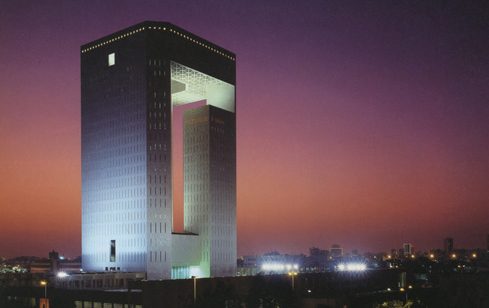
jeddah

Islamic Development Bank headquarters located in Saudi Arabia's Jeddah.

IDB's main objective is to foster the economic development and social progress of member countries as well as the Muslim community in accordance with principles of Shariah (Islamic law). The bank has 56 Islamic countries as its members.

The developments follow an agreement between India's state-owned Exim Bank and the Islamic Corporation for the Development of the Private Sector (ICD), a private-sector arm of the IDB group, as part of deals signed during Modi's trip to Saudi Arabia in April.

The IDB, a multilateral lender with an authorised capital of $100 billion, counts 56 Muslim nations as its members. Most of these countries belong to the Organisation of Islamic Cooperation.

ISLAMIC BANKING: SOME FACTS 

  • It is a finance system based on the principle of not charging interest, which is prohibited under Islam. Now, it goes by a more formal moniker – participatory banking.
  • Instead of charging interest, the lender shares a part of the profit – or loss – with the borrower
  • It is open to non-Muslims as well
  • By 2020, the global Islamic banking industry profit pool is expected to reach $30.3 billion.

Its India operations will be led by Zafar Sareshwala, a prominent Muslim businessman from Gujarat whom the Modi government appointed chancellor of the Maulana Azad National Urdu University soon after assuming office.

The agreement in Jeddah was signed by Exim Bank regional head Tarun Sharma and ICD CEO Khaled Al Aboodi in the presence of Ahmad Javed, India's ambassador to Saudi Arabia.

To be based in Ahmedabad, the bank will offer interest-free capital to business startups, including small and medium enterprises within India, marking the entry of the Islamic banking – also known as participatory banking – into the country.

According to an Exim Bank statement, the IDB's bigger role will be in the $100 million (about Rs 670 crore) credit line it has pledged “with the aim of facilitating the export of goods and services from India to ICD's member countries”.

“The ICD will be open for business to all Indians, regardless of religious background. In Malaysia, the KFC chain runs on ICD finance although it is owned by a Chinese firm. Some people have this unnecessary issue with Islamic banking, which is actually known as participatory banking across the globe now,” said Sareshwala, who has been named as a director for the bank's India operations.

The IDB has also promised $55m (about Rs 380 crore) for a state-of-the-art rural mobile medical network – the first leg of which will be launched in Gujarat.

The IDB, which complies with global Islamic finance norms, does not charge interest on loans because the religion prohibits it. Instead, it charges a part of the profit and also shares any losses with the borrower.

According to the EY's World Islamic Banking Competitiveness Report 2016, Global Islamic banking assets would have reached US$1 trillion by 2015-end.

Comments

Ahmed
 - 
Thursday, 2 Jun 2016

Poorna Prakash, Mangalore
We have since long following banks
Catholic Syrian Bank
Nakodar Hindu Bank
The Hindu Co-Operative Bank Ltd.

But, you have a problem as soon as we get a Islamic bank.
This is nothing else but, intolerance.

Don't forget another bank: The Hindu Vote Bank.

Rikaz
 - 
Wednesday, 1 Jun 2016

Why feku's state is getting all of those facilities? why don't they bring it to Karnataka....

suresh
 - 
Wednesday, 1 Jun 2016

All the investment only to gujarat? Why? This investment will be mis used by Gujju's as it says if the business in loss it will be shared by both. gujju's are well known how to make them fool. This will create more mallya;s in Gujarat.

moshu
 - 
Wednesday, 1 Jun 2016

Hope one day rss will understand islam well and will follow the rule of Allah

moshu
 - 
Wednesday, 1 Jun 2016

Siddarth mumbai openly backing his hawala racket crooks operating by his modi govt

Naren kotian
 - 
Wednesday, 1 Jun 2016

It is done to curb India's black money outflow and inflow by hawala means ..since 90% of hawala transactions are mostly encouraged by just particular section ...anyways since they have given 100 million credit line ..so we have ample opportunity to export pig related products to 56 Islamic countries ..hahaha ...nia monitoring is must as terrorists are most likely to use this bank ...

muhammed rafique
 - 
Wednesday, 1 Jun 2016

Appreciate Modi's wisdom in realising the importance of Islamic banking

Rizwan
 - 
Wednesday, 1 Jun 2016

Good initiative by P.M , i appreciate his move. Both india and KSA will be benifited by this.

Asif
 - 
Wednesday, 1 Jun 2016

Al Hamdlillah... itrs great news... waiting from a long time... hope it soon opens its branches all over India.

Add new comment

  • Coastaldigest.com reserves the right to delete or block any comments.
  • Coastaldigset.com is not responsible for its readers’ comments.
  • Comments that are abusive, incendiary or irrelevant are strictly prohibited.
  • Please use a genuine email ID and provide your name to avoid reject.
coastaldigest.com news network
July 9,2020

Dubai, Jul 9: Air India Express has opened ticket bookings for flights from India to the UAE from July 12 to 26. The carrier posted the announcement on its social media pages.

“INDIA to UAE - Flights are open for sale! Bookings could be made through our website (http://airindiaexpress.in), call centre or authorised travel agents. Visit http://blog.airindiaexpress.in for more details,” the budget airline tweeted.

A clause mentioned in the flyer attached to the post added that only UAE residents with permits to return from India can book flights.

Thousands of Indian expats have been waiting to book flights back to the UAE after being stuck home for about four months due to the COVID-19 travel restrictions.

Vande Bharat Mission flights

Under the fourth phase of Vande Bharat Mission, as many as 104 flights will be operating between UAE and India. 

The Air India announced this on Twitter under a post “#FlyAI : Important Information for ICA approved UAE residents who wish to travel to UAE on Vande Bharat Mission flights.”

A flyer attached to the post addressed passengers who wish to travel to UAE on flights being operated under Vande Bharat Mission by Air India and Air India Express in pursuance of agreement between Civil Aviation authorities of India and the UAE.

“AI and AIE operating evacuation flights to Indian citizens from the UAE to India will carry ICA approved UAE residents (returning to the UAE from India) on the outward journey from India to the UAE.”

“On the India-UAE journey, all these flights will carry only those passengers who are destined for the UAE.”

“This arrangement will be operational for a period of 15 days from July 12 to 26,” the airline added.

While most of the Vande Bharat flights are operated by AIE, a few flights from Sharjah are operated by Air India.

Comments

Prasadramachandran
 - 
Saturday, 11 Jul 2020

My contact number is 7306562447

Add new comment

  • Coastaldigest.com reserves the right to delete or block any comments.
  • Coastaldigset.com is not responsible for its readers’ comments.
  • Comments that are abusive, incendiary or irrelevant are strictly prohibited.
  • Please use a genuine email ID and provide your name to avoid reject.
News Network
March 22,2020

Mangaluru, Mar 22: A 22-year-old man from Bhatkal who had returned from Dubai on March 19 has tested positive for coronavirus.

Sindhu B Rupesh, Deputy Commissioner of Dakshina Kannada confrimed this today.

The youth, after landing at Mangaluru International Airport had got admitted to Govt Wenlock Hospital.

The total number of coronavirus positive patients in India rose to 342 on Sunday, as per the Indian Council of Medical Research (ICMR).

A total of 16,999 samples from 16,109 individuals have been tested for COVID-19 as of 10:00 am on March 22, as per ICMR data.

India reported two deaths today from the highly contagious virus - one each in Maharashtra and Bihar - taking the tally to six, as per state authorities.

Comments

Add new comment

  • Coastaldigest.com reserves the right to delete or block any comments.
  • Coastaldigset.com is not responsible for its readers’ comments.
  • Comments that are abusive, incendiary or irrelevant are strictly prohibited.
  • Please use a genuine email ID and provide your name to avoid reject.
Ram Puniyani
February 4,2020

As democracy is seeping in slowly all over the world, there is an organization which is monitoring the degree of democracy in the individual countries, The Economist Intelligence Unit. As such in each country there are diverse factors which on one hand work to deepen it, while others weaken it. Overall there is a march from theoretical democracy to substantive one. The substantive democracy will herald not just the formal equality, freedom and community feeling in the country but will be founded on the substantive quality of these values. In India while the introduction of modern education, transport, communication laid the backdrop of beginning of the process, the direction towards deepening of the process begins with Mahatma Gandhi when he led the non-cooperation movement in 1920, in which average people participated. The movement of freedom for India went on to become the ‘greatest ever mass movement’ in the World.

The approval and standards for democracy were enshrined in Indian Constitution, which begins ‘We the people of India’, and was adopted on 26th January 1950. With this Constitution and the policies adopted by Nehru the process of democratization started seeping further, the dreaded Emergency in 1975, which was lifted later restored democratic freedoms in some degree. This process of democratisation is facing an opposition since the decade of 1990s after the launch of Ram Temple agitation, and has seen the further erosion with BJP led Government coming to power in 2014. The state has been proactively attacking civil liberties, pluralism and participative political culture with democracy becoming flawed in a serious way. And this is what got reflected in the slipping of India by ten places, to 51st, in 2019. On the index of democracy India slipped down from the score of 7.23 to 6.90. The impact of sectarian BJP politics is writ on the state of the nation, country.

Ironically this lowering of score has come at a time when the popular protests, the deepening of democracy has been given a boost and is picking up with the Shaheen Bagh protests. The protest which began in Shaheen Bagh, Delhi in the backdrop of this Government getting the Citizenship amendment Bill getting converted into an act and mercilessly attacking the students of Jamia Milia Islamia, Aligarh Muslim University along with high handed approach in Jamia Nagar and neighbouring areas.  From 15th December 2019, the laudable protest is on.

It is interesting to note that the lead in this protest has been taken by the Muslim women, from the Burqa-Hijab clad to ‘not looking Muslim’ women and was joined by students and youth from all the communities, and later by the people from all the communities. Interestingly this time around this Muslim women initiated protest has contrast from all the protests which earlier had begun by Muslims. The protests opposing Shah Bano Judgment, the protests opposing entry of women in Haji Ali, the protests opposing the Government move to abolish triple Talaq. So far the maulanas from top were initiating the protests, with beard and skull cap dominating the marches and protests. The protests were by and large for protecting Sharia, Islam and were restricted to Muslim community participating.

This time around while Narendra Modi pronounced that ‘protesters can be identified by their clothes’, those who can be identified by their external appearance are greatly outnumbered by all those identified or not identified by their appearance.

The protests are not to save Islam or any other religion but to protect Indian Constitution. The slogans are structured around ‘Defence of democracy and Indian Constitution’. The theme slogans are not Allahu Akbar’ or Nara-E-Tadbeer’ but around preamble of Indian Constitution. The lead songs have come to be Faiz Ahmad Faiz’s ‘Hum Dekhenge’, a protest against Zia Ul Haq’s attempts to crush democracy in the name of religion. Another leading protest song is from Varun Grover, ‘Tanashah Aayenge…Hum Kagaz nahin Dikhayenge’, a call to civil disobedience against the CAA-NRC exercise and characterising the dictatorial nature of the current ruling regime.

While BJP was telling us that primary problem of Muslim women is Triple talaq, the Muslim women led movements has articulated that primary problem is the very threat to Muslim community. All other communities, cutting across religious lines, those below poverty line, those landless and shelter less people also see that if the citizenship of Muslims can be threatened because of lack of some papers, they will be not far behind in the victimization process being unleashed by this Government.

While CAA-NRC has acted as the precipitating factor, the policies of Modi regime, starting from failure to fulfil the tall promises of bringing back black money, the cruel impact of demonetisation, the rising process of commodities, the rising unemployment, the divisive policies of the ruling dispensation are the base on which these protest movements are standing. The spread of the protest movement, spontaneous but having similar message is remarkable. Shaheen Bagh is no more just a physical space; it’s a symbol of resistance against the divisive policies, against the policies which are increasing the sufferings of poor workers, the farmers and the average sections of society.

What is clear is that as identity issues, emotive issues like Ram Temple, Cow Beef, Love Jihad and Ghar Wapasi aimed to divide the society, Shaheen Bagh is uniting the society like never before. The democratisation process which faced erosion is getting a boost through people coming together around the Preamble of Indian Constitution, singing of Jan Gan Man, waving of tricolour and upholding the national icons like Gandhi, Bhagat Singh, Ambedkar and Maulana Azad. One can feel the sentiments which built India; one can see the courage of people to protect what India’s freedom movement and Indian Constitution gave them.

Surely the communal forces are spreading canards and falsehood against the protests. As such these protests which is a solid foundation of our democracy. The spontaneity of the movement is a strength which needs to be channelized to uphold Indian Constitution and democratic ethos of our beloved country.

Comments

Add new comment

  • Coastaldigest.com reserves the right to delete or block any comments.
  • Coastaldigset.com is not responsible for its readers’ comments.
  • Comments that are abusive, incendiary or irrelevant are strictly prohibited.
  • Please use a genuine email ID and provide your name to avoid reject.