


Saudi based Islamic bank enters India, first branch in Gujarat

[email protected] (CD Network)
June 1, 2016

Ahmedabad, Jun 1: The Saudi Arabia-based Islamic Development Bank (IDB) is set to start its India operations from Gujarat. The international financial institution which has its headquarters in Jeddah has chosen the home state of Prime Minister Narendra Modi to set up its first branch in India. The state will also get 30 medical vans as part of IDB's social sector initiatives.
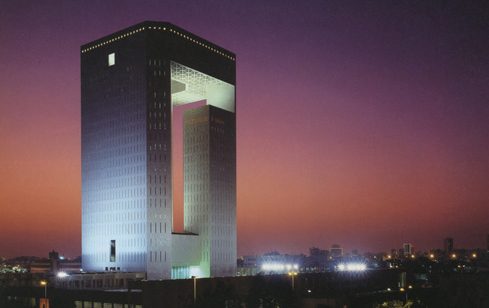
jeddah

Islamic Development Bank headquarters located in Saudi Arabia's Jeddah.

IDB's main objective is to foster the economic development and social progress of member countries as well as the Muslim community in accordance with principles of Shariah (Islamic law). The bank has 56 Islamic countries as its members.

The developments follow an agreement between India's state-owned Exim Bank and the Islamic Corporation for the Development of the Private Sector (ICD), a private-sector arm of the IDB group, as part of deals signed during Modi's trip to Saudi Arabia in April.

The IDB, a multilateral lender with an authorised capital of $100 billion, counts 56 Muslim nations as its members. Most of these countries belong to the Organisation of Islamic Cooperation.

ISLAMIC BANKING: SOME FACTS 

  • It is a finance system based on the principle of not charging interest, which is prohibited under Islam. Now, it goes by a more formal moniker – participatory banking.
  • Instead of charging interest, the lender shares a part of the profit – or loss – with the borrower
  • It is open to non-Muslims as well
  • By 2020, the global Islamic banking industry profit pool is expected to reach $30.3 billion.

Its India operations will be led by Zafar Sareshwala, a prominent Muslim businessman from Gujarat whom the Modi government appointed chancellor of the Maulana Azad National Urdu University soon after assuming office.

The agreement in Jeddah was signed by Exim Bank regional head Tarun Sharma and ICD CEO Khaled Al Aboodi in the presence of Ahmad Javed, India's ambassador to Saudi Arabia.

To be based in Ahmedabad, the bank will offer interest-free capital to business startups, including small and medium enterprises within India, marking the entry of the Islamic banking – also known as participatory banking – into the country.

According to an Exim Bank statement, the IDB's bigger role will be in the $100 million (about Rs 670 crore) credit line it has pledged “with the aim of facilitating the export of goods and services from India to ICD's member countries”.

“The ICD will be open for business to all Indians, regardless of religious background. In Malaysia, the KFC chain runs on ICD finance although it is owned by a Chinese firm. Some people have this unnecessary issue with Islamic banking, which is actually known as participatory banking across the globe now,” said Sareshwala, who has been named as a director for the bank's India operations.

The IDB has also promised $55m (about Rs 380 crore) for a state-of-the-art rural mobile medical network – the first leg of which will be launched in Gujarat.

The IDB, which complies with global Islamic finance norms, does not charge interest on loans because the religion prohibits it. Instead, it charges a part of the profit and also shares any losses with the borrower.

According to the EY's World Islamic Banking Competitiveness Report 2016, Global Islamic banking assets would have reached US$1 trillion by 2015-end.

Comments

Ahmed
 - 
Thursday, 2 Jun 2016

Poorna Prakash, Mangalore
We have since long following banks
Catholic Syrian Bank
Nakodar Hindu Bank
The Hindu Co-Operative Bank Ltd.

But, you have a problem as soon as we get a Islamic bank.
This is nothing else but, intolerance.

Don't forget another bank: The Hindu Vote Bank.

Rikaz
 - 
Wednesday, 1 Jun 2016

Why feku's state is getting all of those facilities? why don't they bring it to Karnataka....

suresh
 - 
Wednesday, 1 Jun 2016

All the investment only to gujarat? Why? This investment will be mis used by Gujju's as it says if the business in loss it will be shared by both. gujju's are well known how to make them fool. This will create more mallya;s in Gujarat.

moshu
 - 
Wednesday, 1 Jun 2016

Hope one day rss will understand islam well and will follow the rule of Allah

moshu
 - 
Wednesday, 1 Jun 2016

Siddarth mumbai openly backing his hawala racket crooks operating by his modi govt

Naren kotian
 - 
Wednesday, 1 Jun 2016

It is done to curb India's black money outflow and inflow by hawala means ..since 90% of hawala transactions are mostly encouraged by just particular section ...anyways since they have given 100 million credit line ..so we have ample opportunity to export pig related products to 56 Islamic countries ..hahaha ...nia monitoring is must as terrorists are most likely to use this bank ...

muhammed rafique
 - 
Wednesday, 1 Jun 2016

Appreciate Modi's wisdom in realising the importance of Islamic banking

Rizwan
 - 
Wednesday, 1 Jun 2016

Good initiative by P.M , i appreciate his move. Both india and KSA will be benifited by this.

Asif
 - 
Wednesday, 1 Jun 2016

Al Hamdlillah... itrs great news... waiting from a long time... hope it soon opens its branches all over India.

Add new comment

  • Coastaldigest.com reserves the right to delete or block any comments.
  • Coastaldigset.com is not responsible for its readers’ comments.
  • Comments that are abusive, incendiary or irrelevant are strictly prohibited.
  • Please use a genuine email ID and provide your name to avoid reject.
coastaldigest.com news network
May 22,2020

It has been 33 years since the night of 22 May, 1987 when nearly 50 Muslim men from Hashimpura, a settlement in Meerut were rounded up and packed into the rear of a truck of the Provincial Armed Constabulary (PAC), an armed police of Uttar Pradesh. It was the blessed month of Ramadan and all the Muslims were fasting.

That night 42 of those on board the truck were killed in two massacres in neighbouring Ghaziabad district. One along the Upper Ganga canal near Muradnagar, the other along the Hindon canal in Makanpur, on the border with Delhi.

The cops had returned home after dumping the dead bodies into the canal. A few days later, the dead bodies were found floating in the canal and a case of murder was registered. 

Vir Bahadur Singh was the chief minister of Uttar Pradesh and Rajiv Gandhi was the prime minister of India when this incident took place. 

Not much has changed for the survivors and the relatives of the victims even today. The wounds are still fresh. Hashimpura remains devoid of basic municipal amenities, the erring silence on the narrow lanes of the locality amid the activities of a daily life speaks of the horror of the fateful day in 1987.

The massacre was the result of one among the many outcomes of the decision taken by the Rajiv Gandhi government to open the locks of Babri Masjid. After a month of rioting, the situation was tense in various parts of Meerut, and a lot spilled over in the nearby areas.

Timeline

May 22, 1987

Nearly 50 Muslims picked up by the PAC personnel from Hashimpura village in Meerut, Uttar Pradesh.
Victims later shot and bodies thrown into a canal. 42 persons declared dead.

1988

UP government orders CB-CID probe in the case.

February 1994

CB-CID submits inquiry report indicting over 60 PAC and police personnel of all ranks.

May 20, 1996

Charge sheet filed against 19 accused before Chief Judicial Magistrate, Ghaziabad by CB-CID of Uttar Pradesh police. 161 people listed as witnesses.

September 2002

Case transferred to Delhi by the Supreme Court on a petition by the families of victims and survivors.

July 2006

Delhi court frames charges of murder, attempt to murder, tampering with evidence and conspiracy under the IPC against 17 accused.

March 8, 2013

Trial court dismisses Subramanian Swamy's plea seeking probe into the alleged role of P Chidambaram, then Minister of State for Home, in the matter.

January 22, 2015

Trial court reserves judgement.

March 21, 2015

Court acquits 16 surviving accused giving them benefit of doubt regarding their identity.

May 18, 2015

Trial court decision challenged in the Delhi HC by the victims' families and eyewitnesses who survived the incident.

May 29, 2015

HC issues notice to the 16 PAC personnel on Uttar Pradesh government's appeal against the trial court verdict.

December 2015

National Human Rights Commission is impleaded in the matter. NHRC also seeks further probe into the massacre.

February 17, 2016

HC tags Swamy's appeal with the other petitions in the matter.

September 6, 2018

Delhi HC reserves verdict in the case.

October 31, 2018

Delhi HC convicts 16 former PAC personnel for life after finding them guilty of the murder of 42 people.

Comments

Add new comment

  • Coastaldigest.com reserves the right to delete or block any comments.
  • Coastaldigset.com is not responsible for its readers’ comments.
  • Comments that are abusive, incendiary or irrelevant are strictly prohibited.
  • Please use a genuine email ID and provide your name to avoid reject.
coastaldigest.com news network
July 21,2020

New Delhi, Jul 21: A 42-year-old contractual doctor, who was working with Delhi government's National Health Mission, passed away yesterday due to covid-19.

Dr Javed Ali had been on the frontline in the fight against the highly contagious illness since March. He tested positive for coronavirus on June 24 and was hospitalised for treatment over the next three weeks.

For the last 10 days, he was on a ventilator. Yesterday morning, Dr Ali breathed his last at the AIIMS trauma centre. He is survived by his wife and two children - a six-year-old son and a 12-year-old daughter.

"I am proud of my husband. He kept working till the end and he is a martyr. He did not take even one day off since March. He worked even on Eid," Dr Heena Kausar, his wife, told media persons.

The cost for the initial treatment at the private hospital was also borne by the family. "No treatment cost was covered when he was at a private hospital initially. We spent around Rs 6 lakh from our own pockets," she said.

Comments

Add new comment

  • Coastaldigest.com reserves the right to delete or block any comments.
  • Coastaldigset.com is not responsible for its readers’ comments.
  • Comments that are abusive, incendiary or irrelevant are strictly prohibited.
  • Please use a genuine email ID and provide your name to avoid reject.
News Network
January 19,2020

Bengaluru, Jan 19: Australia has conferred its highest civilian honour, the Order of Australia honour, on Biocon founder Kiran Mazumdar-Shaw for her contribution towards advancing the country's relationship with India.

Australia's High Commissioner to India Harinder Sidhu invested Mazumdar-Shaw as an Honorary Member within the Order of Australia (AM) in the General Division at a ceremony in Bengaluru on Friday, the Australian High Commission said in a statement.

An alumnus of Federation University Australia, Mazumdar-Shaw is the founder of Biocon, one of India's largest bio-pharmaceutical companies.

She contributes immensely to promoting women in STEM through the joint research programmes developed between Biocon and Deakin University, Australia, as part of her deep and long-standing commitment to gender equality, the statement said.

Mazumdar-Shaw - an Australian Global Alumni Ambassador - is also recognised for her sustained and significant contribution to industry academia collaboration between Australia and India, it said.

The ceremony was attended by representatives from Indian and Australian business, the diplomatic corps, and family, friends and peers of Mazumdar-Shaw, the statement said.

Speaking at the event, Sidhu said, "Dr Mazumdar-Shaw is a tireless champion of the commercial, educational, and people-to-people links between our two countries, and this award recognises her commitment to progressing the Australia-India partnership."

Honorary appointments in the Order of Australia are made to foreign nationals who have made an outstanding contribution to Australia or humanity at large.

Mazumdar-Shaw is the fourth Indian citizen to be awarded Australia's highest civilian honour.

This follows the conferment of superstar batsman Sachin Tendulkar in 2012, Former Attorney General of India Soli Jehangir Sorabjee in 2006, and Mother Teresa of Kolkata (Agnes Gonxha Bojaxhiu) in 1982.

Comments

Add new comment

  • Coastaldigest.com reserves the right to delete or block any comments.
  • Coastaldigset.com is not responsible for its readers’ comments.
  • Comments that are abusive, incendiary or irrelevant are strictly prohibited.
  • Please use a genuine email ID and provide your name to avoid reject.