India tops global slavery index with 18.35 mn people enslaved

May 31, 2016

Melbourne, May 31: India has the dubious distinction of having the highest number of people in the world trapped in modern slavery with 18.35 million victims of forced labour, ranging from prostitution and begging, according to a new report, which estimated that nearly 46 million people are enslaved globally.
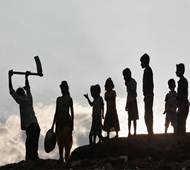
slavery copy copyAccording to the 2016 Global Slavery Index released by Australia-based human rights group Walk Free Foundation today, an estimated 45.8 million people, including women and children, are subject to some form of modern slavery in the world, compared to 35.8 million in 2014.

The report said India has the highest absolute numbers of people trapped in slavery with 18.35 million slaves among its 1.3 billion population while North Korea has the highest incidence (4.37 per cent of the population) and the weakest government response to deal with it.

In the last report in 2014, India had nearly 14.3 million people enslaved.
Incidences of slavery were found in all 167 countries in the index, with Asian countries occupy the top five for people trapped in slavery.

Behind India was China (3.39 million), Pakistan (2.13 million), Bangladesh (1.53 million) and Uzbekistan (1.23 million).

The index said that these five countries combined accounted for almost 58 per cent of the world's enslaved, or 26.6 million people.

The Index presents a ranking of 167 countries based on the proportion of the population that is estimated to be in modern slavery.

Modern slavery refers to situations of exploitation that a person cannot leave because of threats, violence, coercion, abuse of power or deception.

The research included over 42,000 interviews conducted in 53 languages across 25 countries, including 15 state-level surveys in India. These representative surveys covered 44 per cent of the global population.

The countries with the highest estimated prevalence of modern slavery by the proportion of their population are North Korea, Uzbekistan, Cambodia, Cambodia, India, and Qatar.

The countries with the lowest estimated prevalence of modern slavery by the proportion of their population are Luxembourg, Ireland, Norway, Denmark, Switzerland, Austria, Sweden and Belgium, the United States and Canada, and Australia and New Zealand.

The study also tracked the government actions and responses to the modern slavery and of the 161 assessed, 124 nations had criminalised human trafficking in line with the UN trafficking Protocol and 96 nations had developed national action plans to coordinate government response.

It noted that while India had more people enslaved than any other country, it had made significant progress in introducing measures to tackle the problem.

"It has criminalised trafficking, slavery, forced labour, child prostitution and forced marriage. The Indian government is currently tightening legislation against human trafficking, with tougher punishment for repeat offenders. It will offer victims protection and recovery support," it said.

It said that in addition to economic growth in India, ambitious programmes of legal and social reform are being undertaken right across the board, from regulation of labour relations to systems of social insurance for the most vulnerable.

Those governments taking the least action to combat modern slavery are North Korea, Iran, Eritrea, Equatorial Guinea, Hong Kong, Central African Republic, Papua New Guinea, Guinea, the Democratic Republic of the Congo and South Sudan.

The governments that have the strongest response to modern slavery are The Netherlands, the United States of America, the United Kingdom, Sweden, Australia, Portugal, Croatia, Spain, Belgium and Norway.

Seeking strong laws to abolish slavery, Andrew Forrest, Chairman and Founder of Walk Free Foundation, said eradicating slavery makes sense, morally, politically, logically and economically, and called on the governments of the world's leading economies to provide an example to others by enacting and implementing robust anti-slavery measures.

"We call on governments of the top 10 economies of the world to enact laws, at least as strong as the UK Modern Slavery Act 2015, with a budget and capability to ensure organisations are held to account for modern slavery in their supply chains, and to empower independent oversight."

Forrest said leaders of the world's major economies must bring the power of business to this issue, by requiring a focus on supply chain transparency.

"I believe in the critical role of leaders in government, business and civil society. Through our responsible use of power, strength of conviction, determination and collective will, we all can lead the world to end slavery," he said.

Forrest emphasised the key role that business needs to play in eradicating slavery.

"Businesses that don't actively look for forced labour within their supply chains are standing on a burning platform. Business leaders who refuse to look into the realities of their own supply chains are misguided and irresponsible," he said.

Comments

SK
 - 
Thursday, 2 Jun 2016

Since India is facing slavery, Naren has run away to Singapore to enjoy snake/ dog/cat/beef dishes......

Naren kotian
 - 
Tuesday, 31 May 2016

In that mostly 75% are from Muslim community as they enslave women as per their cult following .they have not changed since 6th century ...che papa ...ummah gang ge pitta netti geriruthe ..feku Anthe kumda ...for Muslims he might be feku ..but for nationalist Indians he is true hero who is transforming India .

Add new comment

  • Coastaldigest.com reserves the right to delete or block any comments.
  • Coastaldigset.com is not responsible for its readers’ comments.
  • Comments that are abusive, incendiary or irrelevant are strictly prohibited.
  • Please use a genuine email ID and provide your name to avoid reject.
News Network
January 12,2020

Bengaluru, Jan 12: Protesters plan to intensify their anti-Citizenship (Amendment) Act movement from sit-down satyagrahas and rallies to street and door-to-door campaigns in different parts of the city.

The street campaigns began on January 1 with 20-30 volunteers of Hum Bharat Ke Log, reaching out to people in Koramangala and Whitefield and explaining the CAA, National Population Register (NPR), National Register of Citizens (NRC) and related issues. They have organised four campaigns.

According to Zia Nomani, member of Hum Bharat Ke Log, the campaign will intensify soon. “Over 200-400 volunteers will organise nukkad sabhas and other activities around JP Nagar and Banashankari,” Nomani said.

She added that though protests began as a medium for people to vent their concerns, more needs to be done.

“We have realised that many people have begun working on their personal documents and want to help them understand what CAA is all about,” Nomani said.

Volunteers will talk to people at street junctions, discuss issues and run signature campaigns. They say: “Our movement is focussed on reaching out to people. Pro-CAA workers too started a door-to-door campaign last week.”

Avani Chokshi, an advocate who participated in a campaign, said though people had a cursory idea about these issues, they didn’t know the details. “It through such campaigns that we can reach more people. It’s important to talk to people who haven’t made up their mind about the issues or are even pro-CAA,” said Avani, adding, “It hard to combat hatred in a short span of time. The movement needs to be sustained.”

Activist Geeta Menon, who has been at the forefront of the street campaign, says they were heckled at some places.

Comments

Add new comment

  • Coastaldigest.com reserves the right to delete or block any comments.
  • Coastaldigset.com is not responsible for its readers’ comments.
  • Comments that are abusive, incendiary or irrelevant are strictly prohibited.
  • Please use a genuine email ID and provide your name to avoid reject.
News Network
July 29,2020

Bengaluru, Jul 29: The Karnataka High Court’s division bench of Chief Justice Abhay Oka and Justice H P Sandesh today rejected an application that wanted Amulya Leona’s case to be transferred from Karnataka Police to the National Investigation Agency (NIA).

The bench, while observing that extraordinary jurisdiction can’t be exercised for transferring the case to the NIA, asked “What is so special that investigation should be transferred to NIA?”

The court, in its previous hearing, had questioned the maintainability of the petition seeking transfer of the sedition case against Leona to the NIA.

According to the petitioner, advocate Pavana Chandra Shetty, the case is a serious matter against national integration and unity and has not been investigated properly by the police. The state police also failed to file the chargesheet within 90 days, he said, and also asked for cancellation of her bail.

The bench asked the petitioner as to how a bail, already granted to a person, can be cancelled. “Is it not the indefeasible right of the accused to be released on bail if chargesheet is not filed within stipulated time? How can you make a prayer for cancellation of bail?”  the Court asked.

The counsel for the petitioner also stated that in cases of a cognizable offence, when the chargesheet is purposely not filed within the stipulated time, the matter will have to transferred to the appropriate authority.

The court responded to his contention by asking him how could the court override law and cancel the bail. “Where is the question of cancellation of bail? Can we override the law and say that bail should be cancelled?” said the bench.

Advocate Vishal Raghu had filed the petition for transfer of Leona’s case, who was accused of raising pro-Pakistan slogans at an anti-CAA rally on February 20 at Freedom Park. The advocate had blamed the probe team for not filing a chargesheet on time and has asked the state government to approach the higher court against bail granted to Leona.

Bengaluru student Amulya Leona was charged with sedition for her actions in the presence of All India Majlis-e-Ittehad-ul-Muslimeen chief Asaduddin Owaisi. She was arrested by the Bengaluru police for allegedly shouting ‘Pakistan Zindabad’ slogans at an anti- CAA Protest in Bengaluru in February this year. On June 11, she was granted conditional bail by the Bengaluru civil court.

Her bail plea was earlier rejected by a Bengaluru court, after she had spent a three-month period in jail, stating that she may abscond if she is released. The sessions judge Vidhyadhar Shirahatti had also stated that if the petitioner is granted bail, she may abscond and may involve in similar offence which affects peace at large and hence her petition is liable to be rejected. The court had also noted that Amulya Leona is an influential person who may threaten and influence the witness and hamper the case in case of the prosecution and will abscond if released on bail.

Comments

Add new comment

  • Coastaldigest.com reserves the right to delete or block any comments.
  • Coastaldigset.com is not responsible for its readers’ comments.
  • Comments that are abusive, incendiary or irrelevant are strictly prohibited.
  • Please use a genuine email ID and provide your name to avoid reject.
News Network
February 16,2020

Bengaluru, Feb 16: Radhakrishnan V Nair embarked on a journey of exploring complex subjects and opening up the cocoon of existence that puts people in a zone of comfort. One sole mission of the book is to encourage the readers to break out of that comfort zone.

The architect by profession has a novel to his credit, 'The Cave of Freedom' that had earned him critical acclaim from Jnanpith Awardee UR Ananthamurthy. On February 13, a discussion and the reading of his book had the audience riveted to their seats.

The launch of the book on February 13 at Bangalore International Centre was presided over by Bhaskar Rao, Commissioner of Police, Bengaluru, along with Vasudev Murthy, Technology Management Consultant, leadership trainer and author and Ramessh RK, an industrial designer and choir singer who read out passages from the book.

'Radhakrishnan is trying to inspire you to discover the pleasure of breaking the glass barrier along with the protagonist Dr Prateek. The story 'burst out'", said Radhakrishnan when it could not be contained any longer.

The glass ceiling saw a lot of interest from the audience present. The book includes Dr Prateek who is obsessed with saving lives in the Emergency Room (ER) as the world slept. Then on an eerie rainy night, he is kidnapped.

He struggles to come to terms with the improbability of waking up somewhere in Europe and making his serendipitous escape and being back at work the next morning - all physically impossible from the point of view of time and locality.

The glass ceiling challenges you to see tragedies and their impact on a person's mental well-being from a different perspective.

Radhakrishnan V Nair is an architect by profession and runs his Bengaluru-based firm - Archaid, the tagline of which is 'Architecture in Collaboration with Nature'.

Comments

Add new comment

  • Coastaldigest.com reserves the right to delete or block any comments.
  • Coastaldigset.com is not responsible for its readers’ comments.
  • Comments that are abusive, incendiary or irrelevant are strictly prohibited.
  • Please use a genuine email ID and provide your name to avoid reject.