


India tops global slavery index with 18.35 mn people enslaved

May 31, 2016

Melbourne, May 31: India has the dubious distinction of having the highest number of people in the world trapped in modern slavery with 18.35 million victims of forced labour, ranging from prostitution and begging, according to a new report, which estimated that nearly 46 million people are enslaved globally.
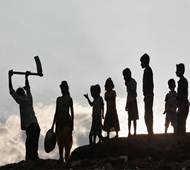
slavery copy copyAccording to the 2016 Global Slavery Index released by Australia-based human rights group Walk Free Foundation today, an estimated 45.8 million people, including women and children, are subject to some form of modern slavery in the world, compared to 35.8 million in 2014.

The report said India has the highest absolute numbers of people trapped in slavery with 18.35 million slaves among its 1.3 billion population while North Korea has the highest incidence (4.37 per cent of the population) and the weakest government response to deal with it.

In the last report in 2014, India had nearly 14.3 million people enslaved.
Incidences of slavery were found in all 167 countries in the index, with Asian countries occupy the top five for people trapped in slavery.

Behind India was China (3.39 million), Pakistan (2.13 million), Bangladesh (1.53 million) and Uzbekistan (1.23 million).

The index said that these five countries combined accounted for almost 58 per cent of the world's enslaved, or 26.6 million people.

The Index presents a ranking of 167 countries based on the proportion of the population that is estimated to be in modern slavery.

Modern slavery refers to situations of exploitation that a person cannot leave because of threats, violence, coercion, abuse of power or deception.

The research included over 42,000 interviews conducted in 53 languages across 25 countries, including 15 state-level surveys in India. These representative surveys covered 44 per cent of the global population.

The countries with the highest estimated prevalence of modern slavery by the proportion of their population are North Korea, Uzbekistan, Cambodia, Cambodia, India, and Qatar.

The countries with the lowest estimated prevalence of modern slavery by the proportion of their population are Luxembourg, Ireland, Norway, Denmark, Switzerland, Austria, Sweden and Belgium, the United States and Canada, and Australia and New Zealand.

The study also tracked the government actions and responses to the modern slavery and of the 161 assessed, 124 nations had criminalised human trafficking in line with the UN trafficking Protocol and 96 nations had developed national action plans to coordinate government response.

It noted that while India had more people enslaved than any other country, it had made significant progress in introducing measures to tackle the problem.

"It has criminalised trafficking, slavery, forced labour, child prostitution and forced marriage. The Indian government is currently tightening legislation against human trafficking, with tougher punishment for repeat offenders. It will offer victims protection and recovery support," it said.

It said that in addition to economic growth in India, ambitious programmes of legal and social reform are being undertaken right across the board, from regulation of labour relations to systems of social insurance for the most vulnerable.

Those governments taking the least action to combat modern slavery are North Korea, Iran, Eritrea, Equatorial Guinea, Hong Kong, Central African Republic, Papua New Guinea, Guinea, the Democratic Republic of the Congo and South Sudan.

The governments that have the strongest response to modern slavery are The Netherlands, the United States of America, the United Kingdom, Sweden, Australia, Portugal, Croatia, Spain, Belgium and Norway.

Seeking strong laws to abolish slavery, Andrew Forrest, Chairman and Founder of Walk Free Foundation, said eradicating slavery makes sense, morally, politically, logically and economically, and called on the governments of the world's leading economies to provide an example to others by enacting and implementing robust anti-slavery measures.

"We call on governments of the top 10 economies of the world to enact laws, at least as strong as the UK Modern Slavery Act 2015, with a budget and capability to ensure organisations are held to account for modern slavery in their supply chains, and to empower independent oversight."

Forrest said leaders of the world's major economies must bring the power of business to this issue, by requiring a focus on supply chain transparency.

"I believe in the critical role of leaders in government, business and civil society. Through our responsible use of power, strength of conviction, determination and collective will, we all can lead the world to end slavery," he said.

Forrest emphasised the key role that business needs to play in eradicating slavery.

"Businesses that don't actively look for forced labour within their supply chains are standing on a burning platform. Business leaders who refuse to look into the realities of their own supply chains are misguided and irresponsible," he said.

Comments

SK
 - 
Thursday, 2 Jun 2016

Since India is facing slavery, Naren has run away to Singapore to enjoy snake/ dog/cat/beef dishes......

Naren kotian
 - 
Tuesday, 31 May 2016

In that mostly 75% are from Muslim community as they enslave women as per their cult following .they have not changed since 6th century ...che papa ...ummah gang ge pitta netti geriruthe ..feku Anthe kumda ...for Muslims he might be feku ..but for nationalist Indians he is true hero who is transforming India .

Add new comment

  • Coastaldigest.com reserves the right to delete or block any comments.
  • Coastaldigset.com is not responsible for its readers’ comments.
  • Comments that are abusive, incendiary or irrelevant are strictly prohibited.
  • Please use a genuine email ID and provide your name to avoid reject.
News Network
July 8,2020

Bengaluru, Jul 8: In yet another revenue generation measure, the Revenue department has issued an order permitting the sale of government land leased to various religious, industrial and other organisations.

Officials say that around Rs 2,250 crore will be generated in Bengaluru Urban district alone, if the order is implemented.

While rules for the process are yet to be formed, it has directed deputy commissioners of various districts to submit proposals for the sale of such lands leased by the government to various institutions under the Karnataka Land Grant Rules, 1969. The order came after a recent Cabinet decision. 

The order issued on July 6 says that government lands leased to private organisations, trusts, industries, educational, social welfare, religious and agricultural purposes can be regularised by paying the guidance value of the land, provided the organisation continued to use the land for the same purpose it was granted for.

If an organisation or trust wanted to convert the land for other purposes, it will be charged twice the guidance value. According to the order, land leased to organisations that are unwilling to purchase the land will be surveyed. “DCs should initiate measures to survey such lands and recover the unused land to the government,” it said.

Revenue Principal Secretary N Manjunath Prasad told DH that rules for the sale of such lands will be formulated shortly. “We have directed deputy commissioners to compile the extent of land leased to various organisations in their respective districts,” he said, noting that 921 acres were leased to private parties in Bengaluru Urban district.

From the 921 acres, the state government used to receive an annual rent of Rs 6.50 crore per year. Sale of leased land in Bengaluru Urban alone will generate around Rs 2,250 crore at current guidance values, Prasad said. 

The government is also pushing for regularisation of unauthorised buildings on Bangalore Development Authority (BDA) land and auction of corner sites to mobilise resources due to the severe economic difficulties in the wake of the Covid-19 pandemic and the state’s reduced share in central taxes.

Comments

Add new comment

  • Coastaldigest.com reserves the right to delete or block any comments.
  • Coastaldigset.com is not responsible for its readers’ comments.
  • Comments that are abusive, incendiary or irrelevant are strictly prohibited.
  • Please use a genuine email ID and provide your name to avoid reject.
News Network
February 28,2020

Mangaluru, Feb 28: BJP Corporator in Mangaluru's ward number 46 (Cantonment), Divakar, has been elected as the Mayor of the city on Friday. While Janaki aka Vedavathi, Corporator of ward number 9 (Kulai), has been elected as the Deputy Mayor.

Divakar secured 46 votes including that of MLAs D Vedavyasa Kamath and Dr Y Bharath Shetty.

Regional Commissioner V Yashwanth conducted the election at the Council Hall of Mangaluru City Corporation (MCC).

Two nominations were filed for the post of Mayor. Congress had fielded Keshav, representing ward 37 (Maroli) for the post of Mayor. Keshav secured 15 votes including that of MLC Ivan D'Souza.

Congress had fielded Zeenath Samshuddin of ward number 44 (Bunder) for the post of Deputy Mayor and secured 17 votes.

Two Social Democratic Party of India (SDPI) corporators remained neutral for the post of Mayor while they supported the candidature of Zeenath Samshuddin of Congress for the Deputy Mayor post. Janaki aka Vedavathi of the BJP secured 46 votes.

The BJP had swept the elections to the 60-member council held on November 12 by winning 44 wards, while the Congress won 14 wards. Social Democratic Party of India won two seats.

Election to the post of Mayor and Deputy Mayor was conducted as per the reservation roaster for the 21st term dated September 3, 2018. Accordingly, the Mayor's post was reserved for candidate from BCM ‘A’ category while that of Deputy Mayor for woman general.

Comments

Add new comment

  • Coastaldigest.com reserves the right to delete or block any comments.
  • Coastaldigset.com is not responsible for its readers’ comments.
  • Comments that are abusive, incendiary or irrelevant are strictly prohibited.
  • Please use a genuine email ID and provide your name to avoid reject.
News Network
May 4,2020

Bengaluru, May 4: First year Pre-University results of Karnataka Department of Pre-University Education will be released soon.

According to a report, the first year PU result will be released on the registered mobile numbers of students or parents on May 5. The report also asked the colleges which offers PU course that the PU results should not be released on the notice boards.

This measure has been taken keeping in view to avoid gatherings in and around the institutions to prevent the spread of coronavirus.

The Deccan Herald report also said the students who are not able to clear the exams after the PU results are declared will be given a chance to appear for supplementary examinations in college level and further details on this will be shared with the institutes by the department in due course.

"After the declaration of results, colleges can conduct online classes for students who are eligible to attend second year PU classes," the report added.

The state is yet to complete the SSLC (class 10) and PU second year (higher secondary or class 12) examinations as the spread of coronavirus and subsequent lockdown announced by the government has put the whole academic activities out of gear in the state.

Recently, the education minister has said the SSLC examinations in the state will be conducted as it is a "crucial stage in a student's life".

"We will consider it (SSLC examinations) when the situation becomes normal," The New Indian Express quoted the minister as saying.

The Karnataka SSLC exam was scheduled to be held between March 27 and April 9, and over eight lakh students had registered for the exam.

Updates on the date and other decisions regarding PU second year exams are awaited.

Earlier, the school education department had decided to promote class 7 and 8 students without any exams in the wake of lockdown aimed at controlling the spread of COVID-19.

Comments

Add new comment

  • Coastaldigest.com reserves the right to delete or block any comments.
  • Coastaldigset.com is not responsible for its readers’ comments.
  • Comments that are abusive, incendiary or irrelevant are strictly prohibited.
  • Please use a genuine email ID and provide your name to avoid reject.