


India tops global slavery index with 18.35 mn people enslaved

May 31, 2016

Melbourne, May 31: India has the dubious distinction of having the highest number of people in the world trapped in modern slavery with 18.35 million victims of forced labour, ranging from prostitution and begging, according to a new report, which estimated that nearly 46 million people are enslaved globally.
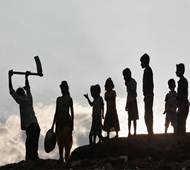
slavery copy copyAccording to the 2016 Global Slavery Index released by Australia-based human rights group Walk Free Foundation today, an estimated 45.8 million people, including women and children, are subject to some form of modern slavery in the world, compared to 35.8 million in 2014.

The report said India has the highest absolute numbers of people trapped in slavery with 18.35 million slaves among its 1.3 billion population while North Korea has the highest incidence (4.37 per cent of the population) and the weakest government response to deal with it.

In the last report in 2014, India had nearly 14.3 million people enslaved.
Incidences of slavery were found in all 167 countries in the index, with Asian countries occupy the top five for people trapped in slavery.

Behind India was China (3.39 million), Pakistan (2.13 million), Bangladesh (1.53 million) and Uzbekistan (1.23 million).

The index said that these five countries combined accounted for almost 58 per cent of the world's enslaved, or 26.6 million people.

The Index presents a ranking of 167 countries based on the proportion of the population that is estimated to be in modern slavery.

Modern slavery refers to situations of exploitation that a person cannot leave because of threats, violence, coercion, abuse of power or deception.

The research included over 42,000 interviews conducted in 53 languages across 25 countries, including 15 state-level surveys in India. These representative surveys covered 44 per cent of the global population.

The countries with the highest estimated prevalence of modern slavery by the proportion of their population are North Korea, Uzbekistan, Cambodia, Cambodia, India, and Qatar.

The countries with the lowest estimated prevalence of modern slavery by the proportion of their population are Luxembourg, Ireland, Norway, Denmark, Switzerland, Austria, Sweden and Belgium, the United States and Canada, and Australia and New Zealand.

The study also tracked the government actions and responses to the modern slavery and of the 161 assessed, 124 nations had criminalised human trafficking in line with the UN trafficking Protocol and 96 nations had developed national action plans to coordinate government response.

It noted that while India had more people enslaved than any other country, it had made significant progress in introducing measures to tackle the problem.

"It has criminalised trafficking, slavery, forced labour, child prostitution and forced marriage. The Indian government is currently tightening legislation against human trafficking, with tougher punishment for repeat offenders. It will offer victims protection and recovery support," it said.

It said that in addition to economic growth in India, ambitious programmes of legal and social reform are being undertaken right across the board, from regulation of labour relations to systems of social insurance for the most vulnerable.

Those governments taking the least action to combat modern slavery are North Korea, Iran, Eritrea, Equatorial Guinea, Hong Kong, Central African Republic, Papua New Guinea, Guinea, the Democratic Republic of the Congo and South Sudan.

The governments that have the strongest response to modern slavery are The Netherlands, the United States of America, the United Kingdom, Sweden, Australia, Portugal, Croatia, Spain, Belgium and Norway.

Seeking strong laws to abolish slavery, Andrew Forrest, Chairman and Founder of Walk Free Foundation, said eradicating slavery makes sense, morally, politically, logically and economically, and called on the governments of the world's leading economies to provide an example to others by enacting and implementing robust anti-slavery measures.

"We call on governments of the top 10 economies of the world to enact laws, at least as strong as the UK Modern Slavery Act 2015, with a budget and capability to ensure organisations are held to account for modern slavery in their supply chains, and to empower independent oversight."

Forrest said leaders of the world's major economies must bring the power of business to this issue, by requiring a focus on supply chain transparency.

"I believe in the critical role of leaders in government, business and civil society. Through our responsible use of power, strength of conviction, determination and collective will, we all can lead the world to end slavery," he said.

Forrest emphasised the key role that business needs to play in eradicating slavery.

"Businesses that don't actively look for forced labour within their supply chains are standing on a burning platform. Business leaders who refuse to look into the realities of their own supply chains are misguided and irresponsible," he said.

Comments

SK
 - 
Thursday, 2 Jun 2016

Since India is facing slavery, Naren has run away to Singapore to enjoy snake/ dog/cat/beef dishes......

Naren kotian
 - 
Tuesday, 31 May 2016

In that mostly 75% are from Muslim community as they enslave women as per their cult following .they have not changed since 6th century ...che papa ...ummah gang ge pitta netti geriruthe ..feku Anthe kumda ...for Muslims he might be feku ..but for nationalist Indians he is true hero who is transforming India .

Add new comment

  • Coastaldigest.com reserves the right to delete or block any comments.
  • Coastaldigset.com is not responsible for its readers’ comments.
  • Comments that are abusive, incendiary or irrelevant are strictly prohibited.
  • Please use a genuine email ID and provide your name to avoid reject.
News Network
January 5,2020

Madikeri, Jan 5: Frequent attacks by Tigers on their cattle in South Kodagu region has left the dairy farmers a worried lot and causing concern for their life.

Several farmers have been rearing cows to supplement their income when low prices of pepper and coffee affect their earnings. At least 13 cows have fallen prey to Tigers in the months of November and December last year.

The Forest Department provides a compensation of Rs 10,000 if a cattle is killed by a tiger or in the attack. The compensation amount is meagre when it comes to the loss incurred by the farmers.

Though the Forest Department has submitted a proposal to increase the compensation amount to the government, no action has been initiated in this regard.

Comments

Add new comment

  • Coastaldigest.com reserves the right to delete or block any comments.
  • Coastaldigset.com is not responsible for its readers’ comments.
  • Comments that are abusive, incendiary or irrelevant are strictly prohibited.
  • Please use a genuine email ID and provide your name to avoid reject.
News Network
June 10,2020

Bengaluru, June 10: A court in Bengaluru has ejected the bail plea of Amulya Leona Noronha, a college student who has been accused of sedition for saying “Pakistan Zindabad” at the beginning of a speech during a protest against the Citizenship Amendment Act (CAA) in the city on February 20.

The court claimed that if granted bail, the 19-year-old student of journalism and English at a Bengaluru college “may involve (herself) in similar offence which affects peace at large”.

Rejecting her bail plea, 60th additional city civil and sessions judge Vidyadhar Shirahatti said in his order, “If the petitioner is granted bail, she may abscond. Therefore, the bail petition of the petitioner is liable to be rejected.”

The police had booked Amulya under charges of sedition and promoting enmity between groups, although her friends claimed she was trying to convey a message of universal humanity by chanting zindabad in the name of all nations, including Pakistan and India.

Amulya, known for her oratory, and often invited at protests against the CAA, NRC and NPR, was arrested on the evening of February 20.

Video clips of the speech showed her chanting “Hindustan Zindabad” soon after saying “Pakistan Zindabad” and trying to tell the audience — her microphone had been taken away by then — that all nations are one in the end. She could not complete the speech; the protest was being held at Bengaluru’s Freedom Park.

Amulya’s bail plea was delayed on account of the lockdown, which came into force on March 25 — around the time hearings were due to begin in a lower court. Bengaluru police did not file a chargesheet against the student during the lockdown.

In the course of bail hearings, which began after lockdown restrictions were eased, the public prosecutor argued that Amulya was trying to incite people to create a law and order problem. The prosecutor also argued that she had earlier been accused of causing hatred and disaffection towards religion and the government established by law in India by holding a placard that stated “F##k Hindutva” during a student protest.

The prosecution argued that the student, if released, may commit similar offences since cases were already registered against her.

Defending Amulya, a friend who was part of the February 20 protest said, “Before she could complete what she wanted to say they surrounded her and grabbed the microphone. She was later placed under arrest on charges of sedition. What she was trying to say was, if we love one country it does not mean we should hate another.” Another friend said, “Please see her Facebook post of February 16, around 8 pm. Loving another country does not mean you are going against your own — this is exactly what she was trying to say (at the protest). She is promoting unity among nations…”

Comments

Add new comment

  • Coastaldigest.com reserves the right to delete or block any comments.
  • Coastaldigset.com is not responsible for its readers’ comments.
  • Comments that are abusive, incendiary or irrelevant are strictly prohibited.
  • Please use a genuine email ID and provide your name to avoid reject.
coastaldigest.com news network
January 12,2020

Mangaluru, Jan 12: Sudarshan Moodbidri and Robin Devaiah were today unanimous elected presidents of Dakshina Kannada and Kodagu district units of Bharatiya Janata Party.

Karnataka BJP vice-president Nirmal Kumar Surana oversaw the election process of the two district units at the BJP’s party office here.

While Sanjeeva Matandoor, Puttur MLA and incumbent president of DK unit of the party welcomed his successor Sudarshan, it was the turn of BB Bharatheesh, president of Kodagu unit to welcome Robin.

K Uday Kumar Shetty, DK district election officer and Ravi Kalappa, Kodagu district assistant election officer conducted the election under the supervision of Surana in the presence of MLAs of the party from respective districts.

Sudarshan started out his career as taluk and then district convener of Bajrang Dal before taking up responsibility as seva pramukh of Vishwa Hindu Parishad.

He formally joined the BJP as general secretary of Mulki-Moodbidri assembly unit of the party, moved on as convener of training cell of the party and was the general secretary of the district unit of the party before his elevation. A B.Com student of Dhavala College, Moodbidri, he is 44.

Robin, 50, who started out as a RSS volunteer as a student, too is incumbent general secretary of the Kodagu unit. Having been a member of ABVP for 8-years, he joined BJP formally in 1996 through Yuva Morcha and was its district treasurer, national executive member and state general secretary.

A product of Field Marshal K M Cariappa College, Kodagu, he served two terms as general secretary of the district unit prior to his elevation.

Comments

Add new comment

  • Coastaldigest.com reserves the right to delete or block any comments.
  • Coastaldigset.com is not responsible for its readers’ comments.
  • Comments that are abusive, incendiary or irrelevant are strictly prohibited.
  • Please use a genuine email ID and provide your name to avoid reject.