


India tops global slavery index with 18.35 mn people enslaved

May 31, 2016

Melbourne, May 31: India has the dubious distinction of having the highest number of people in the world trapped in modern slavery with 18.35 million victims of forced labour, ranging from prostitution and begging, according to a new report, which estimated that nearly 46 million people are enslaved globally.
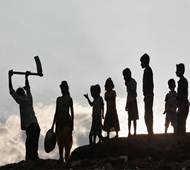
slavery copy copyAccording to the 2016 Global Slavery Index released by Australia-based human rights group Walk Free Foundation today, an estimated 45.8 million people, including women and children, are subject to some form of modern slavery in the world, compared to 35.8 million in 2014.

The report said India has the highest absolute numbers of people trapped in slavery with 18.35 million slaves among its 1.3 billion population while North Korea has the highest incidence (4.37 per cent of the population) and the weakest government response to deal with it.

In the last report in 2014, India had nearly 14.3 million people enslaved.
Incidences of slavery were found in all 167 countries in the index, with Asian countries occupy the top five for people trapped in slavery.

Behind India was China (3.39 million), Pakistan (2.13 million), Bangladesh (1.53 million) and Uzbekistan (1.23 million).

The index said that these five countries combined accounted for almost 58 per cent of the world's enslaved, or 26.6 million people.

The Index presents a ranking of 167 countries based on the proportion of the population that is estimated to be in modern slavery.

Modern slavery refers to situations of exploitation that a person cannot leave because of threats, violence, coercion, abuse of power or deception.

The research included over 42,000 interviews conducted in 53 languages across 25 countries, including 15 state-level surveys in India. These representative surveys covered 44 per cent of the global population.

The countries with the highest estimated prevalence of modern slavery by the proportion of their population are North Korea, Uzbekistan, Cambodia, Cambodia, India, and Qatar.

The countries with the lowest estimated prevalence of modern slavery by the proportion of their population are Luxembourg, Ireland, Norway, Denmark, Switzerland, Austria, Sweden and Belgium, the United States and Canada, and Australia and New Zealand.

The study also tracked the government actions and responses to the modern slavery and of the 161 assessed, 124 nations had criminalised human trafficking in line with the UN trafficking Protocol and 96 nations had developed national action plans to coordinate government response.

It noted that while India had more people enslaved than any other country, it had made significant progress in introducing measures to tackle the problem.

"It has criminalised trafficking, slavery, forced labour, child prostitution and forced marriage. The Indian government is currently tightening legislation against human trafficking, with tougher punishment for repeat offenders. It will offer victims protection and recovery support," it said.

It said that in addition to economic growth in India, ambitious programmes of legal and social reform are being undertaken right across the board, from regulation of labour relations to systems of social insurance for the most vulnerable.

Those governments taking the least action to combat modern slavery are North Korea, Iran, Eritrea, Equatorial Guinea, Hong Kong, Central African Republic, Papua New Guinea, Guinea, the Democratic Republic of the Congo and South Sudan.

The governments that have the strongest response to modern slavery are The Netherlands, the United States of America, the United Kingdom, Sweden, Australia, Portugal, Croatia, Spain, Belgium and Norway.

Seeking strong laws to abolish slavery, Andrew Forrest, Chairman and Founder of Walk Free Foundation, said eradicating slavery makes sense, morally, politically, logically and economically, and called on the governments of the world's leading economies to provide an example to others by enacting and implementing robust anti-slavery measures.

"We call on governments of the top 10 economies of the world to enact laws, at least as strong as the UK Modern Slavery Act 2015, with a budget and capability to ensure organisations are held to account for modern slavery in their supply chains, and to empower independent oversight."

Forrest said leaders of the world's major economies must bring the power of business to this issue, by requiring a focus on supply chain transparency.

"I believe in the critical role of leaders in government, business and civil society. Through our responsible use of power, strength of conviction, determination and collective will, we all can lead the world to end slavery," he said.

Forrest emphasised the key role that business needs to play in eradicating slavery.

"Businesses that don't actively look for forced labour within their supply chains are standing on a burning platform. Business leaders who refuse to look into the realities of their own supply chains are misguided and irresponsible," he said.

Comments

SK
 - 
Thursday, 2 Jun 2016

Since India is facing slavery, Naren has run away to Singapore to enjoy snake/ dog/cat/beef dishes......

Naren kotian
 - 
Tuesday, 31 May 2016

In that mostly 75% are from Muslim community as they enslave women as per their cult following .they have not changed since 6th century ...che papa ...ummah gang ge pitta netti geriruthe ..feku Anthe kumda ...for Muslims he might be feku ..but for nationalist Indians he is true hero who is transforming India .

Add new comment

  • Coastaldigest.com reserves the right to delete or block any comments.
  • Coastaldigset.com is not responsible for its readers’ comments.
  • Comments that are abusive, incendiary or irrelevant are strictly prohibited.
  • Please use a genuine email ID and provide your name to avoid reject.
News Network
February 28,2020

Bengaluru, Feb 28: Historian S. Shettar, 85, breathed his last early on February 28 in Bengaluru. He was suffering from respiratory problems and was hospitalised for over a week.

Shettar was known for his multi-disciplinary work, encompassing linguistics, epigraphy, anthropology, the study of religions and art history. He had extensively worked on the Jain practice of ritual death in Karnataka and Asoka edicts. He had studied and compiled early edicts in Kannada and worked extensively on the growth of Kannada language down the ages.

Born in 1935 at Hampasagara, Ballari district, he went on to study at Cambridge University and started his career as a Professor of History at Karnatak University, Dharwad, his alma mater. He later headed the National Museum Institute of the History of Art, Conservation and Museology in 1978 and Indian Council for Historical Research in 1996. He was also a visiting professor at the National Institute of Advanced Studies, Bengaluru.

He was a bilingual historian who wrote in English for most of his career, but started writing in Kannada in later years. In the last two decades, he developed a keen interest in linguistics and wrote multiple books on classical Kannada and Prakrit. His 2007 book “Shangam Tamilagam” is considered a seminal work in the study of the early period of Dravidian languages. It won him Bhasha Samman from Central Sahitya Akademi. He later wrote two works on Halegannada, classical Kannada. His most recent work was “Prakrita Jagadvalaya” in 2018.

Comments

Add new comment

  • Coastaldigest.com reserves the right to delete or block any comments.
  • Coastaldigset.com is not responsible for its readers’ comments.
  • Comments that are abusive, incendiary or irrelevant are strictly prohibited.
  • Please use a genuine email ID and provide your name to avoid reject.
News Network
July 11,2020

Bengaluru, Jul 11: The Bharatiya Janata Party led government of Karnataka is planning to ban cow slaughter as well as the sale and consumption of beef in the state by bringing Prevention of Cow Slaughter and Preservation Bill, 2012.

"Many states have passed the Anti-Cow Slaughter Bill. We are preparing to implement it in Karnataka as well. The state government will soon implement a ban on cow slaughter, sale and consumption of beef on the lines of many other states," said Prabhu Chauhan, the state's Animal Husbandry Minister.

The Anti-Cow Slaughter Act is already in place in several states like Gujarat, Delhi, Haryana, Maharashtra, Madhya Pradesh among others.

Last month, the Yogi Adityanath-led Uttar Pradesh government passed a draft ordinance to prevent cow slaughter, providing maximum rigorous imprisonment of 10 years and a fine up to Rs 5 lakh.
The Uttar Pradesh Cabinet Cow Slaughter Prevention (Amendment) Ordinance, 2020 aims at making the existing Uttar Pradesh Prevention of Cow Slaughter Act, 1955 more effective towards cow safety.

In Karnataka, the BJP-led government had promised to ban cow slaughter in its manifesto for 2018 state assembly election.

"The government will form a team of experts to look into once the current pandemic situation eases," Chauhan stated, adding that if necessary, the team of experts will visit states like Uttar Pradesh, Gujarat.

The then BS Yediyurappa-led BJP government had passed the Karnataka Prevention of Cow Slaughter and Protection Bill in 2010 but it failed to get presidential approval. Three years later, the Bill was withdrawn by the Siddaramaiah-led Congress government.

"I will discuss this matter with Chief Minister and if this pandemic situation eases, by next session, if not by upcoming assembly session, we will try to bring Karnataka Prevention of Slaughter and Preservation of Cattle Bill," Chauhan added.

Comments

Go-pitha maha
 - 
Sunday, 12 Jul 2020

now india is ruled by most unfit people in the world...

one yogi become CM after dumping his family, another became PM after dumping his family and mother, now they teach that COW is mother and need protection...

the main point is here is the business, they know very well muslims make profit in meat business and now they want to steal from them...gomata, protection all these are bullshit...only gobar bakth will belive...

Add new comment

  • Coastaldigest.com reserves the right to delete or block any comments.
  • Coastaldigset.com is not responsible for its readers’ comments.
  • Comments that are abusive, incendiary or irrelevant are strictly prohibited.
  • Please use a genuine email ID and provide your name to avoid reject.
News Network
April 9,2020

Bengaluru, Apr 9:  Ministers and members of Legislature in Karnataka will take a 30 per cent cut each in their salaries and allowances to fund the fight against coronavirus in the state, for a year.

An ordinance to reduce the salaries of ministers and legislators by 30 per cent for one year to meet the exigencies arising out of COVID-19 pandemic was approved by the state cabinet headed by chief minister B S Yediyurappa on Thursday.

"... we have cut by 30 per cent salaries and allowances of all ministers, MLAs, MLCs, also speaker, deputy speaker, chief whip every one for one year from April 1, amounting to Rs 15.36 crore," Law and Parliamentary Affairs minister J C Madhuswamy said.

Speaking to reporters after the cabinet meeting, he said, "we have the consent from all the political parties for this, so we have passed the ordinance today."

The Union Cabinet on Monday had approved a 30 per cent cut in salaries of all Members of Parliament and a two-year suspension of the MP Local Area Development (MPLAD) scheme.

Comments

Add new comment

  • Coastaldigest.com reserves the right to delete or block any comments.
  • Coastaldigset.com is not responsible for its readers’ comments.
  • Comments that are abusive, incendiary or irrelevant are strictly prohibited.
  • Please use a genuine email ID and provide your name to avoid reject.