


India tops global slavery index with 18.35 mn people enslaved

May 31, 2016

Melbourne, May 31: India has the dubious distinction of having the highest number of people in the world trapped in modern slavery with 18.35 million victims of forced labour, ranging from prostitution and begging, according to a new report, which estimated that nearly 46 million people are enslaved globally.
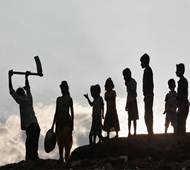
slavery copy copyAccording to the 2016 Global Slavery Index released by Australia-based human rights group Walk Free Foundation today, an estimated 45.8 million people, including women and children, are subject to some form of modern slavery in the world, compared to 35.8 million in 2014.

The report said India has the highest absolute numbers of people trapped in slavery with 18.35 million slaves among its 1.3 billion population while North Korea has the highest incidence (4.37 per cent of the population) and the weakest government response to deal with it.

In the last report in 2014, India had nearly 14.3 million people enslaved.
Incidences of slavery were found in all 167 countries in the index, with Asian countries occupy the top five for people trapped in slavery.

Behind India was China (3.39 million), Pakistan (2.13 million), Bangladesh (1.53 million) and Uzbekistan (1.23 million).

The index said that these five countries combined accounted for almost 58 per cent of the world's enslaved, or 26.6 million people.

The Index presents a ranking of 167 countries based on the proportion of the population that is estimated to be in modern slavery.

Modern slavery refers to situations of exploitation that a person cannot leave because of threats, violence, coercion, abuse of power or deception.

The research included over 42,000 interviews conducted in 53 languages across 25 countries, including 15 state-level surveys in India. These representative surveys covered 44 per cent of the global population.

The countries with the highest estimated prevalence of modern slavery by the proportion of their population are North Korea, Uzbekistan, Cambodia, Cambodia, India, and Qatar.

The countries with the lowest estimated prevalence of modern slavery by the proportion of their population are Luxembourg, Ireland, Norway, Denmark, Switzerland, Austria, Sweden and Belgium, the United States and Canada, and Australia and New Zealand.

The study also tracked the government actions and responses to the modern slavery and of the 161 assessed, 124 nations had criminalised human trafficking in line with the UN trafficking Protocol and 96 nations had developed national action plans to coordinate government response.

It noted that while India had more people enslaved than any other country, it had made significant progress in introducing measures to tackle the problem.

"It has criminalised trafficking, slavery, forced labour, child prostitution and forced marriage. The Indian government is currently tightening legislation against human trafficking, with tougher punishment for repeat offenders. It will offer victims protection and recovery support," it said.

It said that in addition to economic growth in India, ambitious programmes of legal and social reform are being undertaken right across the board, from regulation of labour relations to systems of social insurance for the most vulnerable.

Those governments taking the least action to combat modern slavery are North Korea, Iran, Eritrea, Equatorial Guinea, Hong Kong, Central African Republic, Papua New Guinea, Guinea, the Democratic Republic of the Congo and South Sudan.

The governments that have the strongest response to modern slavery are The Netherlands, the United States of America, the United Kingdom, Sweden, Australia, Portugal, Croatia, Spain, Belgium and Norway.

Seeking strong laws to abolish slavery, Andrew Forrest, Chairman and Founder of Walk Free Foundation, said eradicating slavery makes sense, morally, politically, logically and economically, and called on the governments of the world's leading economies to provide an example to others by enacting and implementing robust anti-slavery measures.

"We call on governments of the top 10 economies of the world to enact laws, at least as strong as the UK Modern Slavery Act 2015, with a budget and capability to ensure organisations are held to account for modern slavery in their supply chains, and to empower independent oversight."

Forrest said leaders of the world's major economies must bring the power of business to this issue, by requiring a focus on supply chain transparency.

"I believe in the critical role of leaders in government, business and civil society. Through our responsible use of power, strength of conviction, determination and collective will, we all can lead the world to end slavery," he said.

Forrest emphasised the key role that business needs to play in eradicating slavery.

"Businesses that don't actively look for forced labour within their supply chains are standing on a burning platform. Business leaders who refuse to look into the realities of their own supply chains are misguided and irresponsible," he said.

Comments

SK
 - 
Thursday, 2 Jun 2016

Since India is facing slavery, Naren has run away to Singapore to enjoy snake/ dog/cat/beef dishes......

Naren kotian
 - 
Tuesday, 31 May 2016

In that mostly 75% are from Muslim community as they enslave women as per their cult following .they have not changed since 6th century ...che papa ...ummah gang ge pitta netti geriruthe ..feku Anthe kumda ...for Muslims he might be feku ..but for nationalist Indians he is true hero who is transforming India .

Add new comment

  • Coastaldigest.com reserves the right to delete or block any comments.
  • Coastaldigset.com is not responsible for its readers’ comments.
  • Comments that are abusive, incendiary or irrelevant are strictly prohibited.
  • Please use a genuine email ID and provide your name to avoid reject.
News Network
April 26,2020

Bengaluru, Apr 26: A 24-year-old man has been arrested in Vijayapura district in Karnataka for posting the photograph of a COVID-19 girl patient as his whatsapp status photo with a derogatory message, police said.

Anil Rathod on Saturday posted the picture of the girl student as status message with a caption, "Bad News Student got Positive"

By putting her photograph as his whatsapp status message, he tried to create fear among the masses and intentionally defamed her by making her photo go viral, the the police said in a statement.

It is an offence to reveal the identity of the COVID-19 patients by taking the photograph and putting it in the public domain, the police said.

Rathod has been booked under for spreading rumours and causing panic, they said.

Comments

Add new comment

  • Coastaldigest.com reserves the right to delete or block any comments.
  • Coastaldigset.com is not responsible for its readers’ comments.
  • Comments that are abusive, incendiary or irrelevant are strictly prohibited.
  • Please use a genuine email ID and provide your name to avoid reject.
News Network
February 1,2020

Mangaluru, Feb 1: “1) Take necessary precautionary measures. 2) Don’t blindly believe in social media rumours.” These are the two important advisories issued by the authorities in Dakshina Kannada district in the wake of coronavirus scare.

According to DHO Dr Ramakrishna there is no specific antiviral treatment recommended for coronavirus infection. Supportive care for infected people can be highly effective, but, there is no vaccine available for coronavirus.

In a health meeting, he advised people to take precautionary measures to prevent the spread of the virus. Following are some of the precautionary measures.

1) Wash your hands often with soap and water or an alcohol-based sanitiser.

2) Avoid touching your eyes, nose and mouth with unwashed hands.

3) Avoid close contact with people who are sick.

4) Stay home when you are sick, and cover your mouth when you cough or use a tissue while sneezing.

5) Throw the used tissue in the dustbin. Clean and disinfect surfaces frequently.

Deputy commissioner Sindhu B Rupesh said there is no need for people to panic about coronavirus.

Dakshina Kannada zilla panchayat CEO R Selvamani said IEC programmes will be held to create awareness on possibilities of spread of diseases.

He also advised people not to follow blindly the advisories being shared on social media, especially WhatsApp without proper verification.

“Posts on cures for coronavirus which are not scientifically proven are being shared on social media. Do not follow such advisories without verifying facts,” he said.

Comments

Add new comment

  • Coastaldigest.com reserves the right to delete or block any comments.
  • Coastaldigset.com is not responsible for its readers’ comments.
  • Comments that are abusive, incendiary or irrelevant are strictly prohibited.
  • Please use a genuine email ID and provide your name to avoid reject.
News Network
April 12,2020

Raipur, Apr 12: As many as 108 out of the 159 people that were quarantined by the Chhattisgarh government last week for allegedly taking part in Delhi’s Tablighi Jamaat congregation are Hindus, according to reliable sources. 

The names of these 159 people, who were said to be in Delhi’s Nizamuddin area when the Tablighi Jamaat congregation was held mid-March, were mentioned in a list issued by the state home department last month. 

The list has been accessed by the many media outlets. But, Raipur Collector S. Bharti Dasan and the state’s Principal Secretary, Home, Subrata Sahu, claimed no such list was issued.

However, a senior state home department official, who didn’t want to be named, said: “Listing of the names was done on the basis of location of mobile phones traced in Nizamuddin in the month of March during the period when congregation of Tablighi Jamaat was held.

“It was subsequently sent to the chief medical officers in the respective districts for further action,” the official added.

These 159 people have either been quarantined at their homes or at government isolation centres. The quarantine exercise took place between 31 March and 1 April.

Interestingly, almost all the people named in the list have denied attending the massive Jamaat congregation, which had seen the participation of over 3,000 people, including foreigners.

Under quarantine “forcefully”, these people alleged they are facing social boycott as they have been “linked to the Tablighi”.

Those placed under quarantine, told media if their phone locations have shown their presence in the Nizamuddin area that didn’t necessarily mean they had attended the Tablighi congregation.

“My neighbours are no longer like my family. After 31 March, I have received more than 500 calls (from relatives and friends) and had to convince them that I didn’t attend the Jamaat event,” Umesh Pandey, a resident of Ambikapur, said.

“People in my area have started saying that some Brahmins took part in the event. I have no objection to being kept in quarantine, but it should be explained why it is being done,” said Pandey, who is a consumer rights activist.

Pandey said, like every year, he had gone to Delhi in March to participate in a consumer protection programme and had stayed at a hotel in Nizamuddin. “I came back on 17 March. After I was quarantined, a false propaganda is being spread about me that I am linked with Tablighi Jamaat activities.”

Pandey said he and his family are now being “looked at as suspects”. 

Kamal Kumar Popatani, a businessman from Bilaspur district, has faced similar problems. Popatani and his family have been living in isolation since 31 March.

“I am completely flabbergasted by this step taken by the state government. I always visit Delhi to procure items for my shop. This time too I had completed my procurement and had returned home on 16 March. Everything was usual till 30 March, but suddenly after 31 March, when this so-called list of 159 alleged suspects was released by the government, we were placed under isolation,” Popatani said.

“My own family members, neighbours and everyone I know are now accusing me that I had joined the Tabligi Jamaat gathering. How can it ever happen? This strange attitude of the government has made my entire family a victim of social boycott.”

Trader Abdul Rahman, a resident of Lutra Sharif area of Bilaspur district, also echoed similar sentiments.

“I returned from Delhi along with my wife on 15 March, but my entire family has been kept in isolation since 31 March. All this is way beyond my comprehension… Blood samples of the entire family were taken. Now everyone is keeping a distance from us and calling us corona suspects,” said Rahman, who had gone to Delhi for a holiday.

“People not only from my village but also in the nearby villages are pointing fingers at me and my family… We are the ones who condemn Tablighi Jamaat and their activities. We have nothing to do with them. The quarantine… has brought…infamy to us,” he added.

In another goof-up, the list even includes names of some people who no longer live in the state but carried mobile numbers issued in Chhattisgarh. One such name is that of BSF sub-inspector Shantanu Mukherjee, who was working in Bhilai about two years ago, but is currently posted in Delhi.

“What kind of list is this? Who released it in the first place? At first, I received a call from the Covid-19 control room in Chhattisgarh and then from the State Police Control Centre. They inquired about my health and current place of posting,” said Mukherjee, whose office is located close to the Nizamuddin area. 

Makkhan Singh Yadav, a sub-inspector with the CRPF, is another case in point. Yadav, who is posted somewhere close to Nizamuddin, had bought a SIM card from Dantewada, when he was posted there five years ago.

“I had received calls from both Delhi and Chhattisgarh police after being marked as a corona suspect. But when I explained the reality to them, no calls were made thereafter. I could not understand how all this is taking place,” said Yadav, who is a native of Rampur, Uttar Pradesh.

A first-year Delhi University student, who belongs to Mahasamund district of Chhattisgarh, has been kept under isolation at a local government hospital.

The student, who didn’t want to be named, said she had gone to Nizamuddin railway station to catch a train for Chhattisgarh.

“I came home immediately after it was announced that educational institutions are shutting down. After returning from Delhi, I spent around 19 days at my own home, but suddenly I was admitted to the hospital on 1 April. Why have I been brought here (hospital) if I have no symptoms? All this feels like some sort of torture.”

“Despite my repeated denial, I was brought here by the health department on the pretext of being associated with the Tablighi Jamaat,” she said. 

Asked about the Tablighi quarantine list, principal secretary Sahu said: “The government has issued no such list. We have received inputs from the social media about three such lists but the state government has not officially prepared any list.

“All those put under quarantine have been done as per the orders issued by the state government. This order states that those who came to the state after 1 March should be kept under isolation,” he added.

Raipur Collector Dasan refused to say anything about the list and added that people have been kept under quarantine after obtaining their “detailed travel history” based on the guidelines issued by the ICMR.

On the allegation of social boycott, Dasan said: “No person or their families placed under home quarantine or isolation should be subjected to any social boycott or misconduct. They also need not have any social inferiority complex in their minds.

“If any person placed under quarantine feels like this (social inferiority complex), the government has arranged counsellors for them. Our counsellors are convincing and assuring such people by reaching out to them.”

Comments

Add new comment

  • Coastaldigest.com reserves the right to delete or block any comments.
  • Coastaldigset.com is not responsible for its readers’ comments.
  • Comments that are abusive, incendiary or irrelevant are strictly prohibited.
  • Please use a genuine email ID and provide your name to avoid reject.