


India tops global slavery index with 18.35 mn people enslaved

May 31, 2016

Melbourne, May 31: India has the dubious distinction of having the highest number of people in the world trapped in modern slavery with 18.35 million victims of forced labour, ranging from prostitution and begging, according to a new report, which estimated that nearly 46 million people are enslaved globally.
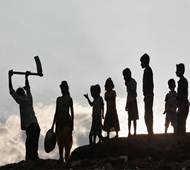
slavery copy copyAccording to the 2016 Global Slavery Index released by Australia-based human rights group Walk Free Foundation today, an estimated 45.8 million people, including women and children, are subject to some form of modern slavery in the world, compared to 35.8 million in 2014.

The report said India has the highest absolute numbers of people trapped in slavery with 18.35 million slaves among its 1.3 billion population while North Korea has the highest incidence (4.37 per cent of the population) and the weakest government response to deal with it.

In the last report in 2014, India had nearly 14.3 million people enslaved.
Incidences of slavery were found in all 167 countries in the index, with Asian countries occupy the top five for people trapped in slavery.

Behind India was China (3.39 million), Pakistan (2.13 million), Bangladesh (1.53 million) and Uzbekistan (1.23 million).

The index said that these five countries combined accounted for almost 58 per cent of the world's enslaved, or 26.6 million people.

The Index presents a ranking of 167 countries based on the proportion of the population that is estimated to be in modern slavery.

Modern slavery refers to situations of exploitation that a person cannot leave because of threats, violence, coercion, abuse of power or deception.

The research included over 42,000 interviews conducted in 53 languages across 25 countries, including 15 state-level surveys in India. These representative surveys covered 44 per cent of the global population.

The countries with the highest estimated prevalence of modern slavery by the proportion of their population are North Korea, Uzbekistan, Cambodia, Cambodia, India, and Qatar.

The countries with the lowest estimated prevalence of modern slavery by the proportion of their population are Luxembourg, Ireland, Norway, Denmark, Switzerland, Austria, Sweden and Belgium, the United States and Canada, and Australia and New Zealand.

The study also tracked the government actions and responses to the modern slavery and of the 161 assessed, 124 nations had criminalised human trafficking in line with the UN trafficking Protocol and 96 nations had developed national action plans to coordinate government response.

It noted that while India had more people enslaved than any other country, it had made significant progress in introducing measures to tackle the problem.

"It has criminalised trafficking, slavery, forced labour, child prostitution and forced marriage. The Indian government is currently tightening legislation against human trafficking, with tougher punishment for repeat offenders. It will offer victims protection and recovery support," it said.

It said that in addition to economic growth in India, ambitious programmes of legal and social reform are being undertaken right across the board, from regulation of labour relations to systems of social insurance for the most vulnerable.

Those governments taking the least action to combat modern slavery are North Korea, Iran, Eritrea, Equatorial Guinea, Hong Kong, Central African Republic, Papua New Guinea, Guinea, the Democratic Republic of the Congo and South Sudan.

The governments that have the strongest response to modern slavery are The Netherlands, the United States of America, the United Kingdom, Sweden, Australia, Portugal, Croatia, Spain, Belgium and Norway.

Seeking strong laws to abolish slavery, Andrew Forrest, Chairman and Founder of Walk Free Foundation, said eradicating slavery makes sense, morally, politically, logically and economically, and called on the governments of the world's leading economies to provide an example to others by enacting and implementing robust anti-slavery measures.

"We call on governments of the top 10 economies of the world to enact laws, at least as strong as the UK Modern Slavery Act 2015, with a budget and capability to ensure organisations are held to account for modern slavery in their supply chains, and to empower independent oversight."

Forrest said leaders of the world's major economies must bring the power of business to this issue, by requiring a focus on supply chain transparency.

"I believe in the critical role of leaders in government, business and civil society. Through our responsible use of power, strength of conviction, determination and collective will, we all can lead the world to end slavery," he said.

Forrest emphasised the key role that business needs to play in eradicating slavery.

"Businesses that don't actively look for forced labour within their supply chains are standing on a burning platform. Business leaders who refuse to look into the realities of their own supply chains are misguided and irresponsible," he said.

Comments

SK
 - 
Thursday, 2 Jun 2016

Since India is facing slavery, Naren has run away to Singapore to enjoy snake/ dog/cat/beef dishes......

Naren kotian
 - 
Tuesday, 31 May 2016

In that mostly 75% are from Muslim community as they enslave women as per their cult following .they have not changed since 6th century ...che papa ...ummah gang ge pitta netti geriruthe ..feku Anthe kumda ...for Muslims he might be feku ..but for nationalist Indians he is true hero who is transforming India .

Add new comment

  • Coastaldigest.com reserves the right to delete or block any comments.
  • Coastaldigset.com is not responsible for its readers’ comments.
  • Comments that are abusive, incendiary or irrelevant are strictly prohibited.
  • Please use a genuine email ID and provide your name to avoid reject.
coastaldigest.com news network
August 8,2020

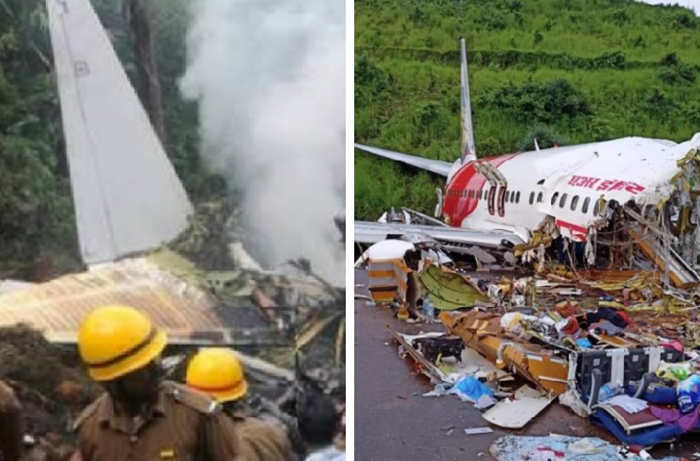
Mangaluru, Aug 8: As visuals of the Air India Express flight crash at Kozhikode international airport emerge, one cannot help but be reminded of an eerily similar and unfortunate accident that occurred a decade ago. The August 7, 2020 tragedy brought back memories of the 2010 crash.

It was on May 22, 2010 that an Air India Express Boeing 737-800 flight from Dubai to Mangaluru over shot the runway while landing at Bajpe airport and fell into a cliff. Of the 160 passengers and 6 crew members on board, 158 were killed (all crew members and 152 passengers) and only 8 survived.

Even back then, the plane had split into two. The crash has been termed as one of India's worst aviation disasters.

The final conversations between Air traffic control (ATC) and the pilot prior to the landing showed no indication of any distress.

Like the Mangaluru accident, Karipur crash too happened when the flight was attempting to land.

The captain of the aircraft which crashed at Mangaluru, Z Glucia, was an experienced pilot with 10,000 hours of flying experience and had 19 landings at the Mangalore airport. Co-pilot S S Ahluwalia, with 3,000 hours of flying experience had as many as 66 landings at this airport. Both the pilot and co-pilot were among the victims.

An investigation into the accident later found that the cause of the accident was the captain’s failure to discontinue an ‘unstabilised approach’ and his persistence to continue with the landing, despite three calls from the First Officer to ‘go-around’.

Comments

Add new comment

  • Coastaldigest.com reserves the right to delete or block any comments.
  • Coastaldigset.com is not responsible for its readers’ comments.
  • Comments that are abusive, incendiary or irrelevant are strictly prohibited.
  • Please use a genuine email ID and provide your name to avoid reject.
coastaldigest.com news network
May 31,2020

Mangaluru, May 31: The bus services by private operators in Dakshina Kannada and Udupi Districts will begin from tomorrow (June 1) with 15 per cent hike in the fares, Canara Bus Owners Association president Rajavarma Ballal said on Sunday.

In a statement issued here, he said that the members of the Association have appealed for a 3-month tax break. ''We have received tax breaks for 2 months and have demanded for an additional month again,'' he added.

He said that the government has agreed to a 15 per cent hike in bus fares. All the passes issued already will be converted into cash cards and no discounts will be available till the end of the COVID-19 crisis.

An added attraction in private buses will be the option of paying travel fares through smart cards.

According to Dakshina Kannada Bus Operators Association president Dilraj Alva, 50 per cent of 325 private city buses will resume their services on Monday. It also meant that 50 per cent of buses will operate on the allotted routes.

The smart cards (or travel cards called Chalo Card) will not be introduced on all routes at a time. They will be introduced in a phased manner covering all routes from Monday.

Comments

Add new comment

  • Coastaldigest.com reserves the right to delete or block any comments.
  • Coastaldigset.com is not responsible for its readers’ comments.
  • Comments that are abusive, incendiary or irrelevant are strictly prohibited.
  • Please use a genuine email ID and provide your name to avoid reject.
News Network
February 18,2020

Bengaluru, Feb 18: A 26-year-old Kannada singer committed suicide over alleged dowry harassment on Monday. Sushmitha, a playback singer who got married to Sharath Kumar about one-and-a-half years ago, hung herself from the ceiling at her parent's home in Nagarabhavi, Bengaluru on Monday.

The singer sent a Whatsapp to her brother and mother before hanging herself early morning on Monday. She accused her husband and his relatives of dowry harassment in her death note.

According to Bengaluru Police, the singer has accused her husband, his sister and his aunt of harassing her for dowry in her death note. On Monday morning, Sushmitha's brother alerted the police after he found her dead body hanging from the ceiling. She used her dupatta to hang herself.

Sushmitha had lent her voice for Kannada songs in films like Haalu Thuppa and Srisamanya.

Police informed that Sushmitha sent a Whatsapp message to her brother, Sachin, at around 1 am on Sunday and explained that her husband Sharath and her relatives have been harassing her since the time she got married. Sachin read the message at around 5:30am and rushed to her room where he found her hanging from the ceiling.

In the text message, Sushmitha wrote that her husband, Sharath, his sister, Geetha, and his aunt, Vydehi, harassed her and they were the reason behind her ending her life. She also stated that she did not want to end her life in their house and hence came to her parents’ house.

The Annapoorneshwari Nagar police have registered a case of dowry death, charging her husband and his sister and aunt based on complaint filed by Sushmitha’s mother Meenakshi. The three accused are on run after hearing about her death and police said that efforts are on to trace them.

Sushmitha's husband Sharath Kumar is a manager in a car showroom and a resident of KS Nagar in Bengaluru.

Comments

Add new comment

  • Coastaldigest.com reserves the right to delete or block any comments.
  • Coastaldigset.com is not responsible for its readers’ comments.
  • Comments that are abusive, incendiary or irrelevant are strictly prohibited.
  • Please use a genuine email ID and provide your name to avoid reject.