


India tops global slavery index with 18.35 mn people enslaved

May 31, 2016

Melbourne, May 31: India has the dubious distinction of having the highest number of people in the world trapped in modern slavery with 18.35 million victims of forced labour, ranging from prostitution and begging, according to a new report, which estimated that nearly 46 million people are enslaved globally.
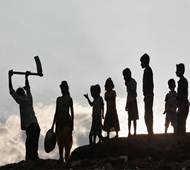
slavery copy copyAccording to the 2016 Global Slavery Index released by Australia-based human rights group Walk Free Foundation today, an estimated 45.8 million people, including women and children, are subject to some form of modern slavery in the world, compared to 35.8 million in 2014.

The report said India has the highest absolute numbers of people trapped in slavery with 18.35 million slaves among its 1.3 billion population while North Korea has the highest incidence (4.37 per cent of the population) and the weakest government response to deal with it.

In the last report in 2014, India had nearly 14.3 million people enslaved.
Incidences of slavery were found in all 167 countries in the index, with Asian countries occupy the top five for people trapped in slavery.

Behind India was China (3.39 million), Pakistan (2.13 million), Bangladesh (1.53 million) and Uzbekistan (1.23 million).

The index said that these five countries combined accounted for almost 58 per cent of the world's enslaved, or 26.6 million people.

The Index presents a ranking of 167 countries based on the proportion of the population that is estimated to be in modern slavery.

Modern slavery refers to situations of exploitation that a person cannot leave because of threats, violence, coercion, abuse of power or deception.

The research included over 42,000 interviews conducted in 53 languages across 25 countries, including 15 state-level surveys in India. These representative surveys covered 44 per cent of the global population.

The countries with the highest estimated prevalence of modern slavery by the proportion of their population are North Korea, Uzbekistan, Cambodia, Cambodia, India, and Qatar.

The countries with the lowest estimated prevalence of modern slavery by the proportion of their population are Luxembourg, Ireland, Norway, Denmark, Switzerland, Austria, Sweden and Belgium, the United States and Canada, and Australia and New Zealand.

The study also tracked the government actions and responses to the modern slavery and of the 161 assessed, 124 nations had criminalised human trafficking in line with the UN trafficking Protocol and 96 nations had developed national action plans to coordinate government response.

It noted that while India had more people enslaved than any other country, it had made significant progress in introducing measures to tackle the problem.

"It has criminalised trafficking, slavery, forced labour, child prostitution and forced marriage. The Indian government is currently tightening legislation against human trafficking, with tougher punishment for repeat offenders. It will offer victims protection and recovery support," it said.

It said that in addition to economic growth in India, ambitious programmes of legal and social reform are being undertaken right across the board, from regulation of labour relations to systems of social insurance for the most vulnerable.

Those governments taking the least action to combat modern slavery are North Korea, Iran, Eritrea, Equatorial Guinea, Hong Kong, Central African Republic, Papua New Guinea, Guinea, the Democratic Republic of the Congo and South Sudan.

The governments that have the strongest response to modern slavery are The Netherlands, the United States of America, the United Kingdom, Sweden, Australia, Portugal, Croatia, Spain, Belgium and Norway.

Seeking strong laws to abolish slavery, Andrew Forrest, Chairman and Founder of Walk Free Foundation, said eradicating slavery makes sense, morally, politically, logically and economically, and called on the governments of the world's leading economies to provide an example to others by enacting and implementing robust anti-slavery measures.

"We call on governments of the top 10 economies of the world to enact laws, at least as strong as the UK Modern Slavery Act 2015, with a budget and capability to ensure organisations are held to account for modern slavery in their supply chains, and to empower independent oversight."

Forrest said leaders of the world's major economies must bring the power of business to this issue, by requiring a focus on supply chain transparency.

"I believe in the critical role of leaders in government, business and civil society. Through our responsible use of power, strength of conviction, determination and collective will, we all can lead the world to end slavery," he said.

Forrest emphasised the key role that business needs to play in eradicating slavery.

"Businesses that don't actively look for forced labour within their supply chains are standing on a burning platform. Business leaders who refuse to look into the realities of their own supply chains are misguided and irresponsible," he said.

Comments

SK
 - 
Thursday, 2 Jun 2016

Since India is facing slavery, Naren has run away to Singapore to enjoy snake/ dog/cat/beef dishes......

Naren kotian
 - 
Tuesday, 31 May 2016

In that mostly 75% are from Muslim community as they enslave women as per their cult following .they have not changed since 6th century ...che papa ...ummah gang ge pitta netti geriruthe ..feku Anthe kumda ...for Muslims he might be feku ..but for nationalist Indians he is true hero who is transforming India .

Add new comment

  • Coastaldigest.com reserves the right to delete or block any comments.
  • Coastaldigset.com is not responsible for its readers’ comments.
  • Comments that are abusive, incendiary or irrelevant are strictly prohibited.
  • Please use a genuine email ID and provide your name to avoid reject.
coastaldigest.com news network
June 27,2020

Bengaluru, June 27: In the wake of mounting covid-19 cases across Karnataka, the state government has decided to extend the night curfew hours and to re-impose Sunday lockdown. 

Chief Minister BS Yediyurappa held an emergency meeting on Saturday with the state's top officials to discuss measures to further contain the spread of the novel coronavirus. 

During the meeting, it was decided that a state-wide lockdown will be imposed on each Sunday starting July 5. Only essential services and supplies will be allowed on Sundays.

Timings of the night curfew have also been revised to 8 PM - 5 AM from the earlier 9 PM - 5 AM. “We have decided to impose a curfew starting Monday, June 29, from 8 pm to 5 am every day. Right now, the curfew timing is 9 pm to 5 am, but it’ll be advanced by an hour to 8 pm,” said Home Minister Basavaraj Bommai

Commissioner of Bengaluru's civic body, BBMP has been directed to set up more wholesale vegetable markets to deter large crowds.

Meanwhile, government offices in Karnataka will open only five days a week and the weekend will be off for government employees.

It was also decided during the meeting on Saturday that a centralized bed-allocation system for Covid-19 patients will be taken up to ensure that each patient gets a bed without overwhelming the healthcare infrastructure.

Yediyurappa has also instructed officials to increase the number of ambulances for Covid-19 patients to 250 apart from arranging separate vehicles to carry mortal remains of victims. The police control room will aid officials in identifying the location and easing the movement of ambulances.

Information about nodal officers working for COVID management will be published. Joint Commissioners of 8 regions will be given additional responsibilities and KAS officers will be appointed to assist them.

The services of 180 ESI doctors appointed by the Labour Department will also be relied on by the state government. CM Yediyurappa has also asked officials to reserve wedding halls, hostels and other institutions in Bengaluru as COVID Care Centres.

Bengaluru Urban DC, on the other hand, was instructed to identify more places for the last rites of patients and also to form more teams for this purpose. 

The BBMP Commissioner has been told to notify reservation of 50 per cent beds in medical colleges and private hospitals.

Comments

Add new comment

  • Coastaldigest.com reserves the right to delete or block any comments.
  • Coastaldigset.com is not responsible for its readers’ comments.
  • Comments that are abusive, incendiary or irrelevant are strictly prohibited.
  • Please use a genuine email ID and provide your name to avoid reject.
News Network
May 21,2020

Bengaluru, May 21: With temples yet to open for devotees as coronavirus restrictions are in place, the Karnataka government is preparing for live streaming of sevas (service) and poojas offered to deities at temples that comes under the state's Hindu Religious Institutions and Charitable Endowment Department.

The government has also decided to develop an app and web-based software with an intention to provide information to devotees regarding temples, also to facilitate online donations and advance booking for various sevas offered there.

Regarding online live streaming, Commissioner of the Hindu Religious Institutions and Charitable Endowment Department has written to the Deputy Commissioners of all the districts and Executive Officers seeking a list of temples that comes under their jurisdiction where such facility can be provided.

"It has been intended to do online live streaming of sevas and pooja rituals at temples that come under the department in the backdrop of COVID-19 crisis. In this regard it is requested to provide a list of temples where online live facility can be provided to devotees, by abiding the traditions and practices of the temple," the letter said.

Though the temples are holding daily poojas and rituals, they are not open to public for now, with COVID-19 induced lockdown restrictions in place.

Officials had recently had stated that the department was planning to have a standard operating procedure (SOP) in place, that needs to be followed at temples in a post lockdown scenario, once they are opened for the public.

There are over 34,000 temples in the state that come under the department.

Meanwhile, in another letter to DCs of 15 districts, also Executive officers and administrators of 'A' grade temples, aimed at development of app and web-based software, the Commissioner has sought information regarding sevas offered at temples in their jurisdictions and those sevas for which option can be provided for devotees to do advance booking.

Comments

Add new comment

  • Coastaldigest.com reserves the right to delete or block any comments.
  • Coastaldigset.com is not responsible for its readers’ comments.
  • Comments that are abusive, incendiary or irrelevant are strictly prohibited.
  • Please use a genuine email ID and provide your name to avoid reject.
News Network
April 20,2020

Mangaluru, Apr 20: As Wenlock hospital has been converted into corona hospital, all the heads of private medical college hospitals have been instructed to treat Wenlock Hospital's out patients and in patients at a government hospital fare or at the charges of Wenlock Hospital, said Deputy Commissioner Sindhu B Rupesh on Sunday.

Treatment is also been given at Bijai, Yekkur, Kulur, Jeppu, Surathkal, Kulai, Padil, Shaktinagar, Bengre and Bunder Primary Health Centers. Patients with MLC (Medico Legal Case) or Police Case may seek treatment at a private medical college or city primary center.

Some private hospitals have already agreed to provide free dialysis services, as requested by the government.

Comments

Add new comment

  • Coastaldigest.com reserves the right to delete or block any comments.
  • Coastaldigset.com is not responsible for its readers’ comments.
  • Comments that are abusive, incendiary or irrelevant are strictly prohibited.
  • Please use a genuine email ID and provide your name to avoid reject.