


India tops global slavery index with 18.35 mn people enslaved

May 31, 2016

Melbourne, May 31: India has the dubious distinction of having the highest number of people in the world trapped in modern slavery with 18.35 million victims of forced labour, ranging from prostitution and begging, according to a new report, which estimated that nearly 46 million people are enslaved globally.
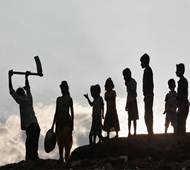
slavery copy copyAccording to the 2016 Global Slavery Index released by Australia-based human rights group Walk Free Foundation today, an estimated 45.8 million people, including women and children, are subject to some form of modern slavery in the world, compared to 35.8 million in 2014.

The report said India has the highest absolute numbers of people trapped in slavery with 18.35 million slaves among its 1.3 billion population while North Korea has the highest incidence (4.37 per cent of the population) and the weakest government response to deal with it.

In the last report in 2014, India had nearly 14.3 million people enslaved.
Incidences of slavery were found in all 167 countries in the index, with Asian countries occupy the top five for people trapped in slavery.

Behind India was China (3.39 million), Pakistan (2.13 million), Bangladesh (1.53 million) and Uzbekistan (1.23 million).

The index said that these five countries combined accounted for almost 58 per cent of the world's enslaved, or 26.6 million people.

The Index presents a ranking of 167 countries based on the proportion of the population that is estimated to be in modern slavery.

Modern slavery refers to situations of exploitation that a person cannot leave because of threats, violence, coercion, abuse of power or deception.

The research included over 42,000 interviews conducted in 53 languages across 25 countries, including 15 state-level surveys in India. These representative surveys covered 44 per cent of the global population.

The countries with the highest estimated prevalence of modern slavery by the proportion of their population are North Korea, Uzbekistan, Cambodia, Cambodia, India, and Qatar.

The countries with the lowest estimated prevalence of modern slavery by the proportion of their population are Luxembourg, Ireland, Norway, Denmark, Switzerland, Austria, Sweden and Belgium, the United States and Canada, and Australia and New Zealand.

The study also tracked the government actions and responses to the modern slavery and of the 161 assessed, 124 nations had criminalised human trafficking in line with the UN trafficking Protocol and 96 nations had developed national action plans to coordinate government response.

It noted that while India had more people enslaved than any other country, it had made significant progress in introducing measures to tackle the problem.

"It has criminalised trafficking, slavery, forced labour, child prostitution and forced marriage. The Indian government is currently tightening legislation against human trafficking, with tougher punishment for repeat offenders. It will offer victims protection and recovery support," it said.

It said that in addition to economic growth in India, ambitious programmes of legal and social reform are being undertaken right across the board, from regulation of labour relations to systems of social insurance for the most vulnerable.

Those governments taking the least action to combat modern slavery are North Korea, Iran, Eritrea, Equatorial Guinea, Hong Kong, Central African Republic, Papua New Guinea, Guinea, the Democratic Republic of the Congo and South Sudan.

The governments that have the strongest response to modern slavery are The Netherlands, the United States of America, the United Kingdom, Sweden, Australia, Portugal, Croatia, Spain, Belgium and Norway.

Seeking strong laws to abolish slavery, Andrew Forrest, Chairman and Founder of Walk Free Foundation, said eradicating slavery makes sense, morally, politically, logically and economically, and called on the governments of the world's leading economies to provide an example to others by enacting and implementing robust anti-slavery measures.

"We call on governments of the top 10 economies of the world to enact laws, at least as strong as the UK Modern Slavery Act 2015, with a budget and capability to ensure organisations are held to account for modern slavery in their supply chains, and to empower independent oversight."

Forrest said leaders of the world's major economies must bring the power of business to this issue, by requiring a focus on supply chain transparency.

"I believe in the critical role of leaders in government, business and civil society. Through our responsible use of power, strength of conviction, determination and collective will, we all can lead the world to end slavery," he said.

Forrest emphasised the key role that business needs to play in eradicating slavery.

"Businesses that don't actively look for forced labour within their supply chains are standing on a burning platform. Business leaders who refuse to look into the realities of their own supply chains are misguided and irresponsible," he said.

Comments

SK
 - 
Thursday, 2 Jun 2016

Since India is facing slavery, Naren has run away to Singapore to enjoy snake/ dog/cat/beef dishes......

Naren kotian
 - 
Tuesday, 31 May 2016

In that mostly 75% are from Muslim community as they enslave women as per their cult following .they have not changed since 6th century ...che papa ...ummah gang ge pitta netti geriruthe ..feku Anthe kumda ...for Muslims he might be feku ..but for nationalist Indians he is true hero who is transforming India .

Add new comment

  • Coastaldigest.com reserves the right to delete or block any comments.
  • Coastaldigset.com is not responsible for its readers’ comments.
  • Comments that are abusive, incendiary or irrelevant are strictly prohibited.
  • Please use a genuine email ID and provide your name to avoid reject.
News Network
July 8,2020

Bengaluru, Jul 8: The expert committee constituted by the Karnataka government to look into imparting online education in the wake of the COVID-19 lockdown submitted its report on Tuesday to the Minister for Primary and Secondary Education, S Suresh Kumar.

Amid growing pressure by educational institutions to allow them to run online classes for the students, the government set up the committee headed by noted educationist M K Sridhar.

The Minister told reporters that some schools wanted to run online classes, including for LKG and UKG students. It had also come to the government's notice that schools were reportedly charging hefty fees in the name of online teaching, he added.

"To address the concerns of parents, schools, and the future of the children, the committee was formed,"Kumar said. He further said that the government would study the recommendations and hold discussions with officials and various stakeholders before arriving at a decision.

The Education Department said that the committee, in its report, titled "Continuation of Learning in School Education of Karnataka: Guidelines During COVID-19 Pandemic for Technology Enabled Education and Beyond", has recommended teaching online or by using printed material. The committee suggested that children in the age group of three to six be taught online by way of story-telling, rhymes and games strictly in the presence of parents thrice a week just for one session a day For students from class one to three, it advised two periods a day and three days a week for online teaching.

Students from class three to five would have classes five days a week and two classes for 30 minutes a day. For students from class six to eight, there could be three classes a day for a duration of 30 minutes to 45 minutes each, while for students of class nine and 10 there would be four sessions a day between 30 and 45 minutes each.

The committee also suggested usage of Doordarshan and Akashwani for the government school children. Suresh Kumar said there were a few petitions filed in the Karnataka High Court regarding online teaching to the children.

Comments

Add new comment

  • Coastaldigest.com reserves the right to delete or block any comments.
  • Coastaldigset.com is not responsible for its readers’ comments.
  • Comments that are abusive, incendiary or irrelevant are strictly prohibited.
  • Please use a genuine email ID and provide your name to avoid reject.
coastaldigest.com news network
July 24,2020

Bengaluru, Jul 24: A government doctor who was turned away by three private hospitals because he could not produce a coronavirus test result passed away today in Bengaluru. Dr Manjunath, who was a frontline COVID-19 doctor, was allegedly turned away by hospitals when he was extremely ill and struggling to breathe.

Dr Manjunath worked in the state Health and Family Welfare department and was based in Ramanagara district, around 50 km from Bengaluru.

D Randeep, a Special Officer with the Bengaluru municipal body BBMP, said that the hospitals that had refused to admit Dr Manjunath would be reported to the health department.

In June-end, Dr Manjunath went to Rajashekhar Hospital in JP Nagar, BGS Global Hospital in Kengeri and Sagar hospital in Kumaraswamy Layout. All three demanded to see his COVID-19 test result but those were still not in at the time, according to his family. His brother-in-law Nagendra is also a doctor with BBMP and in charge of allotting hospital beds, yet he was completely helpless when it came to his own relative.

He was finally admitted to Sagar hospital on June 25 when his family sat in protest on the footpath outside the Dayananda Sagar campus. He was placed on ventilator and later shifted to the Bangalore Medical College and Research Institute, where he died earlier today. The hospital says Dr Manjunath was discharged on July 9 because he wanted plasma therapy.

Six members of his family, including a 14-year-old, tested COVID-19 positive. Most of them have recovered.

Bengaluru has seen several cases of patients being turned away from hospitals in the city. Hospitals say they need Covid test results to know whether to admit patients in the coronavirus ICU or in the general section and to understand treatment protocol.

Mr Randeep said hospitals have been instructed to admit patients even without such a certificate. Notices have been sent to hospitals that fail to comply. The OPD of two private hospitals was sealed for 48 hours when they refused to admit a patient.

Comments

Add new comment

  • Coastaldigest.com reserves the right to delete or block any comments.
  • Coastaldigset.com is not responsible for its readers’ comments.
  • Comments that are abusive, incendiary or irrelevant are strictly prohibited.
  • Please use a genuine email ID and provide your name to avoid reject.
News Network
May 4,2020

The government of India today said it will begin evacuating its nationals stuck abroad due to the coronavirus pandemic from May 7 in a phased manner. This facility would be made available on payment basis. 

A Standard Operating Protocol has been put in place and the travel would be arranged by aircraft as well as naval ships and will be available on a payment-basis, the government said.

"Medical screening of passengers would be done before taking the flight. Only asymptomatic passengers would be allowed to travel. During the journey, all these passengers would have to follow the protocols, such as the health protocols, issued by the ministry of health and the ministry of civil aviation," it said in a statement.

Specifying the protocols upon entry in India, the government said the returning Indians would be medically screened and will have to be quarantined for 14 days, either in a hospital or in an institutional quarantine on payment-basis, by the respective state government.

Comments

Add new comment

  • Coastaldigest.com reserves the right to delete or block any comments.
  • Coastaldigset.com is not responsible for its readers’ comments.
  • Comments that are abusive, incendiary or irrelevant are strictly prohibited.
  • Please use a genuine email ID and provide your name to avoid reject.