Revenue officials in Dakshina Kannada given deadline to clear RTC files

[email protected] (CD Network | Suresh Vamanjoor)
June 5, 2016

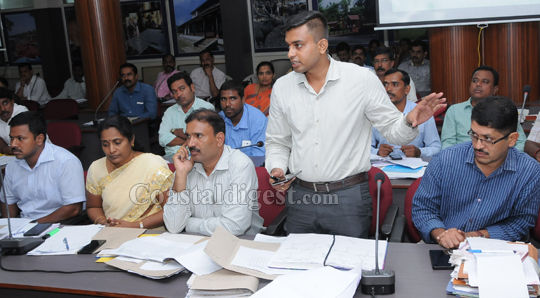
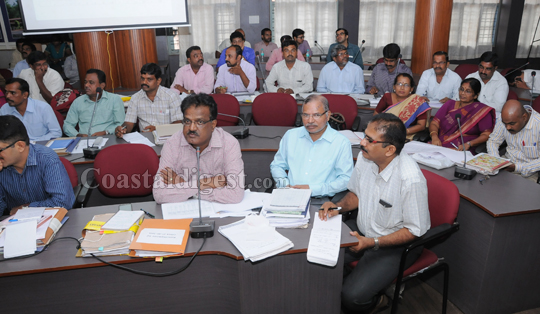
Mangaluru, Jun 5: Revenue officials in Dakshina Kannada have been urged to clear files on time instead of causing inconveniences to the people.

dc ofc 7

Pramod Madhwaraj, Udupi MLA and parliamentary secretary to the revenue minister, who attended a review meeting of revenue officials of the district here on Saturday said that land records should be made up to date.

Mr Madhwaraj fixed deadline for officials to clear files related to issuance of Record of Rights, Tenancy and Crop Inspection (RTC) or pahani, corrections in RTC and other works related to land records. He also warned officials of filing criminal cases if files are found missing in the department.

"No files related to correction in RTC should be pending for more than six months. There are 978 cases related to correction in RTC pertaining to government land in Dakshina Kannada district. There are 2,499 cases related to correction in RTC pertaining to non-government land," he said.

Under the Urban Property Ownership Records (UPOR) project, the process of survey and measurement has been completed in 1,43,387 properties in the city. UPOR cards have been distributed to 15,500 property owners in the city. Officials have informed that there is a shortage of surveyors and inquiry officers in the revenue department. Hence, the process of survey under UPOR is being delayed, he said, adding that the matter will be discussed with revenue minister V Srinivas Prasad.

On regularization of encroached government land, Pramod said the revenue department has received a total of 56,000 applications under 94C from rural areas in the district.

Meanwhile, 4,036 applications are pending under 94CC scheme in Mangaluru city limits, he said.

dc ofc 1

dc ofc 6

Comments

SK
 - 
Sunday, 5 Jun 2016

Govt officers should be taken to task and made accountable.....Lazy officers, they work only for money,,, Hell with these officers......

Add new comment

  • Coastaldigest.com reserves the right to delete or block any comments.
  • Coastaldigset.com is not responsible for its readers’ comments.
  • Comments that are abusive, incendiary or irrelevant are strictly prohibited.
  • Please use a genuine email ID and provide your name to avoid reject.
News Network
May 6,2020

Mysuru, May 6: A seven-months pregnant woman fled Covid-19 hotspot Mumbai along with her family, and made it to her village 1000 km away in KR Pet taluka in Mandya district of Karnataka, flashing her mother's ID card at each checkpost. After reaching her destination, she got herself tested for Covid-19.

She tested positive for the virus on Monday in Mandya.

The 20-year-old woman (assigned the number P637) had been living with her husband and in-laws at Santa Cruz East, Agripada in Mumbai for the past three years. To get out of the containment zone, they started out from Mumbai at 7.30 pm on April 23 -- she, her husband, brother-in-law, co-sister and their children, and a 19-year-old girl. She made it past checkposts at Belagavi, Hubballi, Davanagere, Kadur, Arasikere, Channarayapatna and Shravanabelagola and reached her village Jaaginakere at 3 pm on April 24.

She stayed at her home in the village from 24 April to April 29. With the Mandya district administration testing people on a campaign mode in the entire district, she and her family got themselves tested on May 1.

Her test returned positive on May 4, according to deputy commissioner M V Venkatesh.

Along with her, the 19-year-old girl (P638) who travelled with the family also tested positive. The girl is in the sixth semester of her BE Electronics course at an engineering college in Mumbai.

This is not the first case of a corona fugitive from Mumbai. Earlier, a 50-year-old man who ran a hotel in Mumbai travelled in a vehicle carrying dates and reached Channarayapatna in Hassan district.

In fact there have been three such incidents, including that of seven people coming to Mandya from Mumbai transporting a dead man's body for cremation in his native village of B Kodagalli in Pandavapura taluk.

Mandya deputy commissioner Dr Venkatesh has appealed to natives of Mandya who are stuck in Mumbai to stay there till the Covid situation comes to control.

So far 28 people in Mandya diatrict have tested positive for Covid 19. Seven people have been discharged. Currently there are 21 active cases being treated at the Mandya Institute of Medical Sciences.

Comments

Add new comment

  • Coastaldigest.com reserves the right to delete or block any comments.
  • Coastaldigset.com is not responsible for its readers’ comments.
  • Comments that are abusive, incendiary or irrelevant are strictly prohibited.
  • Please use a genuine email ID and provide your name to avoid reject.
Media Release
January 23,2020

Mangaluru, Jan 23: Veekshitha Arasa, an officially certified Zumba instructor is all set to present Zumba fitness on the Beach to the people of Mangalore on January 26, 2020. The Zumba event will be hosted at Panambur Beach on Republic Day (Sunday) from 4.00 p.m. to 6.00 p.m. Entry is free to the public and there are no tickets.

Veekshitha Arasa will be accompanied by some of the immensely talented Zumba Instructors from Bangalore who have been passionately spreading love for Zumba through their classes and events. Some amazing instructors from Mangalore too will be joining the event to make it even more happening.

With the sole aim to promote fitness among Mangaloreans these Zumba Instructors will make you groove to peppy, energetic numbers and make your evening sweat-blasting and fantastic.

The main presenter and host of this event Veekshitha hails basically from Mangalore. Having conducted Zumba training in various fitness centers and corporates across Bangalore and being the presenter in several mega events both in India and International Platforms in Hong Kong, Veekshitha always had a dream to have a full-fledged Zumba fitness event in her own city - Mangalore. The idea of having it by the beach side fascinated her even more and that’s how this event has been planned exclusively for the people of Mangalore right on the beach.

For all those who have been planning to start their fitness journey this might just be the beginning. Go join the Zumba party and shed some calories.

AJ Hospital & Research Centre, APD Foundation and SS Arrangers & Caterers are the sponsors for the event.

Comments

Add new comment

  • Coastaldigest.com reserves the right to delete or block any comments.
  • Coastaldigset.com is not responsible for its readers’ comments.
  • Comments that are abusive, incendiary or irrelevant are strictly prohibited.
  • Please use a genuine email ID and provide your name to avoid reject.
Agencies
May 8,2020

Washington D.C., May 8: The prime time for brain development in a child's life is the first year, where the infant spends most of the time asleep. It is the time when neural connections form and sensory memories are encoded.

However, when sleep is disrupted, as occurs more often among children with autism, brain development may be affected, too.

New research led by the University of Washington finds that sleep problems in a baby's first 12 months may not only precede an autism diagnosis but also may be associated with altered growth trajectory in a key part of the brain, the hippocampus.

The study, which was published in the American Journal of Psychiatry, researchers report that in a sample of more than 400 taken of 6- to 12-month-old infants, those who were later diagnosed with autism were more likely to have had difficulty falling asleep.

It also states that this sleep difficulty was associated with altered growth trajectories in the hippocampus.

"The hippocampus is critical for learning and memory, and changes in the size of the hippocampus have been associated with poor sleep in adults and older children.

As many as 80 per cent of the children with autism spectrum disorder have sleep problems," said Annette Estes, director of the UW Autism Center and senior author of the study.

"In our clinical experience, parents have a lot of concerns about their children's sleep, and in our work on early autism intervention, we observed that sleep problems were holding children and families back," added Estes, who is also a UW professor of speech and hearing sciences.

"It could be that altered sleep is part-and-parcel of autism for some children. One clue is that behavioural interventions to improve sleep don't work for all children with autism, even when their parents are doing everything just right. This suggests that there may be a biological component to sleep problems for some children with autism," said Estes.

To consider links among sleep, brain development, and autism, researchers at the IBIS Network looked at MRI scans of 432 infants, surveyed parents about sleep patterns, and measured cognitive functioning using a standardized assessment.

At the outset of the study, infants were classified according to their risk for developing autism: Those who were at higher risk of developing autism -- about two-thirds of the study sample -- had an older sibling who had already been diagnosed.

Infant siblings of children with autism have a 20 per cent chance of developing autism spectrum disorder -- a much higher risk than children in the general population.

In the current study, 127 of the 432 infants were identified as "low risk" at the time the MRI scans were taken because they had no family history of autism.

They later evaluated all the participants at 24 months of age to determine whether they had developed autism. Of the roughly 300 children originally considered "high familial risk," 71 were diagnosed with autism spectrum disorder at that age.

Problems with sleep were more common among the infants later diagnosed with an autism spectrum disorder, as were larger hippocampi. No other subcortical brain structures were affected, including the amygdala, which is responsible for certain emotions and aspects of memory, or the thalamus, a signal transmitter from the spinal cord to the cerebral cortex.

The authors note that while parents reported more sleep difficulties among infants who developed autism compared to those who did not, the differences were very subtle and only observed when looking at group averages across hundreds of infants.

Sleep patterns in the first years of life change rapidly as infants transition from sleeping around the clock to a more adult-like sleep/wake cycle. Until further research is completed, Estes said, it is not possible to interpret challenges with sleep as an early sign of increased risk for autism.


Comments

Add new comment

  • Coastaldigest.com reserves the right to delete or block any comments.
  • Coastaldigset.com is not responsible for its readers’ comments.
  • Comments that are abusive, incendiary or irrelevant are strictly prohibited.
  • Please use a genuine email ID and provide your name to avoid reject.