


Beef terror: Tense situation in Dadri as hate-mongers gear up for violence

June 6, 2016

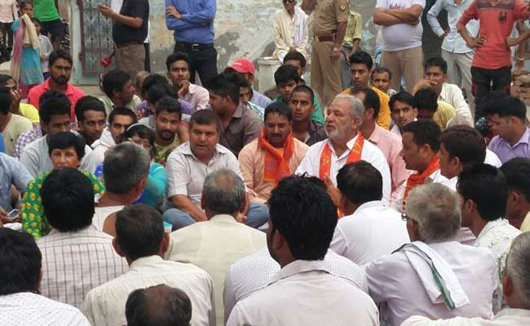
Greater Noida, Jun 6: Nine months after the Dadri lynching, the situation in Bishada village became tense again today as locals held a protest meeting ignoring prohibitory orders demanding that an FIR be registered against the victim's family for alleged cow slaughter.
dadri

The demand was sparked after a controversial forensic report stated that the meat found at the scene of the attack on Mohammad Akhlaq on the night of September 28 following rumours that his family stored and ate beef at their house was that of "cow or its progeny". A clarity was, however, yet to emerge from where exactly the meat was recovered.

The villagers had originally planned to have a maha panchayat to push for registration of the FIR against Akhlaq's family. The protest meeting was also attended by some local level Shiv Sena members, according to the organisers.

District Magistrate of Gautam Budh Nagar NP Singh has clamped Section 144 CrPC and issued prohibitory orders banning gathering of five or more persons in the district after Bishada villagers in Dadri announced panchayat for today and additional security personnel deployed in the village, officials said.

”Situation is under control," District Magistrtae NP Singh said, adding he has appealed to the residents not to resort to violence.

Political leaders should not politicise the matter since it is subjudice. "Let the case proceed in court. They can put their views or evidence before the court. Nobody will be allowed to disturb law and order.”

Sanjay Rana, father of accused Vishal Rana, had threatened that a maha panchayat will be held in the village as police have failed to register an FIR against Akhlaq's family.

"A complaint was filed with police after the forensic report said the meat in the freezer at Akhlaq's house was beef. No FIR has been filed yet in this regard," he said. The report submitted to the fast=track court was prepared by a Mathura-based Forensic lab and it surfaced last week.

The veterinary officer in his preliminary report that was cited by the police earlier had said that the meat sample was not beef, but meat of "goat progeny".

Rana went on to say that a calf had gone missing from the village in September last year and later animal remains were found near Ikhlaq's house. "Then Investigation Officer had taken the photographs of the meat piece and other parts and it was clear that it was calf which was killed. We only want that Ikhlaq's family should be booked for cow slaughtering.”

But Yusuf Saifi, advocate for the victim's family, said, ”meat piece was recovered from the nearby transformer and not from Ikhlaq's house. We will challenge the forensic report too in the court.”

Residents of Bishada village, including kin of the accused in the September 2015 Akhlaq lynching case, yesterday met the Gautam Budh Nagar SSP to press their demand for registration of an FIR against Akhlaq's family after a forensic report stated that the meat found in his house was that of "cow or its progeny".

BJP leader Vinay Katiyar supported the demand for registration of FIR against Akhlaq's family members and demanded that the compensation given to them be withdrawn.

"The question is that cow slaughter had taken place. The report has come and now FIR should be lodged against those involved in cow slaughter. Those who have been locked up in jail should be released. The compensation should be withdrawn. Government should take back the three houses given to them," he said.

The Congress criticised the statements of BJP leaders, saying it will vitiate the atmosphere.

"Calling for maha panchayat and the statements being made after the forensic report came are not proper. Whether it is the Centre or the state government, it should be stopped," Congress leader P L Punia said.

Comments

Intolerence
 - 
Tuesday, 7 Jun 2016

This is what exactly intolerence is all about.. Where is justice to the victims family???

India is Siv senas .. till they rule .. i mean Till mOdi rule

Seedibath
 - 
Tuesday, 7 Jun 2016

People should unite and fight against these hate mongers, they should be attacked in the same way as they attack innocent people, now these are RSS goons omitting their election worsts. only return attack can calm these shaitans.

abdul Rauf C.H
 - 
Tuesday, 7 Jun 2016

Indian Constitution clearly says \ Diffence is Not Offence\" let the muslims of india think in that direction instead waiting for So called Secular Parties and their Administration. sab mile hue Ji. i strongly believe Resistance is the Best Medicine for PEACE...!!"

Add new comment

  • Coastaldigest.com reserves the right to delete or block any comments.
  • Coastaldigset.com is not responsible for its readers’ comments.
  • Comments that are abusive, incendiary or irrelevant are strictly prohibited.
  • Please use a genuine email ID and provide your name to avoid reject.
Agencies
February 20,2020

India ranked 77th on a sustainability index that takes into account per capita carbon emissions and ability of children in a nation to live healthy lives and secures 131st spot on a flourishing ranking that measures the best chance at survival and well-being for children, according to a UN-backed report.

The report was released on Wednesday by a commission of over 40 child and adolescent health experts from around the world. It was commissioned by the World Health Organization (WHO), UN Children's Fund (UNICEF) and The Lancet medical journal.

In the report assessing the capacity of 180 countries to ensure that their youngsters can survive and thrive, India ranks 77th on the Sustainability Index and 131 on the Flourishing Index, it said.

Flourishing is the geometric mean of Surviving and Thriving. For Surviving, the authors selected maternal survival, survival in children younger than 5 years old, suicide, access to maternal and child health services, basic hygiene and sanitation, and lack of extreme poverty.

For Thriving, the domains were educational achievement, growth and nutrition, reproductive freedom, and protection from violence.

Under the Sustainability Index, the authors noted that promoting today's national conditions for children to survive and thrive must not come at the cost of eroding future global conditions for children's ability to flourish.

The Sustainability Index ranks countries on excess carbon emissions compared with the 2030 target. This provides a convenient and available proxy for a country's contribution to sustainability in future.

The report noted that under realistic assumptions about possible trajectories towards sustainable greenhouse gas emissions, models predict that global carbon emissions need to be reduced from 39·7 giga­ tonnes to 22·8 gigatonnes per year by 2030 to maintain even a 66 per cent chance of keeping global warming below 1·5°C.

It said that the world's survival depended on children being able to flourish, but no country is doing enough to give them a sustainable future.

"No country in the world is currently providing the conditions we need to support every child to grow up and have a healthy future," said Anthony Costello, Professor of Global Health and Sustainability at University College London, one of the lead authors of the report.

"Especially, they're under immediate threat from climate change and from commercial marketing, which has grown hugely in the last decade," said Costello – former WHO Director of Mother, Child and Adolescent health.

Norway leads the table for survival, health, education and nutrition rates - followed by South Korea and the Netherlands. Central African Republic, Chad and Somalia come at the bottom.

However, when taking into account per capita CO2 emissions, these top countries trail behind, with Norway 156th, the Republic of Korea 166th and the Netherlands 160th.

Each of the three emits 210 per cent more CO2 per capita than their 2030 target, the data shows, while the US, Australia, and Saudi Arabia are among the 10 worst emitters. The lowest emitters are Burundi, Chad and Somalia.

According to the report, the only countries on track to beat CO2 emission per capita targets by 2030, while also performing fairly – within the top 70 – on child flourishing measures are: Albania, Armenia, Grenada, Jordan, Moldova, Sri Lanka, Tunisia, Uruguay and Vietnam.

"More than 2 billion people live in countries where development is hampered by humanitarian crises, conflicts, and natural disasters, problems increasingly linked with climate change," said Minister Awa Coll-Seck from Senegal, Co-Chair of the commission.

The report also highlights the distinct threat posed to children from harmful marketing.

Evidence suggests that children in some countries see as many as 30,000 advertisements on television alone in a single year, while youth exposure to vaping (e-cigarettes) advertisements increased by more than 250 per cent in the US over two years, reaching more than 24 million young people.

Studies in Australia, Canada, Mexico, New Zealand and the US – among many others – have shown that self-regulation has not hampered commercial ability to advertise to children.

Children's exposure to commercial marketing of junk food and sugary beverages is associated with purchase of unhealthy foods and overweight and obesity, linking predatory marketing to the alarming rise in childhood obesity, it said.

The number of obese children and adolescents increased from 11 million in 1975 to 124 million in 2016 – an 11-fold increase, with dire individual and societal costs, the report said.

To protect children, the authors call for a new global movement driven by and for children.

Specific recommendations include stopping CO2 emissions with the utmost urgency, to ensure children have a future on this planet; placing children and adolescents at the centre of global efforts to achieve sustainable development, the report said.

New policies and investment in all sectors to work towards child health and rights; incorporating children's voices into policy decisions and tightening national regulation of harmful commercial marketing, supported by a new Optional Protocol to the UN Convention on the Rights of the Child, it said.

Comments

Add new comment

  • Coastaldigest.com reserves the right to delete or block any comments.
  • Coastaldigset.com is not responsible for its readers’ comments.
  • Comments that are abusive, incendiary or irrelevant are strictly prohibited.
  • Please use a genuine email ID and provide your name to avoid reject.
coastaldigest.com news network
May 28,2020

Mangaluru/Udupi, May 28: Coastal Karnataka witnessed further spike in covid-19 cases today with 27 people testing positive for coronavirus in Udupi and six in Dakshina Kannada. 

Among 27 coronavirus patients in Udupi 18 are males and 9 females. Among them 24 have come from Maharashtra, two from Telangana and one from Kerala. All of them were under quarantine.

As many as 147 confirmed cases of coronavirus have been reported so far in the district, including a death. Three have recovered, and 143 are active.

In Dakshina Kannada, 2 females aged 18 and 62, and four males aged 25, 36, 50 and 61, are the ones to be tested positive. All the six persons to test positive are Maharashtra returnees.

With this, the number of cases in DK has increased to 87, out of which 51 are currently active. As many as 29 persons have recovered and been discharged, and seven deaths have occurred so far.

Comments

Add new comment

  • Coastaldigest.com reserves the right to delete or block any comments.
  • Coastaldigset.com is not responsible for its readers’ comments.
  • Comments that are abusive, incendiary or irrelevant are strictly prohibited.
  • Please use a genuine email ID and provide your name to avoid reject.
News Network
April 16,2020

New Delhi, Apr 16: Minority Affairs Minister Mukhtar Abbas Naqvi on Thursday directed state waqf boards to ensure strict implementation of lockdown and social distancing guidelines during the holy month of Ramzan starting next week amid the coronavirus pandemic.

At a meeting via video conferencing, Naqvi asked the state waqf boards' officials to create awareness among people to offer prayers and perform other religious rituals like "iftar (breaking of fast)" during Ramzan, which begins on April 24 or 25, staying inside their homes.

More than seven lakh registered mosques, eidgahs, imambadas, dargahs and other religious and social institutions come under state waqf boards across the country. The Central Waqf Council is the regulatory body of state waqf boards in India.

"We should cooperate with health workers, security forces, administrative officers, sanitation workers. They are working for our safety and well-being even putting their own lives at risk in this coronavirus pandemic," Naqvi said.

"We should also demolish rumours and misinformation being spread about quarantine and isolation centres by creating awareness among people that such centres are only meant to protect people, their families and the society from the pandemic," the minister said.

Naqvi told all the state waqf boards and religious and social organisations that everyone should remain cautious of any type of fake news and conspiracies aimed at creating misinformation. 

"Authorities have been working for safety and well-being of all citizens of the country without any discrimination. Such type of rumours and conspiracies are a nefarious design to weaken the fight against coronavirus," he said.

"We should work united to win this fight against corona by defeating any type of rumour, misinformation and conspiracy," the minister said.

Naqvi asked officials of all the state waqf boards to play an active and effective role in ensuring that people follow the guidelines of the Union Home Ministry, state governments and the Central Waqf Council while fulfilling religious responsibilities during Ramzan.

In view of the challenges of the COVID-19 pandemic, all religious and social activities and mass gatherings in all the temples, gurdwaras, churches and other religious and social places of the country have been stopped, he said. 

Similarly, any mass gatherings in mosques and other Muslim religious places of the country has also been stopped, Naqvi said.

He said that due to the COVID-19 threat, religious leaders as well as religious and social organisations from all regions of the country, have appealed to people to offer prayers and perform all other religious rituals staying inside their homes during Ramzan. 

Most of the Muslim nations of the world have also banned mass gatherings at mosques and other religious places during the holy month, he pointed out.

Prime Minister Narendra Modi, in cooperation with all the state governments, has been working effectively for the safety and well-being of the people, he said.

The cooperation of the people has brought great relief to India in the war against COVID-19 Naqvi said, adding that several challenges are still there before the country. 

"We can defeat these challenges of the coronavirus pandemic by following all the guidelines of the central and state governments strictly," he asserted.

Chairman and senior officials from state waqf boards such as Uttar Pradesh (Shia & Sunni), Andhra Pradesh, Bihar (Shia & Sunni), Dadra & Nagar Haveli, Haryana, Karnataka, Kerala, Madhya Pradesh, Punjab, West Bengal, Andaman & Nicobar, Assam, Manipur, among others participated in the meeting.

State waqf boards from Rajasthan, Telangana, Delhi, Chhattisgarh, Gujarat, Himachal Pradesh, Jammu and Kashmir, Jharkhand, Maharashtra, Odisha, Puducherry, Tamil Nadu, Tripura and Uttarakhand also participated.

Comments

Add new comment

  • Coastaldigest.com reserves the right to delete or block any comments.
  • Coastaldigset.com is not responsible for its readers’ comments.
  • Comments that are abusive, incendiary or irrelevant are strictly prohibited.
  • Please use a genuine email ID and provide your name to avoid reject.