


The secrets of Udupi's Madhwa Brahmin kitchen leaked!

[email protected] (News Network | KM Acharya)
August 26, 2015

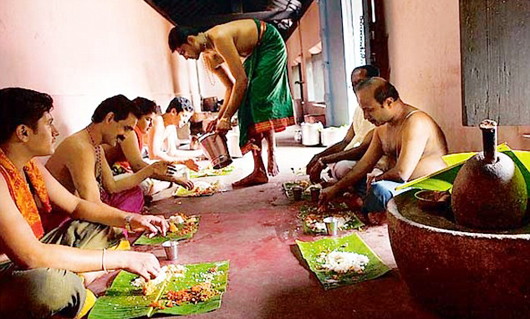
Udupi, Aug 26: What connects Bisi Bele Hulianna, Saaru, Modaka, Huggi, Majjige Palidya and Drakshi Gojju? These are some of the famed dishes of the Madhwa Brahmin community of Udupi, a coastal town in Karnataka where the Krishna temple acts as a pivot in people's lives.
brahmin

Laying out the geographical expanse and scientific logic to the regions Madhwa Brahmins vegetarian food habits, culinary expert Malati Srinivasan and arts and crafts connoisseur Geetha Rao showcase the hitherto unknown vegetarian recipes from Udupi in their book "The Udupi Kitchen."

The authors straddle the traditional and modern and list what was once easily cooked in Udupi households - spice powders, salads and chutneys, savoury snacks, desserts - and elaborate on several recipes which are all-time favourites like Bisi Bele Hulianna, Saaru, Masal Dose and Modaka.

While Bisi Bele Hulianna is a dish of spicy red gram, rice and vegetables, Saaru is spicy red gram soup, Huggi is rice and green gram with black pepper and cumin and Modaka is dumplings with coconut and jiggery filling.

Majjige Palidya is ash gourd with coconut and cumin in sour yoghurt and Drakshi Gojju is raisins in sweet, sour and spicy gravy.

Split into 12 sections, the Udupi Kitchen, published by Westland Ltd, celebrates vegetarian food with aplomb from a town where food is religion as well as a complete mouth-watering experience.

At the core of Udupi cuisine is the use of indigenous vegetables and fruits, cereals and pulses special to the Parashurama Kshetra and traditional Brahmins ate only vegetarian fare without onion and garlic.

According to the authors, Udupi cuisine has a vast variety and is not limited to tiffins or snacks.

"As I began working on this project, I realised how vast and varied our family’s repertoire of Udupi (Madhwa) cuisine was. I wrote down 175 recipes, but have used about a 100 of them in the book," says Srinivasan.

"Writing a cook book for both Indian and non-Indian readers required that a comprehensive multi-lingual glossary be compiled. It also meant using internationally accepted terminology: 'henchu' or 'tava' became griddle, bandle or 'kadhai' became wok, 'tappele' or 'bartan' became saucepan," says Rao.

She says for some kitchen tools like 'eelgemane' and 'ogarane chamcha', which had no "internationally understood" words, substitute words like curved knife blade and tempering-ladle had to be coined.

The story of Udupi cuisine is the story of how a temple-based, Brahmanical culinary tradition got modernised and became a global phenomenon. Food is religion in Udupi.

Fourteen varieties of food are cooked daily and offered to the deity at different times of the day. The food offered to god is 'naivediya', and the food eaten by human beings is 'prasada', food that is blessed.

In Udupi, meals are served on banana leaves in a particular order. Many recipes and foods have also proven health benefits. For example, dishes made from the inner banana stem prevent kidney stones, pepper rasam helps with the lactation of new mothers, jackfruit seeds have high protein content and so on.

The authors also say that the original of the masal dose or the famous masala dosa is attributed to Udupi.

Before it was invented, plain dosa was served with potato playa, without onions, in a separate cup. With changing food tastes, the Udupi chefs began to saute the mashed potatoes with onions and spices.

"As onions were considered taboo food for orthodox Brahmins, it is said that the doses were stuffed with onion-laced playa, instead of served in a separate cup, so that the onion could be 'hidden'," the authors say.

Comments

Usha moorthy
 - 
Wednesday, 8 Jun 2016

I'm extremely pleased that I now have a book to refer to for genuine udupi food!!! Thanks to the authors for painstakingly bringing together these wonderful recipes!!;

Add new comment

  • Coastaldigest.com reserves the right to delete or block any comments.
  • Coastaldigset.com is not responsible for its readers’ comments.
  • Comments that are abusive, incendiary or irrelevant are strictly prohibited.
  • Please use a genuine email ID and provide your name to avoid reject.
News Network
April 16,2020

New Delhi, Apr 16: Minority Affairs Minister Mukhtar Abbas Naqvi on Thursday directed state waqf boards to ensure strict implementation of lockdown and social distancing guidelines during the holy month of Ramzan starting next week amid the coronavirus pandemic.

At a meeting via video conferencing, Naqvi asked the state waqf boards' officials to create awareness among people to offer prayers and perform other religious rituals like "iftar (breaking of fast)" during Ramzan, which begins on April 24 or 25, staying inside their homes.

More than seven lakh registered mosques, eidgahs, imambadas, dargahs and other religious and social institutions come under state waqf boards across the country. The Central Waqf Council is the regulatory body of state waqf boards in India.

"We should cooperate with health workers, security forces, administrative officers, sanitation workers. They are working for our safety and well-being even putting their own lives at risk in this coronavirus pandemic," Naqvi said.

"We should also demolish rumours and misinformation being spread about quarantine and isolation centres by creating awareness among people that such centres are only meant to protect people, their families and the society from the pandemic," the minister said.

Naqvi told all the state waqf boards and religious and social organisations that everyone should remain cautious of any type of fake news and conspiracies aimed at creating misinformation. 

"Authorities have been working for safety and well-being of all citizens of the country without any discrimination. Such type of rumours and conspiracies are a nefarious design to weaken the fight against coronavirus," he said.

"We should work united to win this fight against corona by defeating any type of rumour, misinformation and conspiracy," the minister said.

Naqvi asked officials of all the state waqf boards to play an active and effective role in ensuring that people follow the guidelines of the Union Home Ministry, state governments and the Central Waqf Council while fulfilling religious responsibilities during Ramzan.

In view of the challenges of the COVID-19 pandemic, all religious and social activities and mass gatherings in all the temples, gurdwaras, churches and other religious and social places of the country have been stopped, he said. 

Similarly, any mass gatherings in mosques and other Muslim religious places of the country has also been stopped, Naqvi said.

He said that due to the COVID-19 threat, religious leaders as well as religious and social organisations from all regions of the country, have appealed to people to offer prayers and perform all other religious rituals staying inside their homes during Ramzan. 

Most of the Muslim nations of the world have also banned mass gatherings at mosques and other religious places during the holy month, he pointed out.

Prime Minister Narendra Modi, in cooperation with all the state governments, has been working effectively for the safety and well-being of the people, he said.

The cooperation of the people has brought great relief to India in the war against COVID-19 Naqvi said, adding that several challenges are still there before the country. 

"We can defeat these challenges of the coronavirus pandemic by following all the guidelines of the central and state governments strictly," he asserted.

Chairman and senior officials from state waqf boards such as Uttar Pradesh (Shia & Sunni), Andhra Pradesh, Bihar (Shia & Sunni), Dadra & Nagar Haveli, Haryana, Karnataka, Kerala, Madhya Pradesh, Punjab, West Bengal, Andaman & Nicobar, Assam, Manipur, among others participated in the meeting.

State waqf boards from Rajasthan, Telangana, Delhi, Chhattisgarh, Gujarat, Himachal Pradesh, Jammu and Kashmir, Jharkhand, Maharashtra, Odisha, Puducherry, Tamil Nadu, Tripura and Uttarakhand also participated.

Comments

Add new comment

  • Coastaldigest.com reserves the right to delete or block any comments.
  • Coastaldigset.com is not responsible for its readers’ comments.
  • Comments that are abusive, incendiary or irrelevant are strictly prohibited.
  • Please use a genuine email ID and provide your name to avoid reject.
News Network
July 5,2020

Mangaluru, Jul 5: A COVID-19 patient escaped from a hospital in Mangaluru on Sunday, Mangaluru Commissioner of Police Vikas Kumar.

A total of 1,925 cases of COVID-19 and 37 deaths recorded in Karnataka in the last 24 hours, taking the total number of cases to 23,474.

The health department informed that the death toll rose to 372 while active cases stood at 13,251 in the state.

According to the Union Health Ministry, India has recorded 6,73,165 numbers of COVID-19 cases and 19,268 deaths. 

Comments

Add new comment

  • Coastaldigest.com reserves the right to delete or block any comments.
  • Coastaldigset.com is not responsible for its readers’ comments.
  • Comments that are abusive, incendiary or irrelevant are strictly prohibited.
  • Please use a genuine email ID and provide your name to avoid reject.
News Network
March 21,2020

Mangaluru, Mar 21: Taking strict measures to contain the spreading of COVID-19, Dakshina Kannada Deputy Commissioner Sindhu B Rupesh, who is also District Magistrate, ordered sealing of road connectivity leading to Kerala State for all kinds of traffic from March 21 to midnight of March 31.

No vehicles will be allowed to operate between Dakshina Kannada and Kasaragod district in Kerala, the Deputy Commissioner said in a late-night order on Friday.

Ms. Rupesh said that in case of any emergency, vehicles will be allowed only through the Talapady check post on the National Highway 66, which is about 17 km away from Mangaluru city.

The Deputy Commissioner’s order came after the Kasaragod district reported six COVID-19 positive cases on Friday.

The order said that many vehicles operated between Kasaragod in Kerala and Mangaluru and hence, there is a need to take precautionary measures.

Private buses to not ply

Private bus operators in Dakshina Kannada will not operate their buses on March 22 to support the ‘Janata Curfew’ called by Prime Minister Narendra Modi.

Dilraj Alva, president, Dakshina Kananda Bus Operators’ Association, said in a release on Friday that people should remain in their homes on Sunday to help contain the community spreading of COVID-19. The decision has been taken in the interest of the public, he said.

Comments

Add new comment

  • Coastaldigest.com reserves the right to delete or block any comments.
  • Coastaldigset.com is not responsible for its readers’ comments.
  • Comments that are abusive, incendiary or irrelevant are strictly prohibited.
  • Please use a genuine email ID and provide your name to avoid reject.