


The secrets of Udupi's Madhwa Brahmin kitchen leaked!

[email protected] (News Network | KM Acharya)
August 26, 2015

Udupi, Aug 26: What connects Bisi Bele Hulianna, Saaru, Modaka, Huggi, Majjige Palidya and Drakshi Gojju? These are some of the famed dishes of the Madhwa Brahmin community of Udupi, a coastal town in Karnataka where the Krishna temple acts as a pivot in people's lives.
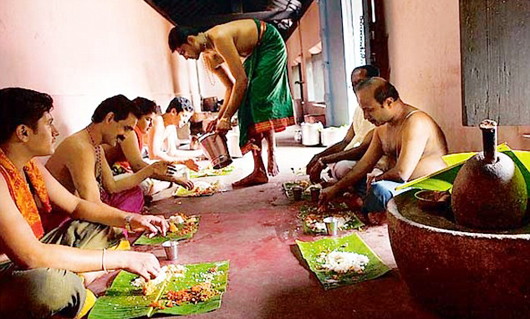
brahmin

Laying out the geographical expanse and scientific logic to the regions Madhwa Brahmins vegetarian food habits, culinary expert Malati Srinivasan and arts and crafts connoisseur Geetha Rao showcase the hitherto unknown vegetarian recipes from Udupi in their book "The Udupi Kitchen."

The authors straddle the traditional and modern and list what was once easily cooked in Udupi households - spice powders, salads and chutneys, savoury snacks, desserts - and elaborate on several recipes which are all-time favourites like Bisi Bele Hulianna, Saaru, Masal Dose and Modaka.

While Bisi Bele Hulianna is a dish of spicy red gram, rice and vegetables, Saaru is spicy red gram soup, Huggi is rice and green gram with black pepper and cumin and Modaka is dumplings with coconut and jiggery filling.

Majjige Palidya is ash gourd with coconut and cumin in sour yoghurt and Drakshi Gojju is raisins in sweet, sour and spicy gravy.

Split into 12 sections, the Udupi Kitchen, published by Westland Ltd, celebrates vegetarian food with aplomb from a town where food is religion as well as a complete mouth-watering experience.

At the core of Udupi cuisine is the use of indigenous vegetables and fruits, cereals and pulses special to the Parashurama Kshetra and traditional Brahmins ate only vegetarian fare without onion and garlic.

According to the authors, Udupi cuisine has a vast variety and is not limited to tiffins or snacks.

"As I began working on this project, I realised how vast and varied our family’s repertoire of Udupi (Madhwa) cuisine was. I wrote down 175 recipes, but have used about a 100 of them in the book," says Srinivasan.

"Writing a cook book for both Indian and non-Indian readers required that a comprehensive multi-lingual glossary be compiled. It also meant using internationally accepted terminology: 'henchu' or 'tava' became griddle, bandle or 'kadhai' became wok, 'tappele' or 'bartan' became saucepan," says Rao.

She says for some kitchen tools like 'eelgemane' and 'ogarane chamcha', which had no "internationally understood" words, substitute words like curved knife blade and tempering-ladle had to be coined.

The story of Udupi cuisine is the story of how a temple-based, Brahmanical culinary tradition got modernised and became a global phenomenon. Food is religion in Udupi.

Fourteen varieties of food are cooked daily and offered to the deity at different times of the day. The food offered to god is 'naivediya', and the food eaten by human beings is 'prasada', food that is blessed.

In Udupi, meals are served on banana leaves in a particular order. Many recipes and foods have also proven health benefits. For example, dishes made from the inner banana stem prevent kidney stones, pepper rasam helps with the lactation of new mothers, jackfruit seeds have high protein content and so on.

The authors also say that the original of the masal dose or the famous masala dosa is attributed to Udupi.

Before it was invented, plain dosa was served with potato playa, without onions, in a separate cup. With changing food tastes, the Udupi chefs began to saute the mashed potatoes with onions and spices.

"As onions were considered taboo food for orthodox Brahmins, it is said that the doses were stuffed with onion-laced playa, instead of served in a separate cup, so that the onion could be 'hidden'," the authors say.

Comments

Usha moorthy
 - 
Wednesday, 8 Jun 2016

I'm extremely pleased that I now have a book to refer to for genuine udupi food!!! Thanks to the authors for painstakingly bringing together these wonderful recipes!!;

Add new comment

  • Coastaldigest.com reserves the right to delete or block any comments.
  • Coastaldigset.com is not responsible for its readers’ comments.
  • Comments that are abusive, incendiary or irrelevant are strictly prohibited.
  • Please use a genuine email ID and provide your name to avoid reject.
News Network
August 5,2020

Shivamogga, Aug 5: Karnataka Minister KS Eshwarappa on Wednesday hailed the laying of foundation stone (bhoomi pujan) for a grand Ram temple in Ayodhya and said "Kashi Vishwanath and "Krishna Janmasthan temples have to be liberated".

"It is a good day that the foundation stone for Ram Temple has been laid. A beautiful temple will come up, but there are Kashi Vishwanath and Krishna Janmasthan temples which have to be liberated," Eshwarappa said.

The minister said that there is a "sign of slavery" at Krishna temple in Mathura and Kashi Vishwanath temple in Varanasi.

"The whole nation is dreaming of Shri Krishna temple in Mathura and Kashi Vishwanath temple. I have visited the two temples. 

There is a sign of slavery. Mosques are there at holy places. When I visited the place at Mathura, I witnessed the wall. When we look at the wall, we feel like we are still slaves," he said.

"While visiting Kashi, there is also a structure of slavery. Dream of Hindus is fulfilled in Ayodhya. One day, it will be fulfilled in Mathura and Kashi. Mathura Sri Krishna and Kashi Vishwanath will be freed and temple will be built," Eshwarappa added.

The Places of Worship Act, enacted in 1991, says that religious character of a place of worship existing on the August 15, 1947 shall continue to be the same as it existed on that day. The Act kept Ayodhya case out of its purview.

Comments

Add new comment

  • Coastaldigest.com reserves the right to delete or block any comments.
  • Coastaldigset.com is not responsible for its readers’ comments.
  • Comments that are abusive, incendiary or irrelevant are strictly prohibited.
  • Please use a genuine email ID and provide your name to avoid reject.
News Network
March 15,2020

Bengaluru, Mar 15: The week-long ban imposed by the Karnataka Government from Saturday is yet to get a total response in the State to fight against the spread of killer disease Coronavirus (COVID-19).

The ban has witnessed a considerable reduction in the travelling public by Bus and train. Bus terminal and Railway stations wore desert look or only a very few public travelling. KSRTC, which was maintaining service for every 10 minutes once between the State Capital and to City of Palaces, was forced to cancel most of the service due to very little patronage. 

"We were left with no option but to cancel the fleet since there are no passengers," sources at the KSRTC Bus terminal told media persons.

Comments

Add new comment

  • Coastaldigest.com reserves the right to delete or block any comments.
  • Coastaldigset.com is not responsible for its readers’ comments.
  • Comments that are abusive, incendiary or irrelevant are strictly prohibited.
  • Please use a genuine email ID and provide your name to avoid reject.
News Network
April 28,2020

Bengaluru, Apr 28:  Karnataka Chief Minister B S Yediyurappa today launched a Helpline service for Kannadigas residing outside Karnataka.

On April 24, Dakshina Kannada district in-charge Minister Kota Srinivas Poojary in a letter to the Chief Minister requested a helpline for stranded Kannadigas in Mumbai, other States and other countries.

The helpline will help resolve the problem of stranded Kannadigas across the country. After a request is made, local authorities of the caller will be contacted to provide the required help. The helpline will be operated from Bengaluru and staffed with 50 employees in three shifts.

Comments

Add new comment

  • Coastaldigest.com reserves the right to delete or block any comments.
  • Coastaldigset.com is not responsible for its readers’ comments.
  • Comments that are abusive, incendiary or irrelevant are strictly prohibited.
  • Please use a genuine email ID and provide your name to avoid reject.