


The secrets of Udupi's Madhwa Brahmin kitchen leaked!

[email protected] (News Network | KM Acharya)
August 26, 2015

Udupi, Aug 26: What connects Bisi Bele Hulianna, Saaru, Modaka, Huggi, Majjige Palidya and Drakshi Gojju? These are some of the famed dishes of the Madhwa Brahmin community of Udupi, a coastal town in Karnataka where the Krishna temple acts as a pivot in people's lives.
brahmin

Laying out the geographical expanse and scientific logic to the regions Madhwa Brahmins vegetarian food habits, culinary expert Malati Srinivasan and arts and crafts connoisseur Geetha Rao showcase the hitherto unknown vegetarian recipes from Udupi in their book "The Udupi Kitchen."

The authors straddle the traditional and modern and list what was once easily cooked in Udupi households - spice powders, salads and chutneys, savoury snacks, desserts - and elaborate on several recipes which are all-time favourites like Bisi Bele Hulianna, Saaru, Masal Dose and Modaka.

While Bisi Bele Hulianna is a dish of spicy red gram, rice and vegetables, Saaru is spicy red gram soup, Huggi is rice and green gram with black pepper and cumin and Modaka is dumplings with coconut and jiggery filling.

Majjige Palidya is ash gourd with coconut and cumin in sour yoghurt and Drakshi Gojju is raisins in sweet, sour and spicy gravy.

Split into 12 sections, the Udupi Kitchen, published by Westland Ltd, celebrates vegetarian food with aplomb from a town where food is religion as well as a complete mouth-watering experience.

At the core of Udupi cuisine is the use of indigenous vegetables and fruits, cereals and pulses special to the Parashurama Kshetra and traditional Brahmins ate only vegetarian fare without onion and garlic.

According to the authors, Udupi cuisine has a vast variety and is not limited to tiffins or snacks.

"As I began working on this project, I realised how vast and varied our family’s repertoire of Udupi (Madhwa) cuisine was. I wrote down 175 recipes, but have used about a 100 of them in the book," says Srinivasan.

"Writing a cook book for both Indian and non-Indian readers required that a comprehensive multi-lingual glossary be compiled. It also meant using internationally accepted terminology: 'henchu' or 'tava' became griddle, bandle or 'kadhai' became wok, 'tappele' or 'bartan' became saucepan," says Rao.

She says for some kitchen tools like 'eelgemane' and 'ogarane chamcha', which had no "internationally understood" words, substitute words like curved knife blade and tempering-ladle had to be coined.

The story of Udupi cuisine is the story of how a temple-based, Brahmanical culinary tradition got modernised and became a global phenomenon. Food is religion in Udupi.

Fourteen varieties of food are cooked daily and offered to the deity at different times of the day. The food offered to god is 'naivediya', and the food eaten by human beings is 'prasada', food that is blessed.

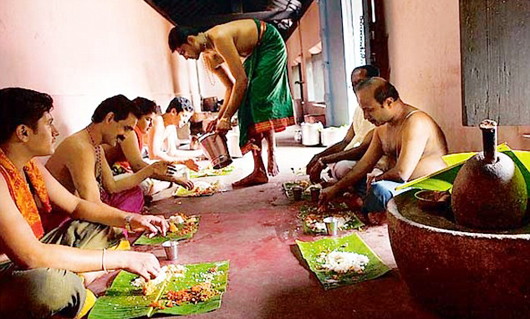
In Udupi, meals are served on banana leaves in a particular order. Many recipes and foods have also proven health benefits. For example, dishes made from the inner banana stem prevent kidney stones, pepper rasam helps with the lactation of new mothers, jackfruit seeds have high protein content and so on.

The authors also say that the original of the masal dose or the famous masala dosa is attributed to Udupi.

Before it was invented, plain dosa was served with potato playa, without onions, in a separate cup. With changing food tastes, the Udupi chefs began to saute the mashed potatoes with onions and spices.

"As onions were considered taboo food for orthodox Brahmins, it is said that the doses were stuffed with onion-laced playa, instead of served in a separate cup, so that the onion could be 'hidden'," the authors say.

Comments

Usha moorthy
 - 
Wednesday, 8 Jun 2016

I'm extremely pleased that I now have a book to refer to for genuine udupi food!!! Thanks to the authors for painstakingly bringing together these wonderful recipes!!;

Add new comment

  • Coastaldigest.com reserves the right to delete or block any comments.
  • Coastaldigset.com is not responsible for its readers’ comments.
  • Comments that are abusive, incendiary or irrelevant are strictly prohibited.
  • Please use a genuine email ID and provide your name to avoid reject.
coastaldigest.com news network
January 12,2020

Mangaluru, Jan 12: Sudarshan Moodbidri and Robin Devaiah were today unanimous elected presidents of Dakshina Kannada and Kodagu district units of Bharatiya Janata Party.

Karnataka BJP vice-president Nirmal Kumar Surana oversaw the election process of the two district units at the BJP’s party office here.

While Sanjeeva Matandoor, Puttur MLA and incumbent president of DK unit of the party welcomed his successor Sudarshan, it was the turn of BB Bharatheesh, president of Kodagu unit to welcome Robin.

K Uday Kumar Shetty, DK district election officer and Ravi Kalappa, Kodagu district assistant election officer conducted the election under the supervision of Surana in the presence of MLAs of the party from respective districts.

Sudarshan started out his career as taluk and then district convener of Bajrang Dal before taking up responsibility as seva pramukh of Vishwa Hindu Parishad.

He formally joined the BJP as general secretary of Mulki-Moodbidri assembly unit of the party, moved on as convener of training cell of the party and was the general secretary of the district unit of the party before his elevation. A B.Com student of Dhavala College, Moodbidri, he is 44.

Robin, 50, who started out as a RSS volunteer as a student, too is incumbent general secretary of the Kodagu unit. Having been a member of ABVP for 8-years, he joined BJP formally in 1996 through Yuva Morcha and was its district treasurer, national executive member and state general secretary.

A product of Field Marshal K M Cariappa College, Kodagu, he served two terms as general secretary of the district unit prior to his elevation.

Comments

Add new comment

  • Coastaldigest.com reserves the right to delete or block any comments.
  • Coastaldigset.com is not responsible for its readers’ comments.
  • Comments that are abusive, incendiary or irrelevant are strictly prohibited.
  • Please use a genuine email ID and provide your name to avoid reject.
News Network
June 11,2020

New Delhi, Jun 11: The Department of Pharmaceuticals has given its nod for lifting of ban on the export of hydroxychloroquine, Union Minister D V Sadananda Gowda said on Wednesday.

India had banned export of hydroxychloroquine on March 25, with some exceptions, amid views in some quarters that the drug could be used to fight COVID-19. On April 4, it completely banned the exports without any exception.

"Department of Pharmaceuticals has approved the lifting of ban on export of Hydroxychloroquine API as well as formulations. Manufacturers except SEZ/EOU Units have to supply 20 per cent production in the domestic market," the minister of chemicals and fertilisers said in a tweet.

The Directorate General of Foreign Trade (DGFT) has been asked to issue formal notification in this regard, he added.

In another tweet, Gowda said he held discussions with representatives of pharma companies along with some of his ministerial colleagues on the challenges being faced by the industry and on the roadmap to boost exports.

"Had detailed discussion with representatives of pharma companies & association, stakeholder Ministries along with Hon Ministers @piyushGoyal  ji, @HardeepSPuri  ji, & @MansukhMandviya  ji on entire gamut of challenges faced by the industry as well as strategies to boost pharma export," Gowda tweeted.

India exported hydroxychloroquine API (active pharmaceutical ingredient) worth USD 1.22 billion in April-January 2019-20.

During the same period, exports of formulations made from hydroxychloroquine was at USD 5.50 billion.

Comments

Add new comment

  • Coastaldigest.com reserves the right to delete or block any comments.
  • Coastaldigset.com is not responsible for its readers’ comments.
  • Comments that are abusive, incendiary or irrelevant are strictly prohibited.
  • Please use a genuine email ID and provide your name to avoid reject.
News Network
April 23,2020

Mangaluru, Apr 23: An astronomical phenomenon, ‘Zero Shadow Day', will be observed in Mangaluru on April 24 and in Udupi on April 25. 

According to a press release from Poornaprajna Amateur Astronomers’ Club, the wonder will commence and people will see their shadows disappear for a few moments at 12:28 pm.

The phenomenon is called as Zero Shadow Day. If a person takes a candle in a dark room and use it to create a shadow of one’s palm on the wall, the hand will cast shadow on the wall as one moves the hand. But when one places the palm on the wall, there will be no shadow.

In the phenomenon, the sun at these times shines exactly above the heads on these days. In astronomy, this point is called as Zenith. The point in the sky directly above an observer at any given location. So it is quite clear now that on Zero Shadow Day, the sun passes through the Zenith as a result of which, all objects will have minimal or no shadow if they are on the ground.

The reason for this happens on some specific days is concerned with astronomy. The earth spins around on its own axis and causes days and nights. It also revolves around the sun causing a year. But the seasons are caused because the axis is tilted at an angle of 23.5 degrees. It is because of this tilt that the sun rises every day in the east gradually moving towards the north till June 21st and then slowly proceeding towards the south till December 21st every year. “We call these days solstice. This means the sun shines between the Tropic of Cancer and Tropic of Capricorn every day passing by the equator on the days we call equinox,” the release stated.

As the earth moves around the sun and revolves on its own axis, for all the people between Tropic of Cancer and Tropic of Capricorn, the Sun at noon moves father and closer to the zenith passing through zenith twice causing two Zero Shadow Days per year. People at Mangaluru will observe this on April 24 and August 18 every year and People in Udupi will observe this on April 25 and August 17 every year.

Places with same latitudes will observe the same days of Zero Shadow but the time would vary with longitude. For example, people of Bengaluru as they share the latitude with Mangaluru will also observe it on April 24. While the people of Mangaluru will observe their shadows disappear at 12.28pm, people of Bengaluru will observe this at 12:17pm. Places like Moodabidri, Bantwal, Sakleshpur and Hassan will also observe Zero Shadow on April 24.

Places like Brahmavar, Karkala, Sringeri, Kudremukha, Chikkamagaluru will observe the Zero Shadow Day on the same day as Udupi on April 25.

Comments

Add new comment

  • Coastaldigest.com reserves the right to delete or block any comments.
  • Coastaldigset.com is not responsible for its readers’ comments.
  • Comments that are abusive, incendiary or irrelevant are strictly prohibited.
  • Please use a genuine email ID and provide your name to avoid reject.