


The secrets of Udupi's Madhwa Brahmin kitchen leaked!

[email protected] (News Network | KM Acharya)
August 26, 2015

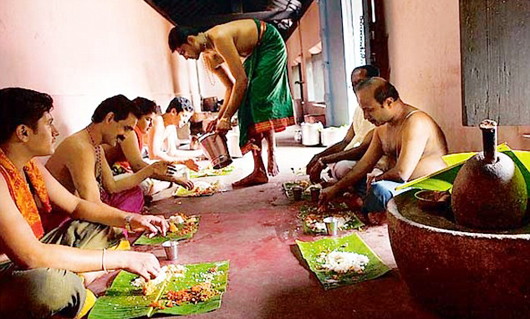
Udupi, Aug 26: What connects Bisi Bele Hulianna, Saaru, Modaka, Huggi, Majjige Palidya and Drakshi Gojju? These are some of the famed dishes of the Madhwa Brahmin community of Udupi, a coastal town in Karnataka where the Krishna temple acts as a pivot in people's lives.
brahmin

Laying out the geographical expanse and scientific logic to the regions Madhwa Brahmins vegetarian food habits, culinary expert Malati Srinivasan and arts and crafts connoisseur Geetha Rao showcase the hitherto unknown vegetarian recipes from Udupi in their book "The Udupi Kitchen."

The authors straddle the traditional and modern and list what was once easily cooked in Udupi households - spice powders, salads and chutneys, savoury snacks, desserts - and elaborate on several recipes which are all-time favourites like Bisi Bele Hulianna, Saaru, Masal Dose and Modaka.

While Bisi Bele Hulianna is a dish of spicy red gram, rice and vegetables, Saaru is spicy red gram soup, Huggi is rice and green gram with black pepper and cumin and Modaka is dumplings with coconut and jiggery filling.

Majjige Palidya is ash gourd with coconut and cumin in sour yoghurt and Drakshi Gojju is raisins in sweet, sour and spicy gravy.

Split into 12 sections, the Udupi Kitchen, published by Westland Ltd, celebrates vegetarian food with aplomb from a town where food is religion as well as a complete mouth-watering experience.

At the core of Udupi cuisine is the use of indigenous vegetables and fruits, cereals and pulses special to the Parashurama Kshetra and traditional Brahmins ate only vegetarian fare without onion and garlic.

According to the authors, Udupi cuisine has a vast variety and is not limited to tiffins or snacks.

"As I began working on this project, I realised how vast and varied our family’s repertoire of Udupi (Madhwa) cuisine was. I wrote down 175 recipes, but have used about a 100 of them in the book," says Srinivasan.

"Writing a cook book for both Indian and non-Indian readers required that a comprehensive multi-lingual glossary be compiled. It also meant using internationally accepted terminology: 'henchu' or 'tava' became griddle, bandle or 'kadhai' became wok, 'tappele' or 'bartan' became saucepan," says Rao.

She says for some kitchen tools like 'eelgemane' and 'ogarane chamcha', which had no "internationally understood" words, substitute words like curved knife blade and tempering-ladle had to be coined.

The story of Udupi cuisine is the story of how a temple-based, Brahmanical culinary tradition got modernised and became a global phenomenon. Food is religion in Udupi.

Fourteen varieties of food are cooked daily and offered to the deity at different times of the day. The food offered to god is 'naivediya', and the food eaten by human beings is 'prasada', food that is blessed.

In Udupi, meals are served on banana leaves in a particular order. Many recipes and foods have also proven health benefits. For example, dishes made from the inner banana stem prevent kidney stones, pepper rasam helps with the lactation of new mothers, jackfruit seeds have high protein content and so on.

The authors also say that the original of the masal dose or the famous masala dosa is attributed to Udupi.

Before it was invented, plain dosa was served with potato playa, without onions, in a separate cup. With changing food tastes, the Udupi chefs began to saute the mashed potatoes with onions and spices.

"As onions were considered taboo food for orthodox Brahmins, it is said that the doses were stuffed with onion-laced playa, instead of served in a separate cup, so that the onion could be 'hidden'," the authors say.

Comments

Usha moorthy
 - 
Wednesday, 8 Jun 2016

I'm extremely pleased that I now have a book to refer to for genuine udupi food!!! Thanks to the authors for painstakingly bringing together these wonderful recipes!!;

Add new comment

  • Coastaldigest.com reserves the right to delete or block any comments.
  • Coastaldigset.com is not responsible for its readers’ comments.
  • Comments that are abusive, incendiary or irrelevant are strictly prohibited.
  • Please use a genuine email ID and provide your name to avoid reject.
News Network
February 19,2020

Feb 19: Bavaguthu Raghuram Shetty was once a typical billionaire with a taste for the high-life.

He splurged on a private jet, vintage cars and two entire floors of the Burj Khalifa, the world’s tallest skyscraper. His website shows him hobnobbing with politicians, Bill Gates and Bollywood royalty.

“The thrill of speed and freedom makes me love cars,” Shetty, 77, told local reporters last year.

Shetty had more than enough money -- at least on paper -- to afford such a lifestyle from companies he helped found, including hospital operator NMC Health Plc and financial services firm Finablr Plc. On Dec. 10, his stakes in the public companies were valued at $2.4 billion, making up the bulk of a fortune spanning education, hospitality and one of the world’s oldest tea companies.

Then, a week later, Carson Block came along.

Block’s investment firm, Muddy Waters, issued a report criticizing NMC’s accounts and disclosing a short position. Since then, Muddy Waters’s scrutiny has snowballed into a troubling scenario for Shetty that sheds light on his complex share arrangements and casts doubts about his net worth. His holdings in Finablr and NMC are worth $885 million, but Shetty’s fortune may now be just a fraction of that, depending on the size of his borrowings.

Filings this month show that Shetty pledged a quarter of his NMC stake against loans with First Abu Dhabi Bank and Zurich-based Falcon Private Bank. Two other shareholders may own half of his reported stake. Another lender -- Al Salam Bank Bahrain -- has already sold some of those shares to enforce security over a loan for Shetty, and NMC said Tuesday that First Abu Dhabi Bank sold another chunk earlier this month.

The situation “seems to have gone beyond some of the issues that Muddy Waters focused on initially,“ said Gavin Launder, a fund manager at Legal & General Investment Management, who owned shares in NMC until October. “The increased scrutiny has unearthed other issues.”

Law firm Herbert Smith Freehills has launched a review of Shetty’s holdings at his request, a spokesperson for the Indian-born businessman said, declining to comment further until the analysis is completed. Shetty resigned Sunday as NMC’s chairman.

In its Dec. 17 report on NMC, Muddy Waters hinted at potential overpayment for assets, inflated cash balances and understated debt. Shares of the United Arab Emirates’ biggest private health-care provider have since plunged 67%, and the firm is now the focus of takeover speculation. The sell-off also spread to Finablr, whose stock has tumbled 64% in that span.

NMC has disputed Muddy Waters’s claims, and the company hired former FBI Director Louis Freeh to conduct an independent review of the short seller’s allegations. Meanwhile, local regulators “are making inquiries with the relevant parties,” a spokesperson for the U.K.’s Financial Conduct Authority said.

Shetty is hardly the only ultra-wealthy person to leverage his assets. Elon Musk has used his shares in Tesla Inc. to obtain personal loans, while Oracle Corp. Chairman Larry Ellison has put up millions of the company’s shares to fund a lavish lifestyle that includes trophy properties, America’s Cup teams and the Indian Wells tennis facility in California.

But such deals can also sour, as demonstrated by Shetty’s lenders selling shares his investment firm pledged. He and his advisers are investigating details of the sales as part of their legal review, according to filings.

To complicate matters, Shetty pledged another batch of NMC stock in 2018 as part of a so-called equity collar arrangement with Goldman Sachs Group Inc. that uses options to limit the impact from share moves. Last month, he also pledged most of his stake in Finablr to refinance a loan from the company’s takeover of foreign-exchange firm Travelex for about $1.2 billion.

BRS Ventures Investment, the UAE-based holding company for most of Shetty’s assets, doesn’t report consolidated financials, preventing a complete analysis of his net worth. His other assets include a catering company, a waste-management firm and pharmaceutical business Neopharma, which four months ago was in the early stages of planning for an initial public offering.

Block, 43, earned his reputation as a short seller a decade ago through targeting U.S.-listed Chinese companies that he claimed were frauds. More recently, his San Francisco-based firm focused on British litigation-finance firm Burford Capital Ltd. and Japanese biotech stock PeptiDream Inc. Short sellers seek to benefit from a decline in a company’s share price.

Shetty founded NMC in 1975 after moving to Abu Dhabi from his native India. He created Finablr two years ago to consolidate his financial brands before listing it on the London Stock Exchange in 2019.

Block said he didn’t anticipate NMC’s shareholding drama.

“I wouldn’t have been able to predict that we’d get these bizarre disclosures about unclear share ownership coming out of the company,” he said in a Feb. 13 phone interview. “This has been obviously a more dramatic unraveling than we usually see.”

Comments

Add new comment

  • Coastaldigest.com reserves the right to delete or block any comments.
  • Coastaldigset.com is not responsible for its readers’ comments.
  • Comments that are abusive, incendiary or irrelevant are strictly prohibited.
  • Please use a genuine email ID and provide your name to avoid reject.
News Network
February 25,2020

Mangaluru, Feb 25: Notorious gangster Ravi Poojary,

who has been extradited to India from Senegal, has 34 cases registered against him within the city police commissionerate.

Now in Bengaluru police custody for interrogation in connection with several cases there, Poojary faces cases relating to murder, murder attempt, extortion and threat calls in the city, police sources said.

Sources said the city police are trying to get Pujari for interrogation though it would take a while as the court has allowed Bengaluru police to keep him in custody for questioning and evidence taking for 15 days.

Most of the cases in the city against him, 28 of them, are in connection with threat calls.

He had allegedly made threat calls in 2015 to the then state ministers B Ramanath Rai and Abhayachandra Jain, demanding immediate arrest of the accused in the murder of Bajrang Dal worker Prashanth Poojary.

All the cases against Poojary in the city were registered between 2007 and 2018.

Cases involving murder, death threats and shootouts are among the cases to be investigated, the sources said.

A total of 28 cases of death threat calls, one of murder, three of shootouts, one of abduction and a case of funding his associates lodged in prison are the crimes being probed by the city police.

The cases are now pending in courts at different stages of trial.

Cases of making threat calls to businessmen using his associates demanding protection money have been registered at Moodbidri, Kavoor, Kadri, Konaje, Barke and Urwa police stations.

Some of his associates were imprisoned in 2012 in connection with threat calls to a businessman from Kinnigoli.

The case relating to providing them money while in prison was also registered in the same year.

Pujari, wanted in many cases including extortion and murder in different parts of the country, including Karnataka and who had been on the run for over 15 years, was deported to Senegal following his arrest and later extradited

He had jumped bail in Senegal last year after being arrested there.

Comments

Add new comment

  • Coastaldigest.com reserves the right to delete or block any comments.
  • Coastaldigset.com is not responsible for its readers’ comments.
  • Comments that are abusive, incendiary or irrelevant are strictly prohibited.
  • Please use a genuine email ID and provide your name to avoid reject.
coastaldigest.com web desk
June 17,2020

Remember social media memes of Chinese companies exporting #BoycottChina hats and t-shirts to India? This time India’s sensational and saffronite TV anchor Arnab Goswami vindicated those memes by hosting an anti-China debate show which was sponsored by Chinese companies!

While the last night's debate was all about boycotting Chinese products in the wake of massacre of over 20 Indian soldiers by their Chinese counterparts in eastern Ladakh, the show was brazenly promoting Chinese products through advertisement placements. 

During the debate, amongst the flashy headlines, there were two brand sponsorships that appeared: VIVO and Xiaomi. Both companies are giant Chinese multinational corporations. 

Twitter user Nirmala Tai, who was among those who spotted this irony, highlighted two instances during the debate where the logo of one of the brands popped up, and one where Xiaomi was found promoting the Mi 10. 

Many Twitterati used Goswami’s some of the favourite words such as ‘hypocrite’ and ‘anti-national’ to target him. They hit out at his channel for accepting sponsorship deals from Chinese brands at a time when anti-China sentiment is strong in the country.

Comments

Add new comment

  • Coastaldigest.com reserves the right to delete or block any comments.
  • Coastaldigset.com is not responsible for its readers’ comments.
  • Comments that are abusive, incendiary or irrelevant are strictly prohibited.
  • Please use a genuine email ID and provide your name to avoid reject.