


11 get life term in Gulberg society massacre case

June 17, 2016

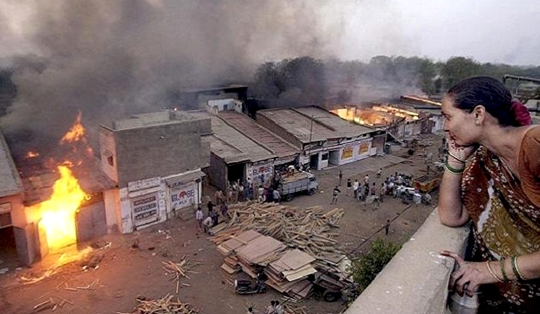
Ahmedabad, Jun 17: Calling the Gulberg massacre as the "darkest day" in the history of civil society, a special SIT court here today sentenced 11 convicts to life imprisonment in the case of burning alive of 69 people, including former Congress MP Eshan Jafri in the 2002 post-Godhra violence.
Gulberg1

Rejecting the demand for death sentence for all the convicts, the court said life imprisonment for the 11 will be till death if the state does not exercise power to remit the sentence.

The court awarded ten year jail term to one of the 13 convicted for lesser offences while 12 others have been given seven-year sentence each. The prosecution had argued that all the 24 convicts should be given death penalty.

While describing the massacre as the darkest day in the history of civil society, Special court Judge P B Desai refused death penalty saying, "If you look at all aspects, no previous antecedent has been placed on record".

Post the incident, 90 per cent of the accused were released on bail, yet no complaints against them have been given even by victims, and there is no record to show that they committed any offence during the time of bail, the judge further said, while giving reasons why he thought that this was not a fit case to give capital punishment to the convicts.

The court said it has decided to award imprisonment for life without any time frame to 11 accused, who have been convicted for murder, while requesting the state not to use its power to remit the sentence after 14 years of imprisonment.

"CrPC provisions give power to the state to remit sentence after 14 years jail, section 433-A imposes some restriction on that power. In case the state does not exercise power to remit the sentence, life imprisonment will mean that it is till death," the court said.

"I cannot add beyond what has been prescribed under section 302, it is not necessary for a state to exercise power to remit sentence, state may not exercise power of remittance," the judge said, adding the court's direction cannot be binding as he cannot take away the executive powers of the state.

As regards the 13 others accused convicted for lesser offences not including murder (302), the court awarded 10 years imprisonment to one Mangilal Jain, while 12 others were awarded seven-year sentence each.

The Gulberg Society massacre, which took place here on February 28, 2002 when Narendra Modi was the Gujarat Chief Minister, shook the nation when a mob of 400 people set about attacking the society in the heart of Ahmedabad and killed the residents including Jafri.

It was one of the nine cases of the 2002 Gujarat riots probed by the Supreme Court-appointed SIT.

"All the sentences will run concurrently as the Supreme Court has laid it down clearly that if the crime had single purpose, sentences given for different sections of IPC should run concurrently," the court said.

The prosecution and the victims had demanded that sentences awarded to all the accused should not run concurrently as all the 24 convicts will have to spend their entire life behind bars.

Earlier on June 2, the court had convicted 11 persons for murder and other offences, while 13 others, including VHP leader Atul Vaidya, were charged with lesser offences. It had acquitted 36 others in the case.

Those given life sentence in the case are - Kailash Dhobi, Yogendra Shekhawat, Jayesh Jingar, Krishna Kalal, Jayesh Parmar, Raju Tiwari, Bharat Rajput, Dinesh Sharma, Narayan Tank, Lakhansinh Chudasama and Bharat Taili.

One Mangilal Jain, who was convicted for lesser offence, has been sentenced to 10 years jail term.

Besides, VHP leader Atul Vaid, Mukesh Jingar, Prakash Padhiyar, Surendrasinh Chauhan, Dilip Parmar, Babu Marwadi, Manish Jain, Dharmesh Shukla, Kapil Mishra, Suresh Dhobi, Ambesh Jingar and Sandeep Punjabi have been sentenced to seven years imprisonment each.

During the argument on quantum of sentence, special public prosecutor and counsel for Supreme Court-appointed Special Investigation Team (SIT), R C Kodekar had asked the court for nothing less than death sentence or jail term till death for all 24 convicts.

Lawyer for the victims, S M Vora, also sought maximum punishment for the accused and argued that sentencing for each offence should not run concurrently so that they spend their entire life in jail.

However, lawyer of the accused, Abhay Bhardwaj, has refuted the demand of capital punishment or maximum punishment in his arguments saying that the incident was spontaneous and there were enough provocations for it.

The Gulberg society massacre was one of the nine cases of 2002 Gujarat riots probed by the SC-appointed SIT.

The incident had taken place a day after S-6 coach of Sabarmati Express was burnt near Godhra train station in which 58 'kar sevaks' returning from Ayodhya were killed.

During the course of trial, as many as 338 witnesses were cross-examined, with four different judges having presided over the case.

Comments

Ahmed Ali K
 - 
Friday, 17 Jun 2016

Death sentence?
for what?
Is he a non Hindu?

Jaleel S
 - 
Friday, 17 Jun 2016

Rarest of rare judgement...

Add new comment

  • Coastaldigest.com reserves the right to delete or block any comments.
  • Coastaldigset.com is not responsible for its readers’ comments.
  • Comments that are abusive, incendiary or irrelevant are strictly prohibited.
  • Please use a genuine email ID and provide your name to avoid reject.
Agencies
January 5,2020

Bikaner, Jan 5: A government-run hospital in Bikaner saw the death of at least 162 children, higher than the number of deaths in Kota's JK Lon Hospital in December.

"In December, we received 2,219 children from different hospitals out of which 162 children died in the Intensive Care Unit here. None of them was born at the hospital," said Dr HS Kumar, Principal, Sardar Patel Medical College, PBM Hospital.

He, however, denied any negligence on the part of the hospital and said that all efforts were made to save every single life.

The official said that all the deceased children had taken birth at the Primary Healthcare Centres (PHC) and the Community Health Centres (CHC) and were referred to the PBM Hospital in a critical condition.

"Their condition was critical and they breathed their last during treatment," he said.

At least 110 children have lost their lives at JK Lon government hospital in Kota, Rajasthan.

Comments

Add new comment

  • Coastaldigest.com reserves the right to delete or block any comments.
  • Coastaldigset.com is not responsible for its readers’ comments.
  • Comments that are abusive, incendiary or irrelevant are strictly prohibited.
  • Please use a genuine email ID and provide your name to avoid reject.
News Network
May 12,2020

Thiruvananthapuram, May 12: Kerala Government on Tuesday issued modified guidelines for infrastructure arrangements and procedures to be followed to ensure smooth interstate movement of stranded persons during the lockdown.

"Necessary permission, if any, required from the State where you are presently located need to be taken for ensuring a smooth journey till Kerala border," read the order by the state government.

It has also made it clear that people will only be allowed to travel if they have the permit from the state government and local authorities.

"You are requested to start the journey only after receiving the travel permit from the Government of Kerala and the local authority of your present location to avoid any problem during travel. Those who reach at the check post without passes will not be allowed entry," it further read.

The orders by the government further read:

*To maintain social distancing norms, only 4 persons will be permitted to travel in a car, 5 in an SUV, 10 in a van and 25 in a bus. The maximum number of passengers in a van /bus will be half of the seating capacity).

*Keep sanitiser, use masks and maintain physical distancing throughout the journey.

*An exit and entry pass/passes shall be issued by the District Collectors to those persons who seek to go outside states to bring back their stranded child/ children, spouse and parent/s.

*Everybody including those coming from red zones shall remain under home quarantine for 14 days from the date of arrival.

*Only priority groups and persons will be allowed entry passes:

a) Those from neighbouring states seeking Medical aid in Kerala

b) Pregnant ladies with family

c) Family members including children separated due to lockdown

d) Students

e) Senior citizens with family members

f) Persons who had lost a job.

The guidelines further added that all luggage must be disinfected and temperature checks must be carried out with Infrared flash thermometer among other things.

Comments

Add new comment

  • Coastaldigest.com reserves the right to delete or block any comments.
  • Coastaldigset.com is not responsible for its readers’ comments.
  • Comments that are abusive, incendiary or irrelevant are strictly prohibited.
  • Please use a genuine email ID and provide your name to avoid reject.
News Network
January 22,2020

Jan 22: India's ranking in the latest global Democracy Index has dropped 10 places to the 51st spot out of 167 owing to violent protests and threats to civil liberties challenging freedoms across the country.

Prime Minister Narendra Modi's government has been criticized by rights groups and western governments after shutting off the internet and mobile phone networks and detaining opposition politicians in Kashmir.

Modi’s government has also responded harshly to ongoing protests against a controversial, religion-based citizenship law. Muslims have said their neighborhoods have been targeted, while the central government has attempted to ban protests and urged TV news channels not to broadcast “anti-national” content. Some leaders in Modi’s ruling party called for “revenge” against protesters. India’s score in 2019 was its worst ranking since the EIU’s records began in 2006, and has fallen gradually since Modi was elected in 2014.

The Economist Intelligence Unit’s 2019 Democracy Index, which provides an annual comparative analysis of political systems across 165 countries and two territories, said the past year was the bleakest for democracies since the research firm began compiling the list in 2006.

“The 2019 result is even worse than that recorded in 2010, in the wake of the global economic and financial crisis,” the research group said in releasing the report on Wednesday.

The average global score slipped to 5.44 out of a possible 10 -- from 5.48 in 2018 -- driven mainly by “sharp regressions” in Latin America, Sub-Saharan Africa, the Middle East and North Africa. Apart from coup-prone Thailand, which improved its score after holding an election last year, there were also notable declines in Asia after a tumultuous period of protests and new measures restricting freedom across the region’s democracies.

Asia Declines

Hong Kong, meanwhile, fell three places to rank 75th out of 167 as more than seven months of violent and disruptive protests rocked the Asian financial hub. An aggressive police response early in the unrest, when protests were mostly peaceful, led to a “marked decline in confidence in government -- the main factor behind the decline in the territory’s score in our 2019 index,” the group said.

In Singapore, which ranked alongside Hong Kong at 75th, a new “fake news” law led to a deteriorating score on civil liberties.

“The government claims that the law was enacted simply to prevent the dissemination of false news, but it threatens freedom of expression in Singapore, as it can be used to curtail political debate and silence critics of the government,” EIU analysts said.

China’s score fell to just 2.26 in the EIU’s ranking, placing it near the bottom of the list at 153, as discrimination against minorities, repression and surveillance of the population intensified. Still, in China “the majority of the population is unconvinced that democracy would benefit the economy, and support for democratic ideals is absent,” the EIU said.

Comments

Add new comment

  • Coastaldigest.com reserves the right to delete or block any comments.
  • Coastaldigset.com is not responsible for its readers’ comments.
  • Comments that are abusive, incendiary or irrelevant are strictly prohibited.
  • Please use a genuine email ID and provide your name to avoid reject.