


11 get life term in Gulberg society massacre case

June 17, 2016

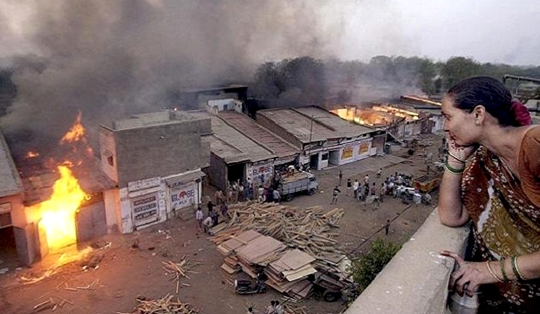
Ahmedabad, Jun 17: Calling the Gulberg massacre as the "darkest day" in the history of civil society, a special SIT court here today sentenced 11 convicts to life imprisonment in the case of burning alive of 69 people, including former Congress MP Eshan Jafri in the 2002 post-Godhra violence.
Gulberg1

Rejecting the demand for death sentence for all the convicts, the court said life imprisonment for the 11 will be till death if the state does not exercise power to remit the sentence.

The court awarded ten year jail term to one of the 13 convicted for lesser offences while 12 others have been given seven-year sentence each. The prosecution had argued that all the 24 convicts should be given death penalty.

While describing the massacre as the darkest day in the history of civil society, Special court Judge P B Desai refused death penalty saying, "If you look at all aspects, no previous antecedent has been placed on record".

Post the incident, 90 per cent of the accused were released on bail, yet no complaints against them have been given even by victims, and there is no record to show that they committed any offence during the time of bail, the judge further said, while giving reasons why he thought that this was not a fit case to give capital punishment to the convicts.

The court said it has decided to award imprisonment for life without any time frame to 11 accused, who have been convicted for murder, while requesting the state not to use its power to remit the sentence after 14 years of imprisonment.

"CrPC provisions give power to the state to remit sentence after 14 years jail, section 433-A imposes some restriction on that power. In case the state does not exercise power to remit the sentence, life imprisonment will mean that it is till death," the court said.

"I cannot add beyond what has been prescribed under section 302, it is not necessary for a state to exercise power to remit sentence, state may not exercise power of remittance," the judge said, adding the court's direction cannot be binding as he cannot take away the executive powers of the state.

As regards the 13 others accused convicted for lesser offences not including murder (302), the court awarded 10 years imprisonment to one Mangilal Jain, while 12 others were awarded seven-year sentence each.

The Gulberg Society massacre, which took place here on February 28, 2002 when Narendra Modi was the Gujarat Chief Minister, shook the nation when a mob of 400 people set about attacking the society in the heart of Ahmedabad and killed the residents including Jafri.

It was one of the nine cases of the 2002 Gujarat riots probed by the Supreme Court-appointed SIT.

"All the sentences will run concurrently as the Supreme Court has laid it down clearly that if the crime had single purpose, sentences given for different sections of IPC should run concurrently," the court said.

The prosecution and the victims had demanded that sentences awarded to all the accused should not run concurrently as all the 24 convicts will have to spend their entire life behind bars.

Earlier on June 2, the court had convicted 11 persons for murder and other offences, while 13 others, including VHP leader Atul Vaidya, were charged with lesser offences. It had acquitted 36 others in the case.

Those given life sentence in the case are - Kailash Dhobi, Yogendra Shekhawat, Jayesh Jingar, Krishna Kalal, Jayesh Parmar, Raju Tiwari, Bharat Rajput, Dinesh Sharma, Narayan Tank, Lakhansinh Chudasama and Bharat Taili.

One Mangilal Jain, who was convicted for lesser offence, has been sentenced to 10 years jail term.

Besides, VHP leader Atul Vaid, Mukesh Jingar, Prakash Padhiyar, Surendrasinh Chauhan, Dilip Parmar, Babu Marwadi, Manish Jain, Dharmesh Shukla, Kapil Mishra, Suresh Dhobi, Ambesh Jingar and Sandeep Punjabi have been sentenced to seven years imprisonment each.

During the argument on quantum of sentence, special public prosecutor and counsel for Supreme Court-appointed Special Investigation Team (SIT), R C Kodekar had asked the court for nothing less than death sentence or jail term till death for all 24 convicts.

Lawyer for the victims, S M Vora, also sought maximum punishment for the accused and argued that sentencing for each offence should not run concurrently so that they spend their entire life in jail.

However, lawyer of the accused, Abhay Bhardwaj, has refuted the demand of capital punishment or maximum punishment in his arguments saying that the incident was spontaneous and there were enough provocations for it.

The Gulberg society massacre was one of the nine cases of 2002 Gujarat riots probed by the SC-appointed SIT.

The incident had taken place a day after S-6 coach of Sabarmati Express was burnt near Godhra train station in which 58 'kar sevaks' returning from Ayodhya were killed.

During the course of trial, as many as 338 witnesses were cross-examined, with four different judges having presided over the case.

Comments

Ahmed Ali K
 - 
Friday, 17 Jun 2016

Death sentence?
for what?
Is he a non Hindu?

Jaleel S
 - 
Friday, 17 Jun 2016

Rarest of rare judgement...

Add new comment

  • Coastaldigest.com reserves the right to delete or block any comments.
  • Coastaldigset.com is not responsible for its readers’ comments.
  • Comments that are abusive, incendiary or irrelevant are strictly prohibited.
  • Please use a genuine email ID and provide your name to avoid reject.
News Network
January 1,2020

Kolkata, Jan 1: US-based Bangladeshi author and playwright Sharbari Zohra Ahmed feels that the people of the country of her origin are more alike than different from Indians as they were originally Hindus.

But Bangladeshis now want to forget their Hindu roots, said the author, who was born in Dhaka and moved to the United States when she was just three weeks old.

Ahmed, who is the co-writer of the Season 1 of 'Quantico', a popular American television drama thriller series starring Priyanka Chopra, rues that her identity as a Bengali is getting lost in Bangladesh due to the influence of right-wing religious groups.

"How can Bangladesh deny its Hindu heritage? We were originally Hindus. Islam came later," Ahmed said while speaking to PTI here recently.

"The British exploited us, stole from us and murdered us," she said about undivided India, adding that the colonialists destroyed the thriving Muslin industry in Dhaka.

Ahmed said the question of her belief and identity in Bangladesh, where the state religion is Islam, has prompted her to write her debut novel 'Dust Under Her Feet'.

The British exploitation of India and the country's partition based on religion has also featured in her novel in a big way.

Ahmed calls Winston Churchill, the British prime minister during World War II, a "racist".

"He took the rice from Bengal to feed his soldiers and didn't care when he was told about that.

"During my research, I learnt that two million Bengalis died in the artificial famine that was created by him. When people praise Churchill, it is like praising Hitler to the Jews. He was horrible," she said.

The author said her novel is an effort to tell the readers what actually happened.

"Great Britain owes us three trillion dollars. You have to put in inflation. Yet, they (the British) still have a colonial mentality and white colonisation is on the rise again," Ahmed, who was in the city to promote her novel, said.

The novel is based in Kolkata, then Calcutta, during World War II when American soldiers were coming to the city in large numbers.

The irony was that while these American soldiers were nice to the locals, they used to segregate the so-called "black" soldiers, the novelist said.

"Calcutta was a cosmopolitan and the rest of the world needs to know how the city's people were exploited, its treasures looted, people divided and hatred instilled in them," she said.

"Kolkata was my choice of place for my debut novel since my mother was born here. She witnessed the 'Direct Action Day' when she was a kid and was traumatised. She saw how a Hindu was killed by Muslims near her home in Park Circus area (in the city)," Ahmed said.

Direct Action Day, also known as the Great Calcutta Killings, was a massive communal riot in the city on August 16, 1946 that continued for the next few days.

Thousands of people were killed in the violence that ultimately paved the way for the partition of India.

'Dust Under Her Feet' is set in the Calcutta of the 1940s and Ahmed in her novel examines the inequities wrought by racism and colonialism.

The story is of young and lovely Yasmine Khan, a doyenne of the nightclub scene in Calcutta.

When the US sets up a large army base in the city to fight the Japanese in Burma, Yasmine spots an opportunity.

The nightclub is where Yasmine builds a family of singers, dancers, waifs and strays.

Every night, the smoke-filled club swarms with soldiers eager to watch her girls dance and sing.

Yasmine meets American soldier Lt Edward Lafaver in the club and for all her cynicism, finds herself falling helplessly for a married man who she is sure will never choose her over his wife.

Outside, the city lives in constant fear of Japanese bombardment at night. An attack and a betrayal test Yasmine's strength and sense of control and her relationship with Edward.

Ahmed teaches creative writing in the MFA program in Manhattanville College and is artist-in-residence in Sacred Heart University's graduate film and television programme.

Comments

abdullah
 - 
Wednesday, 1 Jan 2020

Is she trying to take over Shoorpanakhi Taslim Nasreen? 

Add new comment

  • Coastaldigest.com reserves the right to delete or block any comments.
  • Coastaldigset.com is not responsible for its readers’ comments.
  • Comments that are abusive, incendiary or irrelevant are strictly prohibited.
  • Please use a genuine email ID and provide your name to avoid reject.
News Network
February 24,2020

New Delhi, Feb 24: India and the US are committed to defend their people from radical islamic terrorism, resolved to significantly expand defence ties and are working on a "fantastic" trade deal, said US President Donald Trump on Monday while asserting that his country "loves" and is "loyal" to India.

Addressing a huge crowd at 'Namaste Trump' event at the Motera stadium here, the US president, accompanied by his wife Melania and Prime Minister Narendra Modi, talked about India's great tradition of embracing individual freedom, rule of law, dignity of every human being and where people worship side-by-side in harmony.

On his maiden visit, Trump, who was welcomed by Modi on his arrival here, said his country will remain a "loyal" friend of India and called the Prime Minister an "exceptional leader" who works day and night for the country.

"India and the US are committed to fight terrorists and their ideology; that is why my government is working with Pakistan to crack down on terror groups," Trump said in the presence of his family -- daughter Ivanka, son-in-law Jared Kushner-- and top brass of his administration.

"The US will always be faithful and loyal friend of India. Thank you for the spectacular welcome," he added.

He also announced that the two countries will firm up defence deals worth USD 3 billion on Tuesday and that the US will become India's premier defence partner.

"India and US have natural and enduring friendship," Trump said to a cheering crowd.

"We are quickly revitalising our alliances all around world," he said.

Trump said both countries are working on a "fantastic trade" deal, and observed that Modi is a "tough negotiator".

The US president also heaped praises on Modi, saying the Prime Minister is a "living proof" of what an Indian can achieve with hard work as Trump referred to his humble background as a tea-seller, who had a landslide win in the 2019 Lok Sabha polls.

On his part, Modi welcomed Trump to "world's largest democracy" and said a "new history" was being created.

Modi also praised Trump's leadership in containing terrorism.

Trump said as the world's largest economy, India gives hope to all humanity and has become an economic giant.

"There is a difference between a nation that rises by coercion and one that rises by setting its people free -- that is India. India and the US have natural and enduring friendship," he said.

He also touched on India's cultural diversity and riches as he highlighted the success of its blockbuster movies like DDLJ (Dilwale Dulhania Le Jayenge) and Sholay, and its sporting icons like Sachin Tedulkar and Virat Kohli.

He highlighted the boom in the US economy under his presidency and added that India will soon be home to the biggest middle class as it will eliminate extreme poverty in in next 10 years.

On his part, Modi said ties between India and the US are no longer just another partnership but have touched far greater heights.

Welcoming Trump, he said a "new history" is being created.

Visit of President Trump to India with his family shows strong ties between India and the US, said Modi.

Comments

Add new comment

  • Coastaldigest.com reserves the right to delete or block any comments.
  • Coastaldigset.com is not responsible for its readers’ comments.
  • Comments that are abusive, incendiary or irrelevant are strictly prohibited.
  • Please use a genuine email ID and provide your name to avoid reject.
News Network
March 6,2020

New Delhi, Mar 6: Justice S Muralidhar Thursday cleared the air over the controversy on his transfer from the Delhi High Court to Punjab and Haryana High Court, saying he had replied to Chief Justice of India S A Bobde's communication that he was fine with the proposal and had no objection to it.

The controversy erupted after the Centre issued Justice Muralidhar's transfer notification close to mid night of February 26 -- the day a bench headed by him had pulled up Delhi Police for failing to register FIRs against three BJP leaders for their alleged hate speeches which purportedly led to the recent violence in northeast Delhi.

Justice Muralidhar (58), who received a grand farewell on Thursday from a huge gathering including judges and lawyers amid big rounds of applause, said he wanted to clear the confusion on his transfer and narrated the sequence of events from the time he received CJI's communication till February 26.

The Supreme Court collegium, headed by the CJI, had in a meeting on February 12 recommended the transfer of Justice Muralidhar to Punjab and Haryana High Court.

Justice Muralidhar was number three in the Delhi High Court, his parent high court as a judge.

Explaining the transfer process, he said the 5-member collegium sends to the Centre a recommendation that a judge of a high court should be transferred to another high court. The judge concerned is not at this stage under orders of transfers. That happens only when the collegium's recommendation fructifies into a notification.

“In my case, the collegium's decision was communicated to me by the CJI on February 17 by a letter which sought my response. I acknowledged receipt of the letter, I was then asked to clarify what I meant. As I saw it, if I was to be transferred from the Delhi High Court any way, I was fine with moving to the Punjab and Haryana High Court.

“I therefore clarified to the CJI that I did not object to the proposal. An explanation for my transfer reached the press...on February 20 quoting 'sources in the Supreme Court collegium', confirming what has been indicated to me a couple of days earlier,” he said.

The CJI's letter dated February 14 was delivered to Justice Muralidhar on February 17, the day when the family's pet labrador Sakhi breathed her last.

He said February 26 was perhaps the longest working day of his life as a judge of the Delhi High Court, where he has spent 14 years on the bench.

He said it began at 12:30 am with a sitting at his residence with Justice A J Bhambhani, under the orders of Justice G S Sistani, to deal with a PIL filed by Rahul Roy seeking safe passage of ambulances carrying the injured riot victims.

“When I received a call at my residence from the lawyer for the petitioner, I first called Justice Sistani to ask what should be done, knowing that the Chief Justice (CJ) was on leave. Justice Sistani explained that he too was officially on leave the whole of February 26 and that I should take up the matter.

“This fact is stated in the order passed by the bench after the hearing. Later that day, upon urgent mentioning, as the de facto CJ's bench, Justice Talwant Singh and I took up another fresh PIL on the CJ's board seeking registration of FIRs for hate speeches. After the orders passed on that day, the above two PILs remained on the CJ's Board,” he said.

Justice Muralidhar ended the speech saying the notification which was issued close to midnight of February 26 did two things.

“First, it transferred me to Punjab and Haryana High Court. Second, it appointed me to a position from where I can never be transferred, or removed and in which I shall always be proud to remain. A 'former judge' of arguably the best high court in the country. The High Court of Delhi,” he said, following a standing ovation by all the judges and the gathering, including his family members, former judges, lawyers, court staff and media persons.

Earlier in the day, a farewell programme was also organised by the Delhi High Court Bar Association.

While addressing the gathering at the bar's function, Justice Muralidhar concluded his address saying “When justice has to triumph, it will triumph ... Be with the truth - Justice will be done.”

Justice Muralidhar's mother, wife Usha Ramanathan, former Delhi High Court chief justice A P Shah, senior advocate Shanti Bhushan and former Delhi University VC Upendra Baxi were also present at the later function that was organised by the court.

Bidding adieu to Justice Muralidhar, Delhi HC CJ D N Patel said it was an occasion which has come with a saddening effect and his absence will be felt institutionally as well as personally.

Delhi government standing counsel (criminal) Rahul Mehra termed Justice Muralidhar as a “highly intellectual, courageous, upright and incorruptible judge” and sang bengali song 'ekla chalo re' to describe him.

Mehra said he joins Delhi High Court Bar Association in “strongly condemning” Justice Muralidhar's transfer.

Comments

Add new comment

  • Coastaldigest.com reserves the right to delete or block any comments.
  • Coastaldigset.com is not responsible for its readers’ comments.
  • Comments that are abusive, incendiary or irrelevant are strictly prohibited.
  • Please use a genuine email ID and provide your name to avoid reject.