


11 get life term in Gulberg society massacre case

June 17, 2016

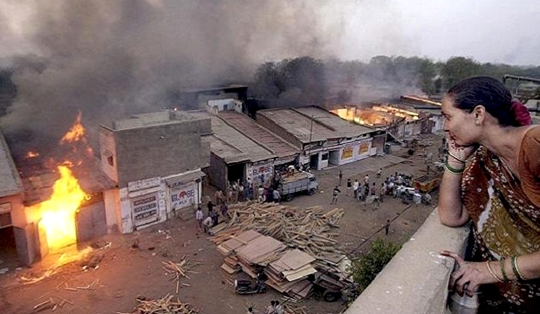
Ahmedabad, Jun 17: Calling the Gulberg massacre as the "darkest day" in the history of civil society, a special SIT court here today sentenced 11 convicts to life imprisonment in the case of burning alive of 69 people, including former Congress MP Eshan Jafri in the 2002 post-Godhra violence.
Gulberg1

Rejecting the demand for death sentence for all the convicts, the court said life imprisonment for the 11 will be till death if the state does not exercise power to remit the sentence.

The court awarded ten year jail term to one of the 13 convicted for lesser offences while 12 others have been given seven-year sentence each. The prosecution had argued that all the 24 convicts should be given death penalty.

While describing the massacre as the darkest day in the history of civil society, Special court Judge P B Desai refused death penalty saying, "If you look at all aspects, no previous antecedent has been placed on record".

Post the incident, 90 per cent of the accused were released on bail, yet no complaints against them have been given even by victims, and there is no record to show that they committed any offence during the time of bail, the judge further said, while giving reasons why he thought that this was not a fit case to give capital punishment to the convicts.

The court said it has decided to award imprisonment for life without any time frame to 11 accused, who have been convicted for murder, while requesting the state not to use its power to remit the sentence after 14 years of imprisonment.

"CrPC provisions give power to the state to remit sentence after 14 years jail, section 433-A imposes some restriction on that power. In case the state does not exercise power to remit the sentence, life imprisonment will mean that it is till death," the court said.

"I cannot add beyond what has been prescribed under section 302, it is not necessary for a state to exercise power to remit sentence, state may not exercise power of remittance," the judge said, adding the court's direction cannot be binding as he cannot take away the executive powers of the state.

As regards the 13 others accused convicted for lesser offences not including murder (302), the court awarded 10 years imprisonment to one Mangilal Jain, while 12 others were awarded seven-year sentence each.

The Gulberg Society massacre, which took place here on February 28, 2002 when Narendra Modi was the Gujarat Chief Minister, shook the nation when a mob of 400 people set about attacking the society in the heart of Ahmedabad and killed the residents including Jafri.

It was one of the nine cases of the 2002 Gujarat riots probed by the Supreme Court-appointed SIT.

"All the sentences will run concurrently as the Supreme Court has laid it down clearly that if the crime had single purpose, sentences given for different sections of IPC should run concurrently," the court said.

The prosecution and the victims had demanded that sentences awarded to all the accused should not run concurrently as all the 24 convicts will have to spend their entire life behind bars.

Earlier on June 2, the court had convicted 11 persons for murder and other offences, while 13 others, including VHP leader Atul Vaidya, were charged with lesser offences. It had acquitted 36 others in the case.

Those given life sentence in the case are - Kailash Dhobi, Yogendra Shekhawat, Jayesh Jingar, Krishna Kalal, Jayesh Parmar, Raju Tiwari, Bharat Rajput, Dinesh Sharma, Narayan Tank, Lakhansinh Chudasama and Bharat Taili.

One Mangilal Jain, who was convicted for lesser offence, has been sentenced to 10 years jail term.

Besides, VHP leader Atul Vaid, Mukesh Jingar, Prakash Padhiyar, Surendrasinh Chauhan, Dilip Parmar, Babu Marwadi, Manish Jain, Dharmesh Shukla, Kapil Mishra, Suresh Dhobi, Ambesh Jingar and Sandeep Punjabi have been sentenced to seven years imprisonment each.

During the argument on quantum of sentence, special public prosecutor and counsel for Supreme Court-appointed Special Investigation Team (SIT), R C Kodekar had asked the court for nothing less than death sentence or jail term till death for all 24 convicts.

Lawyer for the victims, S M Vora, also sought maximum punishment for the accused and argued that sentencing for each offence should not run concurrently so that they spend their entire life in jail.

However, lawyer of the accused, Abhay Bhardwaj, has refuted the demand of capital punishment or maximum punishment in his arguments saying that the incident was spontaneous and there were enough provocations for it.

The Gulberg society massacre was one of the nine cases of 2002 Gujarat riots probed by the SC-appointed SIT.

The incident had taken place a day after S-6 coach of Sabarmati Express was burnt near Godhra train station in which 58 'kar sevaks' returning from Ayodhya were killed.

During the course of trial, as many as 338 witnesses were cross-examined, with four different judges having presided over the case.

Comments

Ahmed Ali K
 - 
Friday, 17 Jun 2016

Death sentence?
for what?
Is he a non Hindu?

Jaleel S
 - 
Friday, 17 Jun 2016

Rarest of rare judgement...

Add new comment

  • Coastaldigest.com reserves the right to delete or block any comments.
  • Coastaldigset.com is not responsible for its readers’ comments.
  • Comments that are abusive, incendiary or irrelevant are strictly prohibited.
  • Please use a genuine email ID and provide your name to avoid reject.
News Network
January 21,2020

Jan 21: Indian policymakers may make it easier for companies to tap foreign funding, as a prolonged cash squeeze makes it tough for firms to borrow at home.

Investors are speculating about potential steps Finance Minister Nirmala Sitharaman could unveil when she presents the nation’s budget on Feb. 1. These measures may include freeing up firms to borrow at higher rates and offering tax breaks to global funds.

“The government will need to relax local rules to make it easier for Indian companies to raise debt overseas and tide over the funding crunch in the onshore market,” said Raj Kothari, London-based head of trading at Jay Capital Ltd. “At the same time, they need to ensure that the borrowers tapping offshore markets abide with stricter corporate governance so as to avoid further defaults.”

A prolonged crisis in India’s shadow bank sector and a pile of bad loans at traditional lenders is making it expensive for Indian companies, other than the best-rated firms, to access funding. The government has tried a series of measures to spur domestic credit, including providing so-called credit enhancement and allowing tiny firms to restructure debt.

Here are some steps Sitharaman may consider to spur foreign borrowing:

• She could raise the cap of 450 basis points above Libor, which limits overall foreign debt costs for Indian companies

• This could help lower-rated firms sell bonds abroad. Indian companies rated BBB currently borrow at more than 10%, about 3.8 percentage points more than their top-rated peers;

• Sitharaman could waive the withholding tax foreign investors need to pay on holdings of rupee-denominated debt sold by Indian companies abroad

• The waiver was offered between September 2018 to March 2019, but wasn’t extended as the highest global interest rates since the financial crisis deterred Indian borrowers. Since then, the three-month Libor has dropped by about 1 percentage point

• She could permit Indian property developers and housing finance lenders to sell overseas bonds for reasons beyond affordable housing projects

• New funding lines to the real estate sector, arguably ground zero of India’s economic slowdown, could help kickstart consumption and investment as the industry is the nation’s biggest job-creator.

Comments

Add new comment

  • Coastaldigest.com reserves the right to delete or block any comments.
  • Coastaldigset.com is not responsible for its readers’ comments.
  • Comments that are abusive, incendiary or irrelevant are strictly prohibited.
  • Please use a genuine email ID and provide your name to avoid reject.
March 24,2020

Gautam Buddh Nagar, Mar 24: As many as 96 First Information Reports (FIRs) were registered and more than 2000 challans issued in Noida yesterday for violation of lockdown rules, police said. The lockdown was imposed in a bid to contain the spread of coronavirus, which has taken more than 14000 lives across the globe.

The FIRs were registered against people for allegedly flouting Section 144 and not adhering to the orders of the state government for staying indoors.
Chief Minister Yogi Adityanath on Monday stated that all borders adjoining Uttar Pradesh should be completely sealed.

Comments

Add new comment

  • Coastaldigest.com reserves the right to delete or block any comments.
  • Coastaldigset.com is not responsible for its readers’ comments.
  • Comments that are abusive, incendiary or irrelevant are strictly prohibited.
  • Please use a genuine email ID and provide your name to avoid reject.
News Network
February 29,2020

Kochi, Feb 29: When Major Abdul Rahim, a soldier in the Afghan army, died in a bomb blast in Kabul on February 19, a tear was shed for him in far away Ernakulam district of Kerala.

The major had received a transplant of hands from Eloor native T G Joseph back in 2015, and the latter’s family had grown attached to the Afghan soldier.

Maj. Abdul Rahim, a bomb disposal expert, had lost his hands in an explosion in 2012. For three years thereafter, he struggled with his handicap. Then, when 54-year-old Joseph passed away in a road accident, it was decided to give his hands to the Afghan major.

The transplant procedure was successfully performed by a team of doctors led by Dr. Subrahmania Iyer at the Amrita Institute of Medical Sciences in Kochi.

After the transplant and an intensive spell of physiotherapy, Abdul Rahim could regain a considerable part of his hands’ functions. He rejoined the army and returned to defuse bombs in his war-torn country.

In gratitude, Major Abdul Rahim would visit Kochi every year to meet Joseph’s family. 

“We were shocked to hear of the demise of Major Abdul Rahim. Though Joseph left us, a part of him lived on. Abdul Rahim was a living memorial for us. Whenever he came to the Amrita institute for a consultation, we used to visit him,” Joseph’s wife was quoted as saying by Mathrubhoomi daily.

Major Abdul Rahim struck up a good friendship with his predecessor, in a way of speaking: the first person to have had a successful hand transplant at the Amrita Institute of Medical Sciences. T R Manu became a close friend of the Afghan solider and kept regularly in touch.

Comments

Add new comment

  • Coastaldigest.com reserves the right to delete or block any comments.
  • Coastaldigset.com is not responsible for its readers’ comments.
  • Comments that are abusive, incendiary or irrelevant are strictly prohibited.
  • Please use a genuine email ID and provide your name to avoid reject.