


11 get life term in Gulberg society massacre case

June 17, 2016

Ahmedabad, Jun 17: Calling the Gulberg massacre as the "darkest day" in the history of civil society, a special SIT court here today sentenced 11 convicts to life imprisonment in the case of burning alive of 69 people, including former Congress MP Eshan Jafri in the 2002 post-Godhra violence.
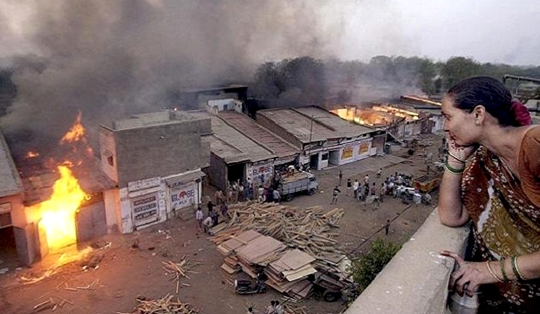
Gulberg1

Rejecting the demand for death sentence for all the convicts, the court said life imprisonment for the 11 will be till death if the state does not exercise power to remit the sentence.

The court awarded ten year jail term to one of the 13 convicted for lesser offences while 12 others have been given seven-year sentence each. The prosecution had argued that all the 24 convicts should be given death penalty.

While describing the massacre as the darkest day in the history of civil society, Special court Judge P B Desai refused death penalty saying, "If you look at all aspects, no previous antecedent has been placed on record".

Post the incident, 90 per cent of the accused were released on bail, yet no complaints against them have been given even by victims, and there is no record to show that they committed any offence during the time of bail, the judge further said, while giving reasons why he thought that this was not a fit case to give capital punishment to the convicts.

The court said it has decided to award imprisonment for life without any time frame to 11 accused, who have been convicted for murder, while requesting the state not to use its power to remit the sentence after 14 years of imprisonment.

"CrPC provisions give power to the state to remit sentence after 14 years jail, section 433-A imposes some restriction on that power. In case the state does not exercise power to remit the sentence, life imprisonment will mean that it is till death," the court said.

"I cannot add beyond what has been prescribed under section 302, it is not necessary for a state to exercise power to remit sentence, state may not exercise power of remittance," the judge said, adding the court's direction cannot be binding as he cannot take away the executive powers of the state.

As regards the 13 others accused convicted for lesser offences not including murder (302), the court awarded 10 years imprisonment to one Mangilal Jain, while 12 others were awarded seven-year sentence each.

The Gulberg Society massacre, which took place here on February 28, 2002 when Narendra Modi was the Gujarat Chief Minister, shook the nation when a mob of 400 people set about attacking the society in the heart of Ahmedabad and killed the residents including Jafri.

It was one of the nine cases of the 2002 Gujarat riots probed by the Supreme Court-appointed SIT.

"All the sentences will run concurrently as the Supreme Court has laid it down clearly that if the crime had single purpose, sentences given for different sections of IPC should run concurrently," the court said.

The prosecution and the victims had demanded that sentences awarded to all the accused should not run concurrently as all the 24 convicts will have to spend their entire life behind bars.

Earlier on June 2, the court had convicted 11 persons for murder and other offences, while 13 others, including VHP leader Atul Vaidya, were charged with lesser offences. It had acquitted 36 others in the case.

Those given life sentence in the case are - Kailash Dhobi, Yogendra Shekhawat, Jayesh Jingar, Krishna Kalal, Jayesh Parmar, Raju Tiwari, Bharat Rajput, Dinesh Sharma, Narayan Tank, Lakhansinh Chudasama and Bharat Taili.

One Mangilal Jain, who was convicted for lesser offence, has been sentenced to 10 years jail term.

Besides, VHP leader Atul Vaid, Mukesh Jingar, Prakash Padhiyar, Surendrasinh Chauhan, Dilip Parmar, Babu Marwadi, Manish Jain, Dharmesh Shukla, Kapil Mishra, Suresh Dhobi, Ambesh Jingar and Sandeep Punjabi have been sentenced to seven years imprisonment each.

During the argument on quantum of sentence, special public prosecutor and counsel for Supreme Court-appointed Special Investigation Team (SIT), R C Kodekar had asked the court for nothing less than death sentence or jail term till death for all 24 convicts.

Lawyer for the victims, S M Vora, also sought maximum punishment for the accused and argued that sentencing for each offence should not run concurrently so that they spend their entire life in jail.

However, lawyer of the accused, Abhay Bhardwaj, has refuted the demand of capital punishment or maximum punishment in his arguments saying that the incident was spontaneous and there were enough provocations for it.

The Gulberg society massacre was one of the nine cases of 2002 Gujarat riots probed by the SC-appointed SIT.

The incident had taken place a day after S-6 coach of Sabarmati Express was burnt near Godhra train station in which 58 'kar sevaks' returning from Ayodhya were killed.

During the course of trial, as many as 338 witnesses were cross-examined, with four different judges having presided over the case.

Comments

Ahmed Ali K
 - 
Friday, 17 Jun 2016

Death sentence?
for what?
Is he a non Hindu?

Jaleel S
 - 
Friday, 17 Jun 2016

Rarest of rare judgement...

Add new comment

  • Coastaldigest.com reserves the right to delete or block any comments.
  • Coastaldigset.com is not responsible for its readers’ comments.
  • Comments that are abusive, incendiary or irrelevant are strictly prohibited.
  • Please use a genuine email ID and provide your name to avoid reject.
News Network
January 30,2020

New Delhi, Jan 30: In a major shift of strategy ahead of the Delhi assembly polls, the Bharatiya Janata Party (BJP) has decided to rope in its senior leaders for massive public rallies.

Its star campaigners like Prime Minister Narendra Modi, Union Home Minister Amit Shah, BJP chief JP Nadda, Uttar Pradesh Chief Minister Yogi Adityanath, and other union ministers would now be addressing massive public rallies in addition to ongoing neighbourhood meetings.

"The big rallies would begin from February 1. While 'Nukkad' meetings will take place till the last day of campaigning, there would be big rallies of the top leadership of the party, " informed a senior party leader.

Sources said the BJP has changed its strategy after the success of its grassroots contact programme as the party wants to consolidate its gains.

"As part of the reworked strategy the BJP has asked its various Mandals to organise public meetings of 10,000-15,000 people in each assembly segment to reach out to the masses," sources added.

While there are two planned for Prime Minister Modi, two have been planned for JDU chief and Bihar Chief Minister Nitish Kumar along with Nadda and Amit Shah. Yogi Aadityanath too would be addressing 12 rallies.

The party is leaving no stone unturned to secure massive gains, which it feels can be converted to victory in the forthcoming polls.

Party sources feel that the relentless campaigning under the guidance of Amit Shah and Nadda has ensured that the morale of party cadre is at an all-time high.

"The neighbourhood meetings have ensured that we have been able to make the people of Delhi aware of the lack of work under the Arvind Kejriwal led Aam Aadmi Party government. They have also been apprised about the anti-national views of the opponents and we think that this is expected to turn the polls into our favour," sources added.

Delhi is scheduled for assembly polls on February 8 and the results for the 70 constituencies will be declared on February 11.

As part of the new strategy, senior leaders like JP Nadda, Amit Shah, Uttar Pradesh chief minister Yogi Adityanath, ministers like Rajnath Singh and Smriti Irani would be holding public rallies in various parts of the city. Several other chief ministers from various BJP ruled states are also expected to be roped in for the campaign.

The strategy for reach out to the masses is an attempt at weakening the hold of AAP on Delhi. With positive feedback coming after the success of the neighbourhood meetings in the past week, the BJP is now looking to increase its potential reach with polls just days away.

Till now the party had deployed 70 union ministers to hold at least one public meeting and one 'padayatra' each as part of the campaign.

Comments

Add new comment

  • Coastaldigest.com reserves the right to delete or block any comments.
  • Coastaldigset.com is not responsible for its readers’ comments.
  • Comments that are abusive, incendiary or irrelevant are strictly prohibited.
  • Please use a genuine email ID and provide your name to avoid reject.
News Network
April 16,2020

United Nations, Apr 16: WHO chief Tedros Adhanom Ghebreyesus has welcomed the world health body's cooperation with India to leverage strategies that helped the country win its war against polio into the response to COVID-19 outbreak, saying such joint efforts will help defeat the pandemic.

The World Health Organization (WHO) has said it will work with India's Ministry of Health and Family Welfare to leverage the strategies that helped the country eradicate polio to fight the pandemic.

Migrants who returned to UP and Bihar were hurriedly housed in schools and panchayat buildings, which were turned into quarantine centres. However, unhygienic conditions and people running away have proved to be a problem

The WHO's national polio surveillance network will be engaged to strengthen COVID-19 surveillance and its field staff will continue to support immunization and elimination of tuberculosis and other diseases.

“Great news: @MoHFW_INDIA & @WHOSEARO initiated a systematic engagement of @WHO's national polio surveillance network, and other field staff, for India's #COVID19 response, tapping into the best practices & resources that helped win its war against polio,” the WHO director-general tweeted, referring to India's Ministry of Health and Family Welfare and World Health Organization Regional Office for South-East Asia.

According to the Johns Hopkins University data, over 2 million people are infected by the virus and more than 136,000 people have died of the disease globally.

Ghebreyesus expressed gratitude to Health and Family Welfare Minister Harsh Vardhan “for his leadership and collaboration” with WHO. “Through these joint efforts we can defeat the #coronavirus and save lives. Together!”

India eliminated polio in 2014.
According to a WHO press release, Vardhan said in New Delhi that “time and again the Government of India and WHO together have shown our ability, competence and prowess to the whole world. With our combined meticulous work, done with full sincerity and dedication, we were able to get rid of polio.”

“All of you in the field – IDSP (Integrated Disease Surveillance Project), state rapid response teams and WHO - are our ‘surveillance corona warriors'. With your joint efforts we can defeat the coronavirus and save lives,” Vardhan added.

WHO South-East Asia Regional Director Poonam Khetrapal Singh said the National Polio Surveillance Project (WHO-NPSP) played a critical role in strengthening surveillance for polio that generated useful, timely and accurate data to guide policies, strategies and interventions until transmission of the poliovirus was interrupted in the country,” adding that the other WHO field staff involved with elimination of tuberculosis and neglected tropical diseases and hypertension control initiative were also significant resources.

Singh added that “it is now time to use all your experience, knowledge and skills, with the same rigor and discipline that you showed while monitoring polio activities, to support districts with surveillance, contact tracing and containment activities.”

The WHO release said strengths of the NPSP team – surveillance, data management, monitoring and supervision, and responding to local situations and challenges – will be utilized to supplement efforts of National Centre for Disease Control, IDSP and Indian Council of Medical Research to strengthen COVID-19 surveillance.

The NPSP team will also support in sharing information and best practices and help states and districts calibrate their response based on transmission scenarios and local capacities.

The WHO field staff will continue to support immunization and surveillance and elimination of Tuberculosis and Neglected Tropical Diseases, Singh said, adding, “disease outbreaks can negatively impact progress in a range of areas, from maternal and child mortality to vaccine-preventable diseases and other treatable conditions. India had been making stupendous progress in these areas and we cannot afford for India's remarkable progress to be set back or reversed.”

Comments

Add new comment

  • Coastaldigest.com reserves the right to delete or block any comments.
  • Coastaldigset.com is not responsible for its readers’ comments.
  • Comments that are abusive, incendiary or irrelevant are strictly prohibited.
  • Please use a genuine email ID and provide your name to avoid reject.
News Network
January 30,2020

Jan 30: BJP leader and West Bengal party head, Dilip Ghosh has yet again made a controversial statement. He said that one has to go to jail in order to gain respect or become a political leader.

"You will not be a leader if you don't go to jail, if Police don't take you, then you must go there yourself. If they don't give you any scope, you do something to go to jail, only then will people respect you. There is no place for soft people in politics," ANI quoted Ghosh as saying.

Earlier, Ghosh had triggered a controversy by saying that anti-CAA protestors in Assam and Uttar Pradesh were shot dead "like dogs", and similar punishment should be given to protestors in Bengal.

Comments

Add new comment

  • Coastaldigest.com reserves the right to delete or block any comments.
  • Coastaldigset.com is not responsible for its readers’ comments.
  • Comments that are abusive, incendiary or irrelevant are strictly prohibited.
  • Please use a genuine email ID and provide your name to avoid reject.