


11 get life term in Gulberg society massacre case

June 17, 2016

Ahmedabad, Jun 17: Calling the Gulberg massacre as the "darkest day" in the history of civil society, a special SIT court here today sentenced 11 convicts to life imprisonment in the case of burning alive of 69 people, including former Congress MP Eshan Jafri in the 2002 post-Godhra violence.
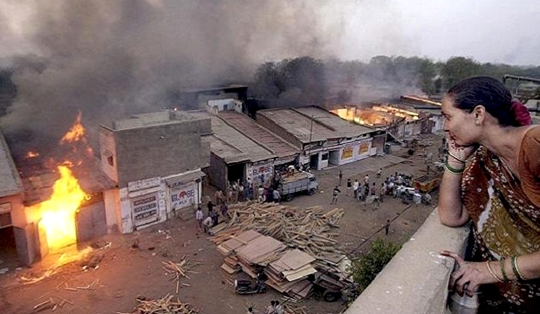
Gulberg1

Rejecting the demand for death sentence for all the convicts, the court said life imprisonment for the 11 will be till death if the state does not exercise power to remit the sentence.

The court awarded ten year jail term to one of the 13 convicted for lesser offences while 12 others have been given seven-year sentence each. The prosecution had argued that all the 24 convicts should be given death penalty.

While describing the massacre as the darkest day in the history of civil society, Special court Judge P B Desai refused death penalty saying, "If you look at all aspects, no previous antecedent has been placed on record".

Post the incident, 90 per cent of the accused were released on bail, yet no complaints against them have been given even by victims, and there is no record to show that they committed any offence during the time of bail, the judge further said, while giving reasons why he thought that this was not a fit case to give capital punishment to the convicts.

The court said it has decided to award imprisonment for life without any time frame to 11 accused, who have been convicted for murder, while requesting the state not to use its power to remit the sentence after 14 years of imprisonment.

"CrPC provisions give power to the state to remit sentence after 14 years jail, section 433-A imposes some restriction on that power. In case the state does not exercise power to remit the sentence, life imprisonment will mean that it is till death," the court said.

"I cannot add beyond what has been prescribed under section 302, it is not necessary for a state to exercise power to remit sentence, state may not exercise power of remittance," the judge said, adding the court's direction cannot be binding as he cannot take away the executive powers of the state.

As regards the 13 others accused convicted for lesser offences not including murder (302), the court awarded 10 years imprisonment to one Mangilal Jain, while 12 others were awarded seven-year sentence each.

The Gulberg Society massacre, which took place here on February 28, 2002 when Narendra Modi was the Gujarat Chief Minister, shook the nation when a mob of 400 people set about attacking the society in the heart of Ahmedabad and killed the residents including Jafri.

It was one of the nine cases of the 2002 Gujarat riots probed by the Supreme Court-appointed SIT.

"All the sentences will run concurrently as the Supreme Court has laid it down clearly that if the crime had single purpose, sentences given for different sections of IPC should run concurrently," the court said.

The prosecution and the victims had demanded that sentences awarded to all the accused should not run concurrently as all the 24 convicts will have to spend their entire life behind bars.

Earlier on June 2, the court had convicted 11 persons for murder and other offences, while 13 others, including VHP leader Atul Vaidya, were charged with lesser offences. It had acquitted 36 others in the case.

Those given life sentence in the case are - Kailash Dhobi, Yogendra Shekhawat, Jayesh Jingar, Krishna Kalal, Jayesh Parmar, Raju Tiwari, Bharat Rajput, Dinesh Sharma, Narayan Tank, Lakhansinh Chudasama and Bharat Taili.

One Mangilal Jain, who was convicted for lesser offence, has been sentenced to 10 years jail term.

Besides, VHP leader Atul Vaid, Mukesh Jingar, Prakash Padhiyar, Surendrasinh Chauhan, Dilip Parmar, Babu Marwadi, Manish Jain, Dharmesh Shukla, Kapil Mishra, Suresh Dhobi, Ambesh Jingar and Sandeep Punjabi have been sentenced to seven years imprisonment each.

During the argument on quantum of sentence, special public prosecutor and counsel for Supreme Court-appointed Special Investigation Team (SIT), R C Kodekar had asked the court for nothing less than death sentence or jail term till death for all 24 convicts.

Lawyer for the victims, S M Vora, also sought maximum punishment for the accused and argued that sentencing for each offence should not run concurrently so that they spend their entire life in jail.

However, lawyer of the accused, Abhay Bhardwaj, has refuted the demand of capital punishment or maximum punishment in his arguments saying that the incident was spontaneous and there were enough provocations for it.

The Gulberg society massacre was one of the nine cases of 2002 Gujarat riots probed by the SC-appointed SIT.

The incident had taken place a day after S-6 coach of Sabarmati Express was burnt near Godhra train station in which 58 'kar sevaks' returning from Ayodhya were killed.

During the course of trial, as many as 338 witnesses were cross-examined, with four different judges having presided over the case.

Comments

Ahmed Ali K
 - 
Friday, 17 Jun 2016

Death sentence?
for what?
Is he a non Hindu?

Jaleel S
 - 
Friday, 17 Jun 2016

Rarest of rare judgement...

Add new comment

  • Coastaldigest.com reserves the right to delete or block any comments.
  • Coastaldigset.com is not responsible for its readers’ comments.
  • Comments that are abusive, incendiary or irrelevant are strictly prohibited.
  • Please use a genuine email ID and provide your name to avoid reject.
News Network
May 26,2020

New Delhi, May 26: With India now in the bracket of top 10 nations worst hit by the novel coronavirus, experts have attributed the surge in cases to easing of travel restrictions and movement of migrants besides enhanced testing capacity.

According to AIIMS Director, Randeep Guleria, the present rise in cases has been reported predominantly from hotspot areas but there is a possibility of further rise in the number of COVID-19 cases in the coming few days due to increased travel.

"Those who are asymptomatic or are in presymptomatic stage will pass through screening mechanisms and may reach areas where there have been minimal or less cases," Guleria said.

He said there was a need for more intense surveillance and monitoring in areas where migrants have returned to contain the spread of the disease.

If proper social distancing and hand hygiene is not maintained at a time when people are out on roads, the coronavirus infection will transmit much faster, he said.

Guleria also noted that testing capacity has been significantly ramped up which is reflecting in the increasing number of cases being detected.

Commenting on the partial resumption of rail and road transport services and migrants returning to their native places, Dr Chandrakant S Pandav, former president of the Indian Public Health Association and Indian Association of Preventive and social medicine, said the floodgates have been opened.

"This is a classic case of creating an enabling environment for coronavirus to spread like wildfire. In the coming few days, the number will rise dramatically. While it is true that lockdown cannot go on forever, the opening up should have been in a measured, calibrated and informed manner," he said.

"Travelling leads to spread of the infection. Now, the government will have to ensure even stronger surveillance to curb the infection but if that will be done is something to be observed," he said.

The death toll due to COVID-19 rose to 4,167 and the number of cases climbed to 1, 45,380 in the country, registering an increase of 146 deaths and 6,535 cases since Monday 8 am, according to the Union Health Ministry.

Dr K K Aggarwal, President of the Confederation of Medical Association of Asia and Oceania (CMAAO), and former IMA President, said there will be a further surge in cases in the coming days if migration continues without any proper social distancing.

"Within the next ten days, the cases will cross two lakh. The very fact that number of cases was rising before the end of the third lockdown and continuing during the fourth lockdown means that people are not following physical distancing as required," he said.

"Even in the last week of May when the temperature is very high, the rising number of cases would mean that human-to-human transmission is more important than surface-to-human transmission. Normally in heat the surface-to-human transmission should have reduced the new cases by half which has not happened," Aggarwal said.

However, Professor K Srinath Reddy, president of the Public Health Foundation of India, said an increase in the number of cases reflects both an increase in testing rates and an increase in spread.

"What we need to see is the number of new tests performed per day and the number of new cases that were identified from them. That gives a better idea of the rate of spread than the total number of new cases alone.

"We also have to see if the testing criteria has remained the same between the two periods of comparison.We may open up gradually but will have to continue case detection, contact tracing and follow personal protection measures as vigorously as possible," he added.

A total of 31,26,119 samples have been tested as on May 26, 9 am and 92,528 samples have been tested in the last 24 hours, ICMR officials said.

India is the tenth most affected nation by the pandemic after the US, Russia, UK, Spain, Italy, Brazil, Germany, Turkey and France, as per the John Hopkins University data.

The country has recorded 6,088, 6,654, 6,767 and 6977 cases on May 22, 23, 24 and 25 respectively. Also, the number of RT-PCR tests for detection of COVID-19 in the country crossed the 30-lakh mark on Monday.

The first two phases of the lockdown led to 14-29 lakh COVID-19 cases being averted, while the number of lives saved in that period was between 37,000 and 78,000, the government said last Friday, citing various studies, and asserted that the unprecedented shutdown has paid "rich dividends" in the fight against the pandemic.

Comments

Add new comment

  • Coastaldigest.com reserves the right to delete or block any comments.
  • Coastaldigset.com is not responsible for its readers’ comments.
  • Comments that are abusive, incendiary or irrelevant are strictly prohibited.
  • Please use a genuine email ID and provide your name to avoid reject.
News Network
July 1,2020

New Delhi, Jul 1: 18,653 COVID-19 cases have been reported in India in the last 24 hours, taking the country's tally of coronavirus cases to 5,85,493, informed the Union Health and Family Welfare Ministry on Wednesday.

As per the Ministry, there are presently 2,20,114 active cases in the country. The number of patients cured/discharged and migrated stands at 3,47,979.

507 deaths due to COVID-19 were reported in the last 24 hours taking the total deaths due to the virus to 17,400.

According to the ministry, Maharashtra is the worst-affected state by the virus with 1,74,761 cases including 7,855 fatalities.

Tamil Nadu is the second worst-hit state with 90,167 cases including 1,201 deaths. Meanwhile, Delhi has a total of 87,360 cases.

The Indian Council of Medical Research said that a total number of 86,26,585 tested up to June 30 of which 2,17,931 samples were tested on Tuesday.

Comments

Add new comment

  • Coastaldigest.com reserves the right to delete or block any comments.
  • Coastaldigset.com is not responsible for its readers’ comments.
  • Comments that are abusive, incendiary or irrelevant are strictly prohibited.
  • Please use a genuine email ID and provide your name to avoid reject.
News Network
April 9,2020

Thiruvananthapuram, Apr 9: Kerala, which was among the first state in the country to report a Corona positive case, has turned its entire public healthcare system into a single interconnected grid to generate uninterrupted information and provide flawless services, thanks to the daily zoom or video conferences of top health authorities for chalking out a dynamic strategy to tackle the COVID-19 pandemic.

The daily zoom or remote conferences held by Health Minister K K Shailaja and top health sector officials with the medical and paramedical personnel on the ground have lent a cutting edge to the state government’s all out efforts in monitoring the situation on the ground and formulating effective responses to address the various needs and concerns of the people, an official release said on Thursday.

The Minister is joined in this meticulous exercise by top administrators and planners, including Dr Rajan N Khobragade, Principal Secretary, Health; Dr. Rathan U Kelker, State Mission Director, National Health Mission, Dr Saritha, Director of Health Services, Dr Ramla Beevi, Director of Medical Education and other senior officials.

Comments

Add new comment

  • Coastaldigest.com reserves the right to delete or block any comments.
  • Coastaldigset.com is not responsible for its readers’ comments.
  • Comments that are abusive, incendiary or irrelevant are strictly prohibited.
  • Please use a genuine email ID and provide your name to avoid reject.