


11 get life term in Gulberg society massacre case

June 17, 2016

Ahmedabad, Jun 17: Calling the Gulberg massacre as the "darkest day" in the history of civil society, a special SIT court here today sentenced 11 convicts to life imprisonment in the case of burning alive of 69 people, including former Congress MP Eshan Jafri in the 2002 post-Godhra violence.
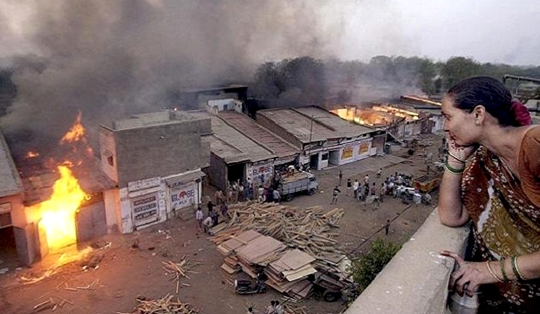
Gulberg1

Rejecting the demand for death sentence for all the convicts, the court said life imprisonment for the 11 will be till death if the state does not exercise power to remit the sentence.

The court awarded ten year jail term to one of the 13 convicted for lesser offences while 12 others have been given seven-year sentence each. The prosecution had argued that all the 24 convicts should be given death penalty.

While describing the massacre as the darkest day in the history of civil society, Special court Judge P B Desai refused death penalty saying, "If you look at all aspects, no previous antecedent has been placed on record".

Post the incident, 90 per cent of the accused were released on bail, yet no complaints against them have been given even by victims, and there is no record to show that they committed any offence during the time of bail, the judge further said, while giving reasons why he thought that this was not a fit case to give capital punishment to the convicts.

The court said it has decided to award imprisonment for life without any time frame to 11 accused, who have been convicted for murder, while requesting the state not to use its power to remit the sentence after 14 years of imprisonment.

"CrPC provisions give power to the state to remit sentence after 14 years jail, section 433-A imposes some restriction on that power. In case the state does not exercise power to remit the sentence, life imprisonment will mean that it is till death," the court said.

"I cannot add beyond what has been prescribed under section 302, it is not necessary for a state to exercise power to remit sentence, state may not exercise power of remittance," the judge said, adding the court's direction cannot be binding as he cannot take away the executive powers of the state.

As regards the 13 others accused convicted for lesser offences not including murder (302), the court awarded 10 years imprisonment to one Mangilal Jain, while 12 others were awarded seven-year sentence each.

The Gulberg Society massacre, which took place here on February 28, 2002 when Narendra Modi was the Gujarat Chief Minister, shook the nation when a mob of 400 people set about attacking the society in the heart of Ahmedabad and killed the residents including Jafri.

It was one of the nine cases of the 2002 Gujarat riots probed by the Supreme Court-appointed SIT.

"All the sentences will run concurrently as the Supreme Court has laid it down clearly that if the crime had single purpose, sentences given for different sections of IPC should run concurrently," the court said.

The prosecution and the victims had demanded that sentences awarded to all the accused should not run concurrently as all the 24 convicts will have to spend their entire life behind bars.

Earlier on June 2, the court had convicted 11 persons for murder and other offences, while 13 others, including VHP leader Atul Vaidya, were charged with lesser offences. It had acquitted 36 others in the case.

Those given life sentence in the case are - Kailash Dhobi, Yogendra Shekhawat, Jayesh Jingar, Krishna Kalal, Jayesh Parmar, Raju Tiwari, Bharat Rajput, Dinesh Sharma, Narayan Tank, Lakhansinh Chudasama and Bharat Taili.

One Mangilal Jain, who was convicted for lesser offence, has been sentenced to 10 years jail term.

Besides, VHP leader Atul Vaid, Mukesh Jingar, Prakash Padhiyar, Surendrasinh Chauhan, Dilip Parmar, Babu Marwadi, Manish Jain, Dharmesh Shukla, Kapil Mishra, Suresh Dhobi, Ambesh Jingar and Sandeep Punjabi have been sentenced to seven years imprisonment each.

During the argument on quantum of sentence, special public prosecutor and counsel for Supreme Court-appointed Special Investigation Team (SIT), R C Kodekar had asked the court for nothing less than death sentence or jail term till death for all 24 convicts.

Lawyer for the victims, S M Vora, also sought maximum punishment for the accused and argued that sentencing for each offence should not run concurrently so that they spend their entire life in jail.

However, lawyer of the accused, Abhay Bhardwaj, has refuted the demand of capital punishment or maximum punishment in his arguments saying that the incident was spontaneous and there were enough provocations for it.

The Gulberg society massacre was one of the nine cases of 2002 Gujarat riots probed by the SC-appointed SIT.

The incident had taken place a day after S-6 coach of Sabarmati Express was burnt near Godhra train station in which 58 'kar sevaks' returning from Ayodhya were killed.

During the course of trial, as many as 338 witnesses were cross-examined, with four different judges having presided over the case.

Comments

Ahmed Ali K
 - 
Friday, 17 Jun 2016

Death sentence?
for what?
Is he a non Hindu?

Jaleel S
 - 
Friday, 17 Jun 2016

Rarest of rare judgement...

Add new comment

  • Coastaldigest.com reserves the right to delete or block any comments.
  • Coastaldigset.com is not responsible for its readers’ comments.
  • Comments that are abusive, incendiary or irrelevant are strictly prohibited.
  • Please use a genuine email ID and provide your name to avoid reject.
News Network
April 12,2020

Hyderabad, Apr 12: Indicating that prolonged lockdown to contain coronavirus spread may lead to job cuts in the Indian IT industry, NASSCOM former president R Chandrashekhar has said that the work-from-home culture may become a positive development in the long run as it opens up newer avenues and save investments by IT firms.

The former bureaucrat also said startups which are surviving on funds infused by venture capitalists may face tougher situations if the present scenario deteriorates.

"The larger companies may not be actually cutting jobs for two reasons. One is that they do not want to lose their employees and they have money to pay. Many of them ( big companies), even if they do shed some jobs it might be at the most people who are on temporary or intern type and all. But they would not want regular and permanent employees to go. So as long as they have sufficient flexibility in their books, they would continue," said NASSCOM former president.

"But beyond a point that it goes on, for let us say, two months or three months, then even for them, they will feel the pressure. They may not just keep on providing subsidies to the employees. So the key question will be how long that goes on," Chandrasekhar said.

He also said the work-from-home systems being adopted by several firms across the globe, including India, may have a negative impact on the industry in the short-term, but in the long run it would change the work culture which hitherto was not experienced by many of the IT firms in India.

 On impact of the prolonged lockdown on startups, he said it would be a big challenge for the budding enterprises as the investments they get are based on their ideas and future revenues and the present situation under which peoples movement is curbed may shackle their progress.

 "Where will they (startups) get money to pay salaries to their employees. Venture capital investors would not pay the money or invest their money to pay salaries because they are not in the charity business."

If the employees are not paid and if they leave and it is difficult for the startup againto come up. So the whole investment plan goes for a toss, he said.

Former chairman of NASSCOM, B V R Mohan Reddy said a clear picture as to what is going to happen has not yet emerged as the situation with all respects is still evolving. Reddy said there will be a demand shrinkage for the IT industry as the entire world is under stress. "There is no economy in this world that is going to do well in this situation.

So, therefore, there will be a demand shrinkage, he said, indicating tougher times of the industry ahead.

Comments

Add new comment

  • Coastaldigest.com reserves the right to delete or block any comments.
  • Coastaldigset.com is not responsible for its readers’ comments.
  • Comments that are abusive, incendiary or irrelevant are strictly prohibited.
  • Please use a genuine email ID and provide your name to avoid reject.
News Network
May 30,2020

New Delhi, May 30: As the NDA government completes one year of its second term, Prime Minister Narendra Modi listed several achievements and initiatives taken by his government in the past year in an audio message addressed to the people of the country.

PM Modi said, "This day last year began a golden chapter in the history of Indian democracy. It was after several decades that the people of the country voted back a full-term government with a full majority."

"Your role has played a pivotal role in creating this chapter. In such a situation, this day is an opportunity for me to bow to the citizens of the country and the democratic ethos of our nation," said PM Modi.

"Had the situation been normal, I would have got the chance to meet you. Your affection and active support in the past year have given me new energy and inspiration. During this period, the way you have shown the collective powers of democracy, they have become an example for the whole world," he added.

PM Modi talked about several important initiatives taken by his government in 2014 as well as India's demonstration of its mettle through the surgical strike and airstrike.

"Six years ago in 2014, the people of this country voted to bring a major change in the country. You voted to change the country's policy and manner. During that tenure where surgical strike and airstrike took place, one rank one pension, one nation one tax GST, and better MSP for farmers were also fulfilled. That period was dedicated to fulfilling many needs of the country."

He further said that in these years the country has seen systems coming out of the quagmire of inertia and corruption. The country has seen governance change to make life easier for the poor.

"During that period, India's stature in the world increased. By opening bank accounts of poor people, by giving them gas connections, by providing free electricity connections, by building washrooms, by building houses, the dignity of the poor has also been increased," said PM Modi.

Comments

Add new comment

  • Coastaldigest.com reserves the right to delete or block any comments.
  • Coastaldigset.com is not responsible for its readers’ comments.
  • Comments that are abusive, incendiary or irrelevant are strictly prohibited.
  • Please use a genuine email ID and provide your name to avoid reject.
Agencies
June 9,2020

Srinagar, Jun 9: Suspended Jammu and Kashmir DSP Davinder Singh, who was nabbed while ferrying two Hizbul Mujahideen terrorists on the Srinagar-Jammu Highway, moved a Delhi court on Tuesday seeking interim bail.

Besides Singh, two other accused -- Syed Naveed Mushtaq and Imran Shafi Mir -- have also sought bail. The Special Cell of the Delhi Police is probing their role in the alleged planning of a terror attack.

The trio has sought bail asserting that there is no evidence to show that there was any conspiracy to commit an act that would threaten the sovereignty of the country. The court has listed the matter for hearing on Wednesday.

"The accused are wrongly and falsely implicated in the case. There is also no material to substantiate that the accused had the intention or conspired to carry out a terror strike," the plea stated.

Singh is currently under judicial custody at the Hira Nagar Jail in J&K till June 16. Besides Singh, three other accused -- Javed Iqbal, Syed Naveed Mushtaq and Imran Shafi Mir -- are also under custody.

Delhi Police's Special Cell had brought him from Hira Nagar Jail to the national capital in March for interrogation in another case.

The police had earlier told the court that Mushtaq, who was the commander of Hizbul Mujahiddeen in Shopian district, along with other militants were planning to execute a terror attack in Delhi and other parts of the country and targeted killings of protected persons.

In connection with this, the Delhi Police had filed an FIR which stated that the youth of Jammu and Kashmir and Punjab are being trained for carrying out terrorist activities. Singh was taken into custody under this FIR and was also interrogated regarding the Khalistan angle.

Comments

Add new comment

  • Coastaldigest.com reserves the right to delete or block any comments.
  • Coastaldigset.com is not responsible for its readers’ comments.
  • Comments that are abusive, incendiary or irrelevant are strictly prohibited.
  • Please use a genuine email ID and provide your name to avoid reject.