


11 get life term in Gulberg society massacre case

June 17, 2016

Ahmedabad, Jun 17: Calling the Gulberg massacre as the "darkest day" in the history of civil society, a special SIT court here today sentenced 11 convicts to life imprisonment in the case of burning alive of 69 people, including former Congress MP Eshan Jafri in the 2002 post-Godhra violence.
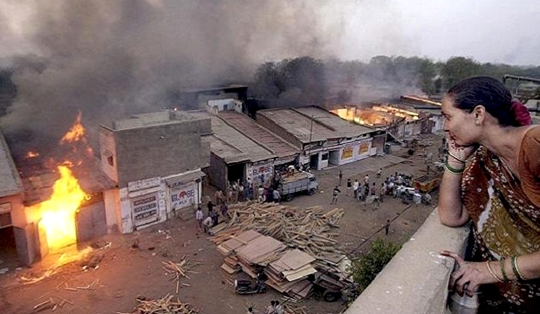
Gulberg1

Rejecting the demand for death sentence for all the convicts, the court said life imprisonment for the 11 will be till death if the state does not exercise power to remit the sentence.

The court awarded ten year jail term to one of the 13 convicted for lesser offences while 12 others have been given seven-year sentence each. The prosecution had argued that all the 24 convicts should be given death penalty.

While describing the massacre as the darkest day in the history of civil society, Special court Judge P B Desai refused death penalty saying, "If you look at all aspects, no previous antecedent has been placed on record".

Post the incident, 90 per cent of the accused were released on bail, yet no complaints against them have been given even by victims, and there is no record to show that they committed any offence during the time of bail, the judge further said, while giving reasons why he thought that this was not a fit case to give capital punishment to the convicts.

The court said it has decided to award imprisonment for life without any time frame to 11 accused, who have been convicted for murder, while requesting the state not to use its power to remit the sentence after 14 years of imprisonment.

"CrPC provisions give power to the state to remit sentence after 14 years jail, section 433-A imposes some restriction on that power. In case the state does not exercise power to remit the sentence, life imprisonment will mean that it is till death," the court said.

"I cannot add beyond what has been prescribed under section 302, it is not necessary for a state to exercise power to remit sentence, state may not exercise power of remittance," the judge said, adding the court's direction cannot be binding as he cannot take away the executive powers of the state.

As regards the 13 others accused convicted for lesser offences not including murder (302), the court awarded 10 years imprisonment to one Mangilal Jain, while 12 others were awarded seven-year sentence each.

The Gulberg Society massacre, which took place here on February 28, 2002 when Narendra Modi was the Gujarat Chief Minister, shook the nation when a mob of 400 people set about attacking the society in the heart of Ahmedabad and killed the residents including Jafri.

It was one of the nine cases of the 2002 Gujarat riots probed by the Supreme Court-appointed SIT.

"All the sentences will run concurrently as the Supreme Court has laid it down clearly that if the crime had single purpose, sentences given for different sections of IPC should run concurrently," the court said.

The prosecution and the victims had demanded that sentences awarded to all the accused should not run concurrently as all the 24 convicts will have to spend their entire life behind bars.

Earlier on June 2, the court had convicted 11 persons for murder and other offences, while 13 others, including VHP leader Atul Vaidya, were charged with lesser offences. It had acquitted 36 others in the case.

Those given life sentence in the case are - Kailash Dhobi, Yogendra Shekhawat, Jayesh Jingar, Krishna Kalal, Jayesh Parmar, Raju Tiwari, Bharat Rajput, Dinesh Sharma, Narayan Tank, Lakhansinh Chudasama and Bharat Taili.

One Mangilal Jain, who was convicted for lesser offence, has been sentenced to 10 years jail term.

Besides, VHP leader Atul Vaid, Mukesh Jingar, Prakash Padhiyar, Surendrasinh Chauhan, Dilip Parmar, Babu Marwadi, Manish Jain, Dharmesh Shukla, Kapil Mishra, Suresh Dhobi, Ambesh Jingar and Sandeep Punjabi have been sentenced to seven years imprisonment each.

During the argument on quantum of sentence, special public prosecutor and counsel for Supreme Court-appointed Special Investigation Team (SIT), R C Kodekar had asked the court for nothing less than death sentence or jail term till death for all 24 convicts.

Lawyer for the victims, S M Vora, also sought maximum punishment for the accused and argued that sentencing for each offence should not run concurrently so that they spend their entire life in jail.

However, lawyer of the accused, Abhay Bhardwaj, has refuted the demand of capital punishment or maximum punishment in his arguments saying that the incident was spontaneous and there were enough provocations for it.

The Gulberg society massacre was one of the nine cases of 2002 Gujarat riots probed by the SC-appointed SIT.

The incident had taken place a day after S-6 coach of Sabarmati Express was burnt near Godhra train station in which 58 'kar sevaks' returning from Ayodhya were killed.

During the course of trial, as many as 338 witnesses were cross-examined, with four different judges having presided over the case.

Comments

Ahmed Ali K
 - 
Friday, 17 Jun 2016

Death sentence?
for what?
Is he a non Hindu?

Jaleel S
 - 
Friday, 17 Jun 2016

Rarest of rare judgement...

Add new comment

  • Coastaldigest.com reserves the right to delete or block any comments.
  • Coastaldigset.com is not responsible for its readers’ comments.
  • Comments that are abusive, incendiary or irrelevant are strictly prohibited.
  • Please use a genuine email ID and provide your name to avoid reject.
Agencies
June 4,2020

New Delhi, Jun 4: CSIR Director-General Shekhar Mande said on Thursday that the World Health Organisation's (WHO) decision to halt hydroxychloroquine (HCQ) drug trial was taken in haste and the global body should have actually analysed the data before making the decision.

"I firmly believe that WHO decision was taken in haste it was a kind of knee jerk reaction they should have actually analyse the data on their own before temporarily suspend the trials that is my personal opinion," Mande said.

India's nodal government agency ICMR (Indian Council of Medical Research) overseeing the country's response to the coronavirus pandemic last month wrote to the WHO citing differences in dosage standards between Indian and international trials that could explain the efficacy issues of HCQ in treating COVID-19 patients.

In addition, Dr Sheela Godbole, National Coordinator of the WHO-India Solidarity Trial and Head of the Division of Epidemiology, ICMR-National AIDS Research Institute also wrote a letter via an email to Dr Soumya Swaminathan, Chief Scientist at World Health Organisation.

In a letter, Dr Godbole stated: "There was no reason to suspend the trial for safety concern," attributing it to the current RECOVERY data which differs significantly from the non-randomised assessment by Mehra et al, a scientific paper.

Referring to the letter, the CSIR head said, "We don't know what actually happened behind the scenes but the hypothesis is that because of the paper published in Lancet. It is a very well known journal and if Lancet has done due vigilance in publishing the paper. 

Therefore, the WHO thought the paper's findings are right that's why WHO hold based on what is published on Lancet. The WHO shouldn't have accepted it immediately this should have taken their own due vigilance to find out that study is right or not."

DG CSIR said because there is a global outcry it must have put pressure on both Lancet as well as WHO and both of them now retracted from their original position. "WHO has started a trial again and Lancet has put an expression of concern on their website both of these are very welcome development for science," he said.

"So I am pretty sure that Lancet would have published the reports only after seeing somewhere the drug failed to work," Mande said.

Comments

Add new comment

  • Coastaldigest.com reserves the right to delete or block any comments.
  • Coastaldigset.com is not responsible for its readers’ comments.
  • Comments that are abusive, incendiary or irrelevant are strictly prohibited.
  • Please use a genuine email ID and provide your name to avoid reject.
News Network
March 2,2020

New Delhi, Mar 2: As communal violence spiked in north-east Delhi earlier this week, Hindu, Muslim and Sikh residents of a colony came together and stood guard against frenzied mobs which ran riot in nearby areas vandalising homes, shops and torching cars.

They have not let their guard down even as the situation is limping back to normalcy following four days of violence that has claimed at least 42 lives and left over 200 injured.

The B-Block colony in Yamuna Vihar has a Hindu-dominated Bahjanpura on one side and Muslim populated Ghonda on the other.

People from all faiths in the locality sit outside their homes at night and deal with any suspected outsider, Arib, a dentist in his 30s, said.

"It is the sloganeering by mobs that causes panic in the dead of night. Such slogans are from both sides and we hear groups of people moving forward towards our area.

"This is where we let the Muslim locals deal with Muslim groups and Hindu residents deal with Hindu groups coming from outside," he said.

Businessmen, doctors and people working at government offices stuck together as violence reached its crest on Monday and Tuesday, and have been guarding the locality round the clock.

Earlier, the locals had claimed inadequate police deployment in the area, but were satisfied as patrolling by security personnel increased in the last two days.

Charanjeet Singh, a Sikh who owns a transport firm, said residents have ensured that not too many people gather to guard the colony at night. It has been decided not use sticks or rods, an idea which seems to have worked in maintaining peace, he said.

"I was 10 years old when we came to this locality from Uttar Pradesh's Meerut in 1982. There were riots in 1984 and tension in 2002, but even then our area remained peaceful. We have always been united and that is the way we have helped each other," Singh, who is now in his 50s, told PTI.

Faisal, a businessman in his 30s, said after two days of major violence, there was palpable tension in the area. "Nobody could sleep in the neighbourhood even on Wednesday and Thursday when the situation was brought under control," he said.

Faisal said around 4 am on Wednesday, three to four miscreants had torched a car, but were chased away by vigilant residents. They raised an alarm and others gathered, saving other vehicles parked nearby from being damaged, he added.

On the idea of not keeping sticks while guarding B-Block, Singh said, "Violence begets violence, crowd begets crowd. We thought if somebody would see sticks or rods in our hands from a distance and large crowds standing guard, it is likely they would want to come prepared. This could fuel violence."

"Now, if there is some young man returning late in the night, we identify if he belongs to our area. If not, we normally inform him about the situation and guide him to his destination, if required," he added.

Seventy-year-old V K Sharma said people in his colony never had any trouble with each other, as he blamed "outside elements" for the violence in north-east Delhi.

"Some people have some problem with symbols. If they find a particular religion's symbol on a shop, home or a car, they vandalise it.

"This is on both sides, Hindus as well as Muslims. But not all people in all religion are like that. There are good people who outnumber these handful people involved in violence," he said.

The violence happened for two days but it would take months for fear to subside, Sharma said, as he took out his two granddaughters, aged nine and two, out for ice cream.

"I cannot reduce the tension outside my home, but at least I can make these kids feel good by reducing their craving for ice cream,” he added.

Colony resident Shiv Kumar, a property consultant, and Wasim, a government official, said they too were members of this voluntary guards' team of the colony which stays up at night to fend off miscreants.

Comments

Add new comment

  • Coastaldigest.com reserves the right to delete or block any comments.
  • Coastaldigset.com is not responsible for its readers’ comments.
  • Comments that are abusive, incendiary or irrelevant are strictly prohibited.
  • Please use a genuine email ID and provide your name to avoid reject.
News Network
March 5,2020

Lucknow, Mar 5: Uttar Pradesh chief minister Yogi Adityanath said last night that the role of teachers would come under the scanner when "anti-India" slogans are raised at universities and institutions of higher education.

"When anti-India slogans are raised at institutions of higher education, we should be prepared to ask why this type of distortion occurrs among our students?" he said at a programme organised by the Basic Shiksha Parishad in Lucknow.

"We begin our work with pledge for the country's unity and integrity and today slogans are raised for the division of the nation. In such a situation, questions are raised over the role of teachers who are considered equal to god in society," he said.

"Who all are involved in this sin and chaos? Governments can provide resources, but the one who has given them basic education, who has given them secondary education and who has led them to that place, all of them should evaluate their actions today," the chief minister said.

Speaking about the condition of education in the state when his government came to power three years ago, he said there was an atmosphere of chaos and anarchy in the state and the condition of basic education was very bad.

"The worst problem was that of proxy teachers. Our government started the process of prohibiting proxy teachers in the first phase," he said.

Adityanath said that a teacher is not just a government servant, but the fate of the nation. He said teachers should learn from Chanakya.

Had Chanakya confined himself to Nalanda University, he would not have been able to make India a superpower of the world during that period. Teachers will have to prepare themselves according to the challenges and need of society, he added.

Comments

Add new comment

  • Coastaldigest.com reserves the right to delete or block any comments.
  • Coastaldigset.com is not responsible for its readers’ comments.
  • Comments that are abusive, incendiary or irrelevant are strictly prohibited.
  • Please use a genuine email ID and provide your name to avoid reject.