


11 get life term in Gulberg society massacre case

June 17, 2016

Ahmedabad, Jun 17: Calling the Gulberg massacre as the "darkest day" in the history of civil society, a special SIT court here today sentenced 11 convicts to life imprisonment in the case of burning alive of 69 people, including former Congress MP Eshan Jafri in the 2002 post-Godhra violence.
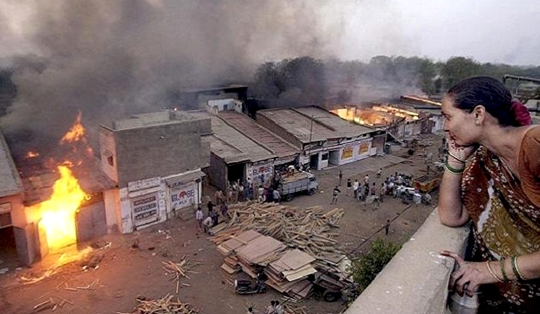
Gulberg1

Rejecting the demand for death sentence for all the convicts, the court said life imprisonment for the 11 will be till death if the state does not exercise power to remit the sentence.

The court awarded ten year jail term to one of the 13 convicted for lesser offences while 12 others have been given seven-year sentence each. The prosecution had argued that all the 24 convicts should be given death penalty.

While describing the massacre as the darkest day in the history of civil society, Special court Judge P B Desai refused death penalty saying, "If you look at all aspects, no previous antecedent has been placed on record".

Post the incident, 90 per cent of the accused were released on bail, yet no complaints against them have been given even by victims, and there is no record to show that they committed any offence during the time of bail, the judge further said, while giving reasons why he thought that this was not a fit case to give capital punishment to the convicts.

The court said it has decided to award imprisonment for life without any time frame to 11 accused, who have been convicted for murder, while requesting the state not to use its power to remit the sentence after 14 years of imprisonment.

"CrPC provisions give power to the state to remit sentence after 14 years jail, section 433-A imposes some restriction on that power. In case the state does not exercise power to remit the sentence, life imprisonment will mean that it is till death," the court said.

"I cannot add beyond what has been prescribed under section 302, it is not necessary for a state to exercise power to remit sentence, state may not exercise power of remittance," the judge said, adding the court's direction cannot be binding as he cannot take away the executive powers of the state.

As regards the 13 others accused convicted for lesser offences not including murder (302), the court awarded 10 years imprisonment to one Mangilal Jain, while 12 others were awarded seven-year sentence each.

The Gulberg Society massacre, which took place here on February 28, 2002 when Narendra Modi was the Gujarat Chief Minister, shook the nation when a mob of 400 people set about attacking the society in the heart of Ahmedabad and killed the residents including Jafri.

It was one of the nine cases of the 2002 Gujarat riots probed by the Supreme Court-appointed SIT.

"All the sentences will run concurrently as the Supreme Court has laid it down clearly that if the crime had single purpose, sentences given for different sections of IPC should run concurrently," the court said.

The prosecution and the victims had demanded that sentences awarded to all the accused should not run concurrently as all the 24 convicts will have to spend their entire life behind bars.

Earlier on June 2, the court had convicted 11 persons for murder and other offences, while 13 others, including VHP leader Atul Vaidya, were charged with lesser offences. It had acquitted 36 others in the case.

Those given life sentence in the case are - Kailash Dhobi, Yogendra Shekhawat, Jayesh Jingar, Krishna Kalal, Jayesh Parmar, Raju Tiwari, Bharat Rajput, Dinesh Sharma, Narayan Tank, Lakhansinh Chudasama and Bharat Taili.

One Mangilal Jain, who was convicted for lesser offence, has been sentenced to 10 years jail term.

Besides, VHP leader Atul Vaid, Mukesh Jingar, Prakash Padhiyar, Surendrasinh Chauhan, Dilip Parmar, Babu Marwadi, Manish Jain, Dharmesh Shukla, Kapil Mishra, Suresh Dhobi, Ambesh Jingar and Sandeep Punjabi have been sentenced to seven years imprisonment each.

During the argument on quantum of sentence, special public prosecutor and counsel for Supreme Court-appointed Special Investigation Team (SIT), R C Kodekar had asked the court for nothing less than death sentence or jail term till death for all 24 convicts.

Lawyer for the victims, S M Vora, also sought maximum punishment for the accused and argued that sentencing for each offence should not run concurrently so that they spend their entire life in jail.

However, lawyer of the accused, Abhay Bhardwaj, has refuted the demand of capital punishment or maximum punishment in his arguments saying that the incident was spontaneous and there were enough provocations for it.

The Gulberg society massacre was one of the nine cases of 2002 Gujarat riots probed by the SC-appointed SIT.

The incident had taken place a day after S-6 coach of Sabarmati Express was burnt near Godhra train station in which 58 'kar sevaks' returning from Ayodhya were killed.

During the course of trial, as many as 338 witnesses were cross-examined, with four different judges having presided over the case.

Comments

Ahmed Ali K
 - 
Friday, 17 Jun 2016

Death sentence?
for what?
Is he a non Hindu?

Jaleel S
 - 
Friday, 17 Jun 2016

Rarest of rare judgement...

Add new comment

  • Coastaldigest.com reserves the right to delete or block any comments.
  • Coastaldigset.com is not responsible for its readers’ comments.
  • Comments that are abusive, incendiary or irrelevant are strictly prohibited.
  • Please use a genuine email ID and provide your name to avoid reject.
News Network
March 9,2020

Kolkata, Mar 9: A diabetic man died in the isolation ward of a hospital in West Bengal's Murshidabad on Sunday, a day after he was admitted there with suspected symptoms of coronavirus following his return from Saudi Arabia.

According to doctors, he was admitted to the hospital with fever, cough and cold.

Though test results of his blood and swab samples for novel coronavirus were awaited, it can be said that he died probably of diabetes, Director of Health Services Ajay Chakraborty told PTI.

"The man was highly diabetic and was on insulin. He returned home from Saudi Arabia and had no money to take insulin for the last three to four days.

"He was also suffering from fever, cough and cold. He was admitted to the isolation ward of the Murshidabad Medical College and Hospital yesterday and died today," the health services director said.

"We are waiting for the results of medical tests. The possibility of his death due to novel coronavirus infection is remote," he said.

However, precautions will be taken during the last rites of the victim according to the directives set by the central and state governments for patients who die of the virus, another senior official said.

"Family members will not be allowed to touch the body since the man had been suffering from cough and breathlessness. Those performing his last rites will be given protective gear, masks and gloves. Though test results are yet to be known, we do not want to take any chance," he said.

Meanwhile, the state health department has issued a directive to all private medical facilities to create a system for assessing all patients at admission allowing early recognition of possible COVID-19 infection and immediate isolation of patients with suspected novel coronavirus infection in an area separate from other patients.

Comments

Add new comment

  • Coastaldigest.com reserves the right to delete or block any comments.
  • Coastaldigset.com is not responsible for its readers’ comments.
  • Comments that are abusive, incendiary or irrelevant are strictly prohibited.
  • Please use a genuine email ID and provide your name to avoid reject.
News Network
March 29,2020

Mumbai, Mar 29: Virologist Minal Dakhave Bhosale led from the front to create India's first coronavirus testing kit even when she was in the last stage of her pregnancy.

Bhosale's efforts paid the price with her team delivering the testing kit in a record time of six weeks.

Bhosale gave birth to a baby girl just a day before submitting the kit to the authorities for evaluation.

"It was like giving birth to two babies," Bhosale told PTI over the phone.

The virologist said both the journeys - that happened in parallel - were not without challenges.

"There were complications in the pregnancy while work on the test kit was on. The baby was delivered through cesarean," she said.

Bhosale said she felt that it was the right time to serve the people to help them in combating the coronavirus threat.

"I had been working for five years in this field and if I don't work in emergency situations when my services are needed the most, then what is the use?" she said.

Though Bhosale was not able to visit the office due to the pregnancy, she was guiding a team of 10 persons working on the project at Mylab Discovery in Pune.

The strong bonds forged with the team over the years and their support made it possible, she said.

Company's co-founder Shrikant Patole said just like drug discovery, test kits too go through a lot of quality checks to improve the precision.

He credited Bhosale for the success of the project.

The COVID-19 testing kit delivered by Bhosale's team will reduce the time taken for delivering a result to 2.5 hours from the prevalent practice of eight hours.

A pioneering approach to testing without compromising on the results was adopted, Bhosale said.

The Maylab test kit will cost Rs1,200, a quarter of Rs 4,500 per kit that the government has been spending on testing so far.

"I'm happy that I could do something for the country," Bhosale said.

As of Friday, only 27,000 of the 1.3 billion people were tested for the virus in the country.

According to experts, high scale testing is essential because it alone can ensure an early diagnosis of COVID-19 and lower down the fatalities.

The company is confident of ramping up the capacity at its plant in Lonavala to deliver 100,000 kits a week, Patole said.

He said the authorities are helping the company, including giving priority for shipping of the raw materials.

Comments

Add new comment

  • Coastaldigest.com reserves the right to delete or block any comments.
  • Coastaldigset.com is not responsible for its readers’ comments.
  • Comments that are abusive, incendiary or irrelevant are strictly prohibited.
  • Please use a genuine email ID and provide your name to avoid reject.
News Network
February 28,2020

Hyderabad, Feb 28: The Cyber Crime Police of Hyderabad has registered an FIR against social media platforms- WhatsApp, Twitter and TikTok- for allowing people to spread anti-national activities, as per a complaint filed by one S Srishailam.

Raghuveer, Additional DCP Cyber Crimes said," We have received a court referred complaint, which was filed by S Srisailam in the concerned court stating that social media platforms Whatsapp, Twitter and TikTok are allowing few people to spread anti-national activities and videos."

S Srisailam also claimed that a few people are running a campaign against the CAA on social media platforms to spread hatred which in turn is causing damage to national integrity.

"In this regard, because the complaint was referred by a court a case has been registered against Whatsapp, Twitter & TikTok under the relevant section of Indian Penal Code and IT Act and took up the investigation," the DCP added.

He also added that the police cannot take action against these platforms as they are not banned in India but can initiate action against persons who intentionally indulge in spreading hatred.

"The police are conducting the investigation and if allegations of the complainant are found to be false then we will drop the case. We had received the case one week ago," informed the DCP.

Comments

Add new comment

  • Coastaldigest.com reserves the right to delete or block any comments.
  • Coastaldigset.com is not responsible for its readers’ comments.
  • Comments that are abusive, incendiary or irrelevant are strictly prohibited.
  • Please use a genuine email ID and provide your name to avoid reject.