


11 get life term in Gulberg society massacre case

June 17, 2016

Ahmedabad, Jun 17: Calling the Gulberg massacre as the "darkest day" in the history of civil society, a special SIT court here today sentenced 11 convicts to life imprisonment in the case of burning alive of 69 people, including former Congress MP Eshan Jafri in the 2002 post-Godhra violence.
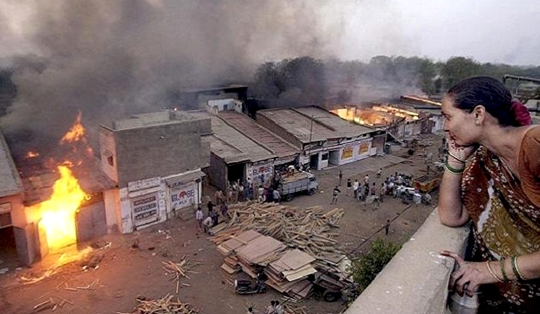
Gulberg1

Rejecting the demand for death sentence for all the convicts, the court said life imprisonment for the 11 will be till death if the state does not exercise power to remit the sentence.

The court awarded ten year jail term to one of the 13 convicted for lesser offences while 12 others have been given seven-year sentence each. The prosecution had argued that all the 24 convicts should be given death penalty.

While describing the massacre as the darkest day in the history of civil society, Special court Judge P B Desai refused death penalty saying, "If you look at all aspects, no previous antecedent has been placed on record".

Post the incident, 90 per cent of the accused were released on bail, yet no complaints against them have been given even by victims, and there is no record to show that they committed any offence during the time of bail, the judge further said, while giving reasons why he thought that this was not a fit case to give capital punishment to the convicts.

The court said it has decided to award imprisonment for life without any time frame to 11 accused, who have been convicted for murder, while requesting the state not to use its power to remit the sentence after 14 years of imprisonment.

"CrPC provisions give power to the state to remit sentence after 14 years jail, section 433-A imposes some restriction on that power. In case the state does not exercise power to remit the sentence, life imprisonment will mean that it is till death," the court said.

"I cannot add beyond what has been prescribed under section 302, it is not necessary for a state to exercise power to remit sentence, state may not exercise power of remittance," the judge said, adding the court's direction cannot be binding as he cannot take away the executive powers of the state.

As regards the 13 others accused convicted for lesser offences not including murder (302), the court awarded 10 years imprisonment to one Mangilal Jain, while 12 others were awarded seven-year sentence each.

The Gulberg Society massacre, which took place here on February 28, 2002 when Narendra Modi was the Gujarat Chief Minister, shook the nation when a mob of 400 people set about attacking the society in the heart of Ahmedabad and killed the residents including Jafri.

It was one of the nine cases of the 2002 Gujarat riots probed by the Supreme Court-appointed SIT.

"All the sentences will run concurrently as the Supreme Court has laid it down clearly that if the crime had single purpose, sentences given for different sections of IPC should run concurrently," the court said.

The prosecution and the victims had demanded that sentences awarded to all the accused should not run concurrently as all the 24 convicts will have to spend their entire life behind bars.

Earlier on June 2, the court had convicted 11 persons for murder and other offences, while 13 others, including VHP leader Atul Vaidya, were charged with lesser offences. It had acquitted 36 others in the case.

Those given life sentence in the case are - Kailash Dhobi, Yogendra Shekhawat, Jayesh Jingar, Krishna Kalal, Jayesh Parmar, Raju Tiwari, Bharat Rajput, Dinesh Sharma, Narayan Tank, Lakhansinh Chudasama and Bharat Taili.

One Mangilal Jain, who was convicted for lesser offence, has been sentenced to 10 years jail term.

Besides, VHP leader Atul Vaid, Mukesh Jingar, Prakash Padhiyar, Surendrasinh Chauhan, Dilip Parmar, Babu Marwadi, Manish Jain, Dharmesh Shukla, Kapil Mishra, Suresh Dhobi, Ambesh Jingar and Sandeep Punjabi have been sentenced to seven years imprisonment each.

During the argument on quantum of sentence, special public prosecutor and counsel for Supreme Court-appointed Special Investigation Team (SIT), R C Kodekar had asked the court for nothing less than death sentence or jail term till death for all 24 convicts.

Lawyer for the victims, S M Vora, also sought maximum punishment for the accused and argued that sentencing for each offence should not run concurrently so that they spend their entire life in jail.

However, lawyer of the accused, Abhay Bhardwaj, has refuted the demand of capital punishment or maximum punishment in his arguments saying that the incident was spontaneous and there were enough provocations for it.

The Gulberg society massacre was one of the nine cases of 2002 Gujarat riots probed by the SC-appointed SIT.

The incident had taken place a day after S-6 coach of Sabarmati Express was burnt near Godhra train station in which 58 'kar sevaks' returning from Ayodhya were killed.

During the course of trial, as many as 338 witnesses were cross-examined, with four different judges having presided over the case.

Comments

Ahmed Ali K
 - 
Friday, 17 Jun 2016

Death sentence?
for what?
Is he a non Hindu?

Jaleel S
 - 
Friday, 17 Jun 2016

Rarest of rare judgement...

Add new comment

  • Coastaldigest.com reserves the right to delete or block any comments.
  • Coastaldigset.com is not responsible for its readers’ comments.
  • Comments that are abusive, incendiary or irrelevant are strictly prohibited.
  • Please use a genuine email ID and provide your name to avoid reject.
News Network
June 30,2020

Hyderabad, Jun 30: Hyderabad-based Bharat Biotech announced that it has successfully developed Covaxin, India's first vaccine candidate for Covid-19, in collaboration with the Indian Council of Medical Research (ICMR) and National Institute of Virology (NIV).

The Drug Controller General of India - CDSCO, Ministry of Health & Family Welfare granted permission to initiate Phase I & II Human clinical trials after the company submitted results generated from preclinical studies, demonstrating safety and immune response. Human clinical trials are scheduled to start across India in July 2020.

The SARS-CoV-2 strain was isolated in NIV, Pune and transferred to Bharat Biotech.

The indigenous, inactivated vaccine developed and manufactured in the company's Bio-Safety Level 3 (BSL-3) High Containment facility located in Genome Valley, Hyderabad.

Announcing the vaccine development milestone, Dr Krishna Ella, Chairman and Managing Director said: "We are proud to announce COVAXIN, India's first indigenous vaccine against COVID-19. The collaboration with ICMR and NIV was instrumental in the development of this vaccine."

Dr Ella added, "The proactive support and guidance from CDSCO has enabled approvals to this project. Our R&D and Manufacturing teams worked tirelessly to deploy our proprietary technologies towards this platform."
Expedited through national regulatory protocols, the company accelerated its objective in completing the comprehensive pre-clinical studies. Results from these studies have been promising and show extensive safety and effective immune responses.

Speaking about Bharat Biotech's prowess, Suchitra Ella, Joint Managing Director said, "Our ongoing research and expertise in forecasting epidemics has enabled us to successfully manufacture a vaccine for the H1N1 pandemic."
"Continuing our focus on creating the only BSL-3 containment facilities for manufacturing and testing in India, Bharat Biotech is committed to advancing vaccine development as a matter of national importance to demonstrate India's strength in handling future pandemics," she added.

Bharat Biotech's track record in developing vero cell culture platform technologies has been proven in several vaccines for Polio, Rabies, Rotavirus, Japanese Encephalitis, Chikungunya and Zika.

Comments

Add new comment

  • Coastaldigest.com reserves the right to delete or block any comments.
  • Coastaldigset.com is not responsible for its readers’ comments.
  • Comments that are abusive, incendiary or irrelevant are strictly prohibited.
  • Please use a genuine email ID and provide your name to avoid reject.
News Network
January 23,2020

Mumbai, Jan 23: Rashmi Sahijwala never expected to start working at the age of 59, let alone join India’s gig economy—now she is part of an army of housewives turning their homes into “cloud kitchens” to feed time-starved millennials.

Asia’s third-largest economy is battling a slowdown so sharp it is creating a drag on global growth, the International Monetary Fund said Monday, but there are some bright spots.

The gig economy, aided by cheap mobile data and abundant labour, has flourished in India, opening up new markets across the vast nation.

Although Indian women have long battled for access to education and employment opportunities, the biggest hurdle for many is convincing conservative families to let them leave home.

But new apps like Curryful, Homefoodi, and Nanighar are tapping the skills of housewives to slice, dice and prepare meals for hungry urbanites from the comfort of their homes.

The so-called cloud kitchens—restaurants that have no physical presence and a delivery-only model—are rising in popularity as there is a boom in food delivery apps such as Swiggy and Zomato.

“We want to be the Uber of home-cooked food,” said Ben Mathew, who launched Curryful in 2018, convinced that housewives were a huge untapped resource.

His company—which employs five people for the app’s daily operations—works with 52 women and three men, and the 31-year-old web entrepreneur hopes to get one million female chefs on-board by 2022.

“We usually train them in processes of sanitisation, cooking, prep time and packaging... and then launch them on the platform,” Mathew told news agency.

One of the first housewives to join Curryful in November 2018 shortly after its launch, Sahijwala was initially apprehensive, despite having four decades of experience in the kitchen.

But backed by her children, including her son who gave her regular feedback about her proposed dishes, she took the plunge.

Since then, she’s undergone a crash course in how to run a business, from creating weekly menus to buying supplies from wholesale markets to cut costs.

The learning curve was steep and Sahijwala switched from cooking everything from scratch to preparing curries and batters for breads in advance to save time and limit leftovers.

She even bought a massive freezer to store fruits and vegetables despite her husband’s reservations about the cost.

“I told him that I am a professional now,” she told news agency.

‘Internet restaurants’

Kallol Banerjee, co-founder of Rebel Foods which runs 301 cloud kitchens backing up 2,200 “internet restaurants”, was among the first entrepreneurs to embrace the concept in 2012.

“We could do more brands from one kitchen and cater to different customer requirements at multiple price points,” Banerjee told AFP.

The chefs buy the ingredients, supply the cookware and pay the utility bills.

The apps—which make their money through charging commission, such as more than 18 percent per order for Curryful—offer training and supply the chefs with containers and bags to pack the food in.

Curryful chef Chand Vyas, 55, spent years trying to set up a lunch delivery business but finally gave up after failing to compete with dabbawalas, Mumbai’s famously efficient food porters.

Today Vyas works seven hours a day, five days a week in her kitchen, serving up a bevy of Indian vegetarian staples, from street food favourites to lentils and rice according to the app’s weekly set menus.

“I don’t understand marketing or how to run a business but I know how to cook. So, the current partnership helps me focus on just that while Curryful takes care of the rest,” Vyas told AFP.

She pockets up to $150 (Rs 10,000 approx) a month after accounting for the commissions and costs, but hopes to earn more as the orders increase.

In contrast, a chef at a bricks-and-mortar restaurant takes home a monthly wage of between $300 (Rs 20,000 approx) and $1,000 (Rs 70,000) approx for working six days a week.

With India’s cloud kitchen sector expected to reach $1.05 billion by 2023, according to data platform Inc42, other companies are also keen to get a slice of the action.

Swiggy, for example, has invested 2.5 billion rupees ($35.3 million) in opening 1,000 cloud kitchens across the nation.

Back in her Mumbai kitchen, Sahijwala is elated to have embarked on a career at an age when her contemporaries are eyeing retirement.

Over the past year, she has seen her profit grow to $200 (Rs 15,000 approx) a month, but more importantly, she said, “My passion has finally found an outlet.

“I am just glad life has given me this chance.”

Comments

Add new comment

  • Coastaldigest.com reserves the right to delete or block any comments.
  • Coastaldigset.com is not responsible for its readers’ comments.
  • Comments that are abusive, incendiary or irrelevant are strictly prohibited.
  • Please use a genuine email ID and provide your name to avoid reject.
News Network
February 11,2020

Aligarh, Feb 11: Paediatrician Dr Kafeel Khan, who was arrested from Mumbai on January 29 after he delivered a speech at Aligarh Muslim University (AMU) against communalism and politics of hate, will be released from jail on Tuesday after he was granted bail by an Aligarh court.

Khan will be released from Mathura jail on Tuesday after legal formalities are completed.

Chief judicial magistrate Karuna Singh granted bail to Khan on Monday on a bail bond of Rs 60,000. Two surety bonds of Rs 60,000 each would also be furnished by the guarantors.

Dr Khan's lawyer, Mohammad Irfan Gazi, told reporters, "The court was told that Khan was falsely implicated by police under political pressure. After hearing the arguments, the court granted him bail."

The suspended doctor was arrested by special task force (STF) of the UP police from Mumbai on January 29, when he reached the city to attend a protest against the Citizenship (Amendment) Act.

He was arrested in connection with a case registered against him in Aligarh under section 153-A (promoting enmity between different groups on ground of religion) of the Indian Penal Code at Civil Lines police station on December 13

The case was filed after his speech at Aligarh Muslim University (AMU).

According to the FIR, while addressing students, without naming anyone, Dr Kafeel Khan said that 'Mota Bhai' is teaching everyone to become Hindu or Muslim but not a human being. "This is a fight for our existence. We have to fight."

The FIR also said that Dr Kafeel Khan made an attempt to vitiate the peaceful atmosphere and disturb the communal harmony with his speech.

Dr Khan was in the news in 2017 when he was named as one of the nine accused in a case involving deaths of several children due to alleged disruption in supply of oxygen at the BRD Medical College in Gorakhpur. Though he was granted clean chit in a departmental inquiry, his suspension has not yet been revoked.

Comments

Add new comment

  • Coastaldigest.com reserves the right to delete or block any comments.
  • Coastaldigset.com is not responsible for its readers’ comments.
  • Comments that are abusive, incendiary or irrelevant are strictly prohibited.
  • Please use a genuine email ID and provide your name to avoid reject.