


11 get life term in Gulberg society massacre case

June 17, 2016

Ahmedabad, Jun 17: Calling the Gulberg massacre as the "darkest day" in the history of civil society, a special SIT court here today sentenced 11 convicts to life imprisonment in the case of burning alive of 69 people, including former Congress MP Eshan Jafri in the 2002 post-Godhra violence.
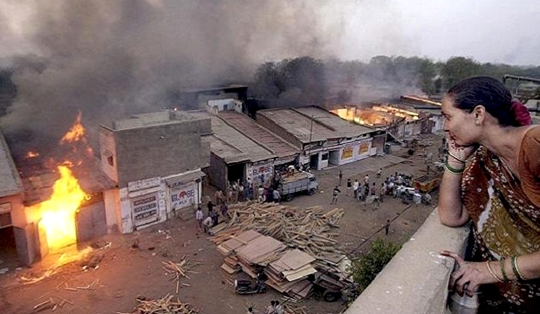
Gulberg1

Rejecting the demand for death sentence for all the convicts, the court said life imprisonment for the 11 will be till death if the state does not exercise power to remit the sentence.

The court awarded ten year jail term to one of the 13 convicted for lesser offences while 12 others have been given seven-year sentence each. The prosecution had argued that all the 24 convicts should be given death penalty.

While describing the massacre as the darkest day in the history of civil society, Special court Judge P B Desai refused death penalty saying, "If you look at all aspects, no previous antecedent has been placed on record".

Post the incident, 90 per cent of the accused were released on bail, yet no complaints against them have been given even by victims, and there is no record to show that they committed any offence during the time of bail, the judge further said, while giving reasons why he thought that this was not a fit case to give capital punishment to the convicts.

The court said it has decided to award imprisonment for life without any time frame to 11 accused, who have been convicted for murder, while requesting the state not to use its power to remit the sentence after 14 years of imprisonment.

"CrPC provisions give power to the state to remit sentence after 14 years jail, section 433-A imposes some restriction on that power. In case the state does not exercise power to remit the sentence, life imprisonment will mean that it is till death," the court said.

"I cannot add beyond what has been prescribed under section 302, it is not necessary for a state to exercise power to remit sentence, state may not exercise power of remittance," the judge said, adding the court's direction cannot be binding as he cannot take away the executive powers of the state.

As regards the 13 others accused convicted for lesser offences not including murder (302), the court awarded 10 years imprisonment to one Mangilal Jain, while 12 others were awarded seven-year sentence each.

The Gulberg Society massacre, which took place here on February 28, 2002 when Narendra Modi was the Gujarat Chief Minister, shook the nation when a mob of 400 people set about attacking the society in the heart of Ahmedabad and killed the residents including Jafri.

It was one of the nine cases of the 2002 Gujarat riots probed by the Supreme Court-appointed SIT.

"All the sentences will run concurrently as the Supreme Court has laid it down clearly that if the crime had single purpose, sentences given for different sections of IPC should run concurrently," the court said.

The prosecution and the victims had demanded that sentences awarded to all the accused should not run concurrently as all the 24 convicts will have to spend their entire life behind bars.

Earlier on June 2, the court had convicted 11 persons for murder and other offences, while 13 others, including VHP leader Atul Vaidya, were charged with lesser offences. It had acquitted 36 others in the case.

Those given life sentence in the case are - Kailash Dhobi, Yogendra Shekhawat, Jayesh Jingar, Krishna Kalal, Jayesh Parmar, Raju Tiwari, Bharat Rajput, Dinesh Sharma, Narayan Tank, Lakhansinh Chudasama and Bharat Taili.

One Mangilal Jain, who was convicted for lesser offence, has been sentenced to 10 years jail term.

Besides, VHP leader Atul Vaid, Mukesh Jingar, Prakash Padhiyar, Surendrasinh Chauhan, Dilip Parmar, Babu Marwadi, Manish Jain, Dharmesh Shukla, Kapil Mishra, Suresh Dhobi, Ambesh Jingar and Sandeep Punjabi have been sentenced to seven years imprisonment each.

During the argument on quantum of sentence, special public prosecutor and counsel for Supreme Court-appointed Special Investigation Team (SIT), R C Kodekar had asked the court for nothing less than death sentence or jail term till death for all 24 convicts.

Lawyer for the victims, S M Vora, also sought maximum punishment for the accused and argued that sentencing for each offence should not run concurrently so that they spend their entire life in jail.

However, lawyer of the accused, Abhay Bhardwaj, has refuted the demand of capital punishment or maximum punishment in his arguments saying that the incident was spontaneous and there were enough provocations for it.

The Gulberg society massacre was one of the nine cases of 2002 Gujarat riots probed by the SC-appointed SIT.

The incident had taken place a day after S-6 coach of Sabarmati Express was burnt near Godhra train station in which 58 'kar sevaks' returning from Ayodhya were killed.

During the course of trial, as many as 338 witnesses were cross-examined, with four different judges having presided over the case.

Comments

Ahmed Ali K
 - 
Friday, 17 Jun 2016

Death sentence?
for what?
Is he a non Hindu?

Jaleel S
 - 
Friday, 17 Jun 2016

Rarest of rare judgement...

Add new comment

  • Coastaldigest.com reserves the right to delete or block any comments.
  • Coastaldigset.com is not responsible for its readers’ comments.
  • Comments that are abusive, incendiary or irrelevant are strictly prohibited.
  • Please use a genuine email ID and provide your name to avoid reject.
Agencies
June 14,2020

New Delhi, Jun 14: Petrol price on Sunday was hiked by a record 62 paise per litre and that of diesel by 64 paise as oil companies for the eighth day in a row adjusted retail rates in line with cost since ending an 82-day hiatus in rate revision.

Petrol price in Delhi was hiked to Rs 75.78 per litre from Rs 75.16 while diesel rates were increased to Rs 74.03 a litre from Rs 73.39, according to a price notification of state oil marketing companies.

Rates have been increased across the country and vary from state to state depending on the incidence of local sales tax or VAT.

The 62 paise a litre increase in petrol and 64 paise hike in diesel price is the highest surge in rates since the daily price revision was started in June 2017.

This is the eighth daily increase in rates in a row since oil companies on June 7 restarted revising prices in line with costs, after ending an 82-day hiatus.

In eight hikes, petrol price has gone up by Rs 4.52 per litre and diesel by Rs 4.64 -- a record increase in rates in any eight days since the daily price revision was introduced.

The freeze in rates was imposed in mid-March soon after the government hiked excise duty on petrol and diesel to shore up additional finances.

Oil PSUs Indian Oil Corp (IOC), Bharat Petroleum Corp Ltd (BPCL) and Hindustan Petroleum Corp Ltd (HPCL), instead of passing on the excise duty hikes to customers, adjusted them against the fall in the retail rates that was warranted because of international oil prices falling to two-decade lows.

The government had first raised excise duty on petrol and diesel by Rs 3 per litre each on March 14 and then again on May 5 by a record Rs 10 per litre in case of petrol and Rs 13 on diesel. The two hikes gave the government Rs 2 lakh crore in additional tax revenues.

State-owned fuel retailers IOC, BPCL and HPCL had frozen petrol and diesel prices since March 16, as if anticipating the government move and set off gains they accrued from continuing drop in international oil prices against the excise duty hike.

They, however, promptly passed the increase in local sales tax or VAT by state governments such as Rs 1.67 increase in VAT on petrol and Rs 7.10 in diesel by the Delhi government on May 4.

The total incidence of excise duty on petrol has risen to Rs 32.98 per litre and that on diesel to Rs 31.83. The excise tax on petrol was Rs 9.48 per litre when the Narendra Modi government took office in 2014 and that on diesel was Rs 3.56 a litre.

The government had between November 2014 and January 2016 raised excise duty on petrol and diesel on nine occasions to take away gains arising from plummeting global oil prices.

In all, duty on petrol rate was hiked by Rs 11.77 per litre and that on diesel by 13.47 a litre in those 15 months that helped government's excise mop up more than double to Rs 2,42,000 crore in 2016-17 from Rs 99,000 crore in 2014-15.

It cut excise duty by Rs 2 in October 2017 and by Rs 1.50 a year later. But it raised excise duty by Rs 2 per litre in July 2019.

It again raised excise duty on March 14 by Rs 3 per litre.

Comments

Add new comment

  • Coastaldigest.com reserves the right to delete or block any comments.
  • Coastaldigset.com is not responsible for its readers’ comments.
  • Comments that are abusive, incendiary or irrelevant are strictly prohibited.
  • Please use a genuine email ID and provide your name to avoid reject.
News Network
May 4,2020

New Delhi, May 4: The country's manufacturing sector activity witnessed unprecedented contraction in April amid national lockdown restrictions, following which new business orders collapsed at a record pace and firms sharply reduced their staff numbers, a monthly survey said on Monday.

The headline seasonally adjusted IHS Markit India Manufacturing Purchasing Managers' Index (PMI) fell to 27.4 in April, from 51.8 in March, reflecting the sharpest deterioration in business conditions across the sector since data collection began over 15 years ago.
The index slipped into contraction mode, after remaining in the growth territory for 32 consecutive months.

In PMI parlance, a print above 50 means expansion, while a score below that denotes contraction.

Amid widespread business closures, demand conditions were severely hampered in April. New orders fell for the first time in two-and-a-half years and at the sharpest rate in the survey's history, far outpacing that seen during the global financial crisis, the survey said.

"After making it through March relatively unscathed, the Indian manufacturing sector felt the full force of the coronavirus pandemic in April," said Eliot Kerr, Economist at IHS Markit.
Panellists attributed lower production to temporary factory closures that were triggered by restrictive measures to limit the spread of COVID-19.

Export orders also witnessed a sharp decline. Following the first reduction since October 2017 during March, foreign sales fell at a quicker rate in April. "In fact, the rate of decline accelerated to the fastest since the series began over 15 years ago," the survey said.

On the employment front, deteriorating demand conditions saw manufacturers drastically cut back staff numbers in April. The reduction in employment was the quickest in the survey's history.

"In the latest survey period, record contractions in output, new orders and employment pointed to a severe deterioration in demand conditions.
“Meanwhile, there was evidence of unprecedented supply-side disruption, with input delivery times lengthening to the greatest extent since data collection began in March 2005," Kerr said.

On the prices front, both input costs and output prices were lowered markedly as suppliers and manufacturers themselves offered discounts in an attempt to secure orders.

Going ahead, sentiment regarding the 12-month outlook for production ticked up from March's recent low on hopes that demand will rebound once the COVID-19 threat has diminished and lockdown restrictions eased.

"There was a hint of positivity when looking at firms' 12-month outlooks, with sentiment towards future activity rebounding from March's record low. That said, the degree of optimism remained well below the historical average," Kerr said.

In India, the death toll due to COVID-19 rose to 1,373 and the number of cases climbed to 42,533 as on Monday, according to the health ministry.

Meanwhile, the coronavirus-induced lockdown has been extended beyond May 4, for another two weeks in the country.

Comments

Add new comment

  • Coastaldigest.com reserves the right to delete or block any comments.
  • Coastaldigset.com is not responsible for its readers’ comments.
  • Comments that are abusive, incendiary or irrelevant are strictly prohibited.
  • Please use a genuine email ID and provide your name to avoid reject.
Agencies
June 12,2020

Google on Friday announced the launch of a new feature on Google Search, Assistant, and Maps for users in India to help them find information on COVID-19 testing centres near them.

The search giant has partnered with the Indian Council of Medical Research (ICMR) and MyGov to provide the information on authorised testing labs.

The feature is currently available in English and eight Indian languages including Hindi, Telugu, Tamil, Malayalam, Kannada, Bengali, Gujarati, and Marathi.

According to the company, users will now see a new "Testing" tab on the search result page providing a list of nearby testing labs along with key information and guidance needed before using their services.

On Google Maps, when users search for keywords like "COVID testing" or "coronavirus testing" they will see a list of nearby testing labs, with a link to Google Search for the government-mandated requirements.

Google said that the Search, Assistant, and Maps currently feature 700 testing labs across 300 cities and working with authorities to identify and add more testing labs located across the country.

The company reiterates that it is important to follow the recommended guidelines that help determine testing eligibility before visiting.

Comments

Add new comment

  • Coastaldigest.com reserves the right to delete or block any comments.
  • Coastaldigset.com is not responsible for its readers’ comments.
  • Comments that are abusive, incendiary or irrelevant are strictly prohibited.
  • Please use a genuine email ID and provide your name to avoid reject.