


11 get life term in Gulberg society massacre case

June 17, 2016

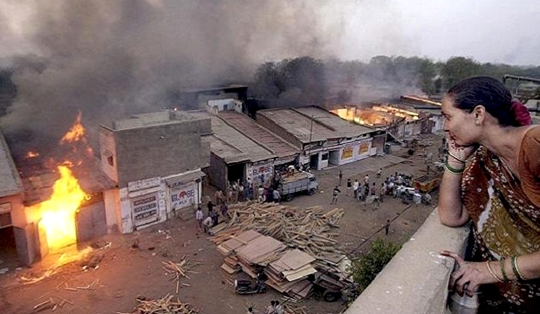
Ahmedabad, Jun 17: Calling the Gulberg massacre as the "darkest day" in the history of civil society, a special SIT court here today sentenced 11 convicts to life imprisonment in the case of burning alive of 69 people, including former Congress MP Eshan Jafri in the 2002 post-Godhra violence.
Gulberg1

Rejecting the demand for death sentence for all the convicts, the court said life imprisonment for the 11 will be till death if the state does not exercise power to remit the sentence.

The court awarded ten year jail term to one of the 13 convicted for lesser offences while 12 others have been given seven-year sentence each. The prosecution had argued that all the 24 convicts should be given death penalty.

While describing the massacre as the darkest day in the history of civil society, Special court Judge P B Desai refused death penalty saying, "If you look at all aspects, no previous antecedent has been placed on record".

Post the incident, 90 per cent of the accused were released on bail, yet no complaints against them have been given even by victims, and there is no record to show that they committed any offence during the time of bail, the judge further said, while giving reasons why he thought that this was not a fit case to give capital punishment to the convicts.

The court said it has decided to award imprisonment for life without any time frame to 11 accused, who have been convicted for murder, while requesting the state not to use its power to remit the sentence after 14 years of imprisonment.

"CrPC provisions give power to the state to remit sentence after 14 years jail, section 433-A imposes some restriction on that power. In case the state does not exercise power to remit the sentence, life imprisonment will mean that it is till death," the court said.

"I cannot add beyond what has been prescribed under section 302, it is not necessary for a state to exercise power to remit sentence, state may not exercise power of remittance," the judge said, adding the court's direction cannot be binding as he cannot take away the executive powers of the state.

As regards the 13 others accused convicted for lesser offences not including murder (302), the court awarded 10 years imprisonment to one Mangilal Jain, while 12 others were awarded seven-year sentence each.

The Gulberg Society massacre, which took place here on February 28, 2002 when Narendra Modi was the Gujarat Chief Minister, shook the nation when a mob of 400 people set about attacking the society in the heart of Ahmedabad and killed the residents including Jafri.

It was one of the nine cases of the 2002 Gujarat riots probed by the Supreme Court-appointed SIT.

"All the sentences will run concurrently as the Supreme Court has laid it down clearly that if the crime had single purpose, sentences given for different sections of IPC should run concurrently," the court said.

The prosecution and the victims had demanded that sentences awarded to all the accused should not run concurrently as all the 24 convicts will have to spend their entire life behind bars.

Earlier on June 2, the court had convicted 11 persons for murder and other offences, while 13 others, including VHP leader Atul Vaidya, were charged with lesser offences. It had acquitted 36 others in the case.

Those given life sentence in the case are - Kailash Dhobi, Yogendra Shekhawat, Jayesh Jingar, Krishna Kalal, Jayesh Parmar, Raju Tiwari, Bharat Rajput, Dinesh Sharma, Narayan Tank, Lakhansinh Chudasama and Bharat Taili.

One Mangilal Jain, who was convicted for lesser offence, has been sentenced to 10 years jail term.

Besides, VHP leader Atul Vaid, Mukesh Jingar, Prakash Padhiyar, Surendrasinh Chauhan, Dilip Parmar, Babu Marwadi, Manish Jain, Dharmesh Shukla, Kapil Mishra, Suresh Dhobi, Ambesh Jingar and Sandeep Punjabi have been sentenced to seven years imprisonment each.

During the argument on quantum of sentence, special public prosecutor and counsel for Supreme Court-appointed Special Investigation Team (SIT), R C Kodekar had asked the court for nothing less than death sentence or jail term till death for all 24 convicts.

Lawyer for the victims, S M Vora, also sought maximum punishment for the accused and argued that sentencing for each offence should not run concurrently so that they spend their entire life in jail.

However, lawyer of the accused, Abhay Bhardwaj, has refuted the demand of capital punishment or maximum punishment in his arguments saying that the incident was spontaneous and there were enough provocations for it.

The Gulberg society massacre was one of the nine cases of 2002 Gujarat riots probed by the SC-appointed SIT.

The incident had taken place a day after S-6 coach of Sabarmati Express was burnt near Godhra train station in which 58 'kar sevaks' returning from Ayodhya were killed.

During the course of trial, as many as 338 witnesses were cross-examined, with four different judges having presided over the case.

Comments

Ahmed Ali K
 - 
Friday, 17 Jun 2016

Death sentence?
for what?
Is he a non Hindu?

Jaleel S
 - 
Friday, 17 Jun 2016

Rarest of rare judgement...

Add new comment

  • Coastaldigest.com reserves the right to delete or block any comments.
  • Coastaldigset.com is not responsible for its readers’ comments.
  • Comments that are abusive, incendiary or irrelevant are strictly prohibited.
  • Please use a genuine email ID and provide your name to avoid reject.
News Network
January 13,2020

Jan 13: For the first time in years, the government of India’s Prime Minister Narendra Modi is playing defense. Protests have sprung up across the country against an amendment to India’s laws — which came into effect on Friday — that makes it easier for members of some religions to become citizens of India. The government claims this is simply an attempt to protect religious minorities in the Muslim-majority countries that border India; but protesters see it as the first step toward a formal repudiation of India’s constitutionally guaranteed secularism — and one that must be resisted.

Modi was re-elected prime minister last year with an enhanced majority; his hold over the country’s politics is absolute. The formal opposition is weak, discredited and disorganized. Yet, somehow, the anti-Citizenship Act protests have taken hold. No political party is behind them; they are generally arranged by student unions, neighborhood associations and the like.

Yet this aspect of their character is precisely what will worry Modi and his right-hand man, Home Minister Amit Shah. They know how to mock and delegitimize opposition parties with ruthless efficiency. Yet creating a narrative that paints large, flag-waving crowds as traitors is not quite that easy.

For that is how these protests look: large groups of young people, many carrying witty signs and the national flag. They meet and read the preamble to India’s Constitution, into which the promise of secularism was written in the 1970’s.

They carry photographs of the Constitution’s drafter, the Columbia University-trained economist and lawyer B. R. Ambedkar. These are not the mobs the government wanted. They hoped for angry Muslims rampaging through the streets of India’s cities, whom they could point to and say: “See? We must protect you from them.” But, in spite of sometimes brutal repression, the protests have largely been nonviolent.

One, in Shaheen Bagh in a Muslim-dominated sector of New Delhi, began simply as a set of local women in a square, armed with hot tea and blankets against the chill Delhi winter. It has now become the focal point of a very different sort of resistance than what the government expected. Nothing could cure the delusions of India’s Hindu middle class, trained to see India’s Muslims as dangerous threats, as effectively as a group of otherwise clearly apolitical women sipping sweet tea and sharing their fears and food with anyone who will listen.

Modi was re-elected less than a year ago; what could have changed in India since then? Not much, I suspect, in most places that voted for him and his party — particularly the vast rural hinterland of northern India. But urban India was also possibly never quite as content as electoral results suggested. India’s growth dipped below 5% in recent quarters; demand has crashed, and uncertainty about the future is widespread. Worse, the government’s response to the protests was clearly ill-judged. University campuses were attacked, in one case by the police and later by masked men almost certainly connected to the ruling party.

Protesters were harassed and detained with little cause. The courts seemed uninterested. And, slowly, anger began to grow on social media — not just on Twitter, but also on Instagram, previously the preserve of pretty bowls of salad. Instagram is the one social medium over which Modi’s party does not have a stranglehold; and it is where these protests, with their photogenic signs and flags, have found a natural home. As a result, people across urban India who would never previously have gone to a demonstration or a political rally have been slowly politicized.

India is, in fact, becoming more like a normal democracy. “Normal,” that is, for the 2020’s. Liberal democracies across the world are politically divided, often between more liberal urban centers and coasts, and angrier, “left-behind” hinterlands. Modi’s political secret was that he was that rare populist who could unite both the hopeful cities and the resentful countryside. Yet this once magic formula seems to have become ineffective. Five of India’s six largest cities are not ruled by Modi’s Bharatiya Janata Party in any case — the financial hub of Mumbai changed hands recently. The BJP has set its sights on winning state elections in Delhi in a few weeks. Which way the capital’s voters will go is uncertain. But that itself is revealing — last year, Modi swept all seven parliamentary seats in Delhi.

In the end, the Citizenship Amendment Act is now law, the BJP might manage to win Delhi, and the protests might die down as the days get unmanageably hot and state repression increases. But urban India has put Modi on notice. His days of being India’s unifier are over: From now on, like all the other populists, he will have to keep one eye on the streets of his country’s cities.

Comments

Add new comment

  • Coastaldigest.com reserves the right to delete or block any comments.
  • Coastaldigset.com is not responsible for its readers’ comments.
  • Comments that are abusive, incendiary or irrelevant are strictly prohibited.
  • Please use a genuine email ID and provide your name to avoid reject.
News Network
June 17,2020

New Delhi, Jun 17: Police Surender Jeet Kaur, Assistant Commissioner of Delhi Police Surender Jeet Kaur, has held herself responsible for the death of her husband Charan Jeet Singh, who succumbed to Covid at a hospital in Delhi.

“My husband didn’t step out of the house when the lockdown started, but I went out daily because of my job… I will never be able to forgive myself,” Kaur on Tuesday, a day after losing her husband.

54-year-old Singh, a resident of Lajpat Nagar and a businessman, is survived by his wife and their 26-year-old son who lives in Canada.

Kaur, 57, ACP (Crimes Against Women) in the South-East district of the Delhi Police, is also ACP (Covid Cell) of the district. On May 20, five days after Kaur tested positive for the virus, her husband Singh tested positive, followed by the ACP’s 80-year-old father on May 24.

All of them had symptoms and while Kaur and Singh were admitted to Indraprastha Apollo hospital, her father was admitted to Max hospital in Saket. On May 26, Kaur returned home after recovering from the virus.

Kaur said, “I last spoke to my husband on May 22 night, when we were both admitted in the hospital in different wards. The doctor called me and said that my husband needs to be put on ventilator support. I had a video call with my husband. He was breathless and told me that his oxygen level was dropping. He showed me the monitor, the doctors in the room, and then said he was having trouble speaking and that he would send me WhatsApp messages.”

A day after he passed away, Kaur recalled the messages that Singh sent her just before being put on ventilator support. “He started sending me details of our finances, accounts… I told him to stop and asked him why he was telling me all this. He said I needed to know… Maybe he feared he wouldn’t come back. I prayed every day, at temples, mosques, churches and gurdwaras for him. I am devastated that he’s gone. We were to move to Canada to live with our son in 2023 after my retirement. We had so many plans.”

Kaur’s brother Maninder Ahluwalia said the hospital tried plasma therapy but Singh didn’t respond to the treatment. “He had diabetes and high BP, but those were always under control. We were hopeful,” he said.

The couple’s son joined on video call from Canada to watch his father’s last journey from the ambulance to the entrance of the crematorium. “My son couldn’t attend his father’s last rites because there are no flights… It’s so unfortunate,” said Kaur.

Friends and family remember Singh as a “jolly, disciplined and brave man”, while Kaur said he was the “perfect partner”. She said, “When I was an SHO-rank officer, I would work for 36 hours straight some days, and he would handle the house and our son who was growing up. I would miss family functions and important occasions but he would always go and make up for my absence. I was able to do this job for decades because of his support.”

On Tuesday afternoon, Singh was cremated in the presence of close family and members of the police fraternity. “The DCP and the Joint CP called me daily to enquire about my husband, other police officers too. I am grateful for their support. They didn’t let me feel alone for a single day,” said Kaur.

Comments

Add new comment

  • Coastaldigest.com reserves the right to delete or block any comments.
  • Coastaldigset.com is not responsible for its readers’ comments.
  • Comments that are abusive, incendiary or irrelevant are strictly prohibited.
  • Please use a genuine email ID and provide your name to avoid reject.
News Network
March 18,2020

Mar 18: Madhya Pradesh Congress Party sought in the Supreme Court on Wednesday that the trust vote in the state assembly be deferred till by-polls for the vacant seats are concluded, saying "heavens are not going to fall" if its government led by Kamal Nath is allowed to remain in office till then.

A bench, comprising Justices D Y Chandrachud and Hemant Gupta, was hearing cross petitions filed by former Madhya Pradesh Chief Minister and senior BJP leader Shivraj Singh Chouhan and MP Congress on the ongoing political crisis in the state after 22 rebel MLAs of the ruling combine purportedly offered to resign.

"Heavens are not going to fall if Congress government is allowed to continue till by-polls and the Shivraj Singh Chouhan's government must not be saddled on the people," said senior advocate Dushyant Dave, appearing for Congress.

"Let them face re-elections and then hold trust vote... You (BJP) have engineered it. My petition raises the frontal attack that you have launched a conspiracy," he said.

Senior advocate Mukul Rohatgi, appearing for Chouhan, vociferously opposed the submission saying that the party which killed the democracy by imposing emergency in 1975 is now referring to "lofty ideals" of B R Ambedkar.

He said that after the resignations of 22 Congress MLAs, out of which six resignations have been accepted, the state government should not be allowed to continue even for a day.

"It is lust of power because of which all these lofty arguments are being made.

"It is unheard of that a person who had lost majority says that he wants to continue for six months and there should be re-election before the trust vote.

Rohatgi said the Kamal Nath government wanted to stay in power by hook or crook.

Earlier in the day, the Madhya Pradesh Congress told the bench that a probe is needed on the resignation letters of its rebel MLAs that have been submitted by BJP leaders to the Speaker of the state Assembly.

Dave said the Governor has no business to send messages at night asking the Chief Minister or Speaker to hold floor test.

"The Speaker is the ultimate master and the Madhya Pradesh Governor is overriding him," he said.

The party alleged that resignations of its rebel MLAs were extracted by force and coercion and they did not act as per their free will.

It also said that its rebel MLAs were taken away in chartered flights and are currently incommunicado in a resort arranged by the BJP.

The advancing of arguments will resume after lunch.

The Madhya Pradesh Congress Legislature party (MPCLP) had Tuesday moved the Supreme Court seeking direction to the Centre and the BJP-led Karnataka government to grant it access to communicate with its rebel MLAs allegedly kept at Bengaluru.

Earlier on Tuesday, the court had asked the Kamal Nath government in the state earlier in the day to respond by Wednesday to a plea by senior BJP leader Shivraj Singh Chouhan seeking immediate floor test in the Assembly.

MPCLP, in its plea filed by Govind Singh, an MLA and chief whip of Congress legislature party, urged the apex court to declare as illegal the action of the Centre, Karnataka government and the MP BJP of illegally confining its MLAs in Bangaluru.

The plea, filed through senior lawyer Devdutt Kamat, said the trust vote would be a "sham" if 22 MLAs did not take part in it as almost 10 per cent of constituencies go unrepresented.

The plea filed by Chouhan and nine BJP lawmakers was moved in the top court just after the Speaker cited coronavirus concerns and adjourned the House till March 26 without taking the floor test apparently defying the directions of Governor Lalji Tandon.

The plea alleged that the Speaker, the Chief Minister and the Principal Secretary of the Assembly have "flagrantly violated the constitutional principles and have deliberately and wilfully defied the directions" issued by the governor asking the government to prove the majority on the floor of the house on March 16 when when the budget session was to commence.

On Saturday night, Tandon wrote to Nath asking him to seek a trust vote in the Assembly soon after the Governor's address on Monday, saying his government was in minority.

After the Speaker accepted the resignation of six Congress MLAs on Saturday, the party now has 108 legislators.

These include 16 rebel legislators who have also put in their papers but their resignations are yet to be accepted.

The BJP has 107 seats in the House, which now has an effective strength of 222, with the majority mark being 112.

Comments

Add new comment

  • Coastaldigest.com reserves the right to delete or block any comments.
  • Coastaldigset.com is not responsible for its readers’ comments.
  • Comments that are abusive, incendiary or irrelevant are strictly prohibited.
  • Please use a genuine email ID and provide your name to avoid reject.