


Smriti Irani resorted to blatant lies' in Parliament, says Rohith Vemula's mom

February 26, 2016

New Delhi, Feb 26: Dalit student Rohith Vemula's mother on Friday launched a scathing attack on HRD minister Smriti Irani, accusing her of resorting to "blatant lies" while talking in Parliament about her son's suicide and that "life imprisonment" will not be enough for her and others "responsible" for his death.rohith
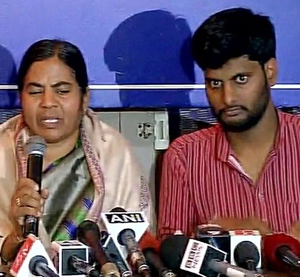
Radhika Vemula, flanked by her other son Raja, said BJP will be "decimated to the ground" if Prime Minister Narendra Modi does not take any action against Irani and her ministerial colleague Bandaru Dattatreya who had written multiple letters to her seeking action against Rohith, alleging anti-national activities.

"Irani, this is not a small screen to act, this is real life. Bring out the facts, don't fabricate them. How many parents you would like to suffer. Irani has lied multiple times while speaking on the issue in Parliament. Why has action not been taken against her?" she said in a news conference.

Speaking in Parliament, Irani had on Wednesday tried to deflect criticism and mounted a strident attack on the opposition accusing it of "politicizing" the PhD scholar's death.

She had said that the committee which acted against Rohith had a dalit representative and that doctors were not allowed to revive him after he was found hanging.

Rohith's brother Raja dubbed Irani's comments as "blatant lies", saying he reached the campus by 8.30pm and saw police and doctors where his body was kept.

"Even life imprisonment will not be enough for the ministers, vice-chancellor and the ABVP activists who were responsible for my son's death. BJP will be decimated to the ground if Modi does not address the issues. We demand formation of an SIT to probe the case," Radhika said.

Rohith's friend Prashant, who was also expelled by the Hyderabad University, cited minutes of the executive council meeting of Hyderabad University, claiming that action was taken against them "in response" to communication from the HRD ministry to not allow the students to continue academic activities.

26-year-old Rohith was found hanging at a hostel room in the university on January 17, days after punitive action was taken against him and four other students for allegedly attacking an ABVP functionary.

Students and Rohith's family have been alleging that Irani and Dattatreya had forced the university to take action against him and others.

The duty doctor at the University of Hyderabad on Thursday contradicted Irani's claim that no doctor was allowed near the body to revive him.

Prashant said Irani must be punished for misleading the nation and giving a false statement in Parliament which is "an offence" under the Constitution.

Comments

Rosalind
 - 
Saturday, 18 Jun 2016

I have learn a few just right stuff here. Definitely price bookmarking for revisiting.
I surprise how so much attempt you put to create this sort of wonderful informative website.

Here is my site ... Lavern: http://smithysingle.webnode.com/

Klandar
 - 
Saturday, 27 Feb 2016

She is an actress, now irani acts in Parliament...
E Daane Moolh Yanh Moole..
Yeregaviye Kiri Kiri....
Moolh Ragale ijji Parliment kulluth Act Malpuli.....

UMMAR
 - 
Saturday, 27 Feb 2016

SHE IS ACTOR IN STAR PLUS SOOO SHE KNOW HW TO ACT IN WCH CONDITION ,

FAKE GOV FAK FAKE MINISTER ,,,, INDIAN NEVER SEEN THIS TYPE OF GOVERMENT VERY VERY CHEAP...... REALY...

Add new comment

  • Coastaldigest.com reserves the right to delete or block any comments.
  • Coastaldigset.com is not responsible for its readers’ comments.
  • Comments that are abusive, incendiary or irrelevant are strictly prohibited.
  • Please use a genuine email ID and provide your name to avoid reject.
News Network
July 23,2020

Bengaluru, Jul 23: Karnataka on Thursday recorded a biggest single-day surge of over 5,000 cases and 97 related fatalities, taking the total number of people who tested positive for the virus to 80,863, the health department said. 

The day also saw a record 2,071 patients getting discharged after recovery.

Out of 5,030 fresh cases reported, a whopping 2,207 cases were from Bengaluru urban alone.

As of July 23 evening, cumulatively 80,863 Covid-19 positive cases have been confirmed in the state, which includes 1,616 deaths and 29,310 discharges, the health department said in its bulletin.

It said, out of 49,931 active cases, 49,291 patients are in isolation at designated hospitals and are stable, while 640 are in ICU. Out of the 97 deaths reported on Thursday 48 are from Bengaluru urban, followed by Mysuru 8, Dakshina Kannada 7 and others.

Most of the dead are either with a history of Severe Acute Respiratory Infection (SARI) or Influenza-like illness (ILI).

Among the districts where the new cases were reported, Bengaluru urban accounts for 2,207, followed by Raichur 258, Kalaburagi 229, Dakshina Kannada 218, and others.

Bengaluru urban district tops the list of positive cases, with a total of 39,200 infections, followed by Dakshina Kannada 4,209 and Kalaburagi 3,370. 

Comments

Add new comment

  • Coastaldigest.com reserves the right to delete or block any comments.
  • Coastaldigset.com is not responsible for its readers’ comments.
  • Comments that are abusive, incendiary or irrelevant are strictly prohibited.
  • Please use a genuine email ID and provide your name to avoid reject.
News Network
March 28,2020

Bengaluru, Mar 28: Sun Tsu, in 'The Art of War' speaks of a skilful general who can subdue his enemy without any fighting. This constitutes the ultimate triumph which is referred to as stratagem. Today, we would need one such when we are faced with the '21-day corona challenge' for India.
Nearly four weeks back, Dr Jyothsna Rao, Dr Gururaj Rao and I sat across the OPD in the afternoon at HCG Bengaluru discussing our ongoing cancer immunology research. While on this topic, we drifted into the discussion on the coronavirus. During this engaging discussion, we wondered the similarity of the enigma between the virus and cancer. I paused to ask Dr Jyothsna and Dr Guru - how we wish we could do something against this virus.
Dr Jyothsna is a PhD from NCBS and had worked under Dr Ralph Steinman, physician and researcher from Rockefeller University, who won the Nobel Prize for his discovery of the dendritic cell and its role in adaptive immunity in 2011. Dr Gururaj is a molecular and cell biologist who did his PhD at the Chapel Hill, University of North Carolina and is the Director of iCrest.
Jyothsna while hearing our perplexing conversation on the covid intervened, "Yes, surely. I think we should take a break from cancer and focus on the innate and adaptive immunity role in COVID-19."
Thus began this sincere attempt to relook the human immune system from the eyes of the COVID-19.
We have 10 types of immune cells at the least which are widely dispersed in millions across the body. When our body is invaded by a foreign organism (bacteria, fungi or virus), these cells work with each other to destroy the invader.
Now, the question is - how do the immune cells talk to each other? They use small-molecule substances called cytokines (cyto means cells; kine means movement). There are many cytokines that are involved in work on the immune system. The most relevant for viruses are interferons.
Interferons (IFN) as the name reflects have an ability to interfere with the viral activity and stop their multiplication. These specialised signal proteins are released by our cells in response to a viral attack to forewarn other cells. They help build the antiviral proteins within the cells to kill the virus as it tries to invade the new cells.
Historically, interferons are a group of cytokines known to be potent antiviral agents against viruses and a hallmark cytokine induced by the host upon viral infections. Interferons possess unique immunoregulatory activities and are signature cytokines released by (TH1) T immune cells, which are crucial in viral infections.
As the outbreak of COVID-19 grapples us, an urgent need for finding strategies to combat the virus is growing. Coronaviruses (CoVs) are a group of RNA viruses. In patients infected with coronavirus, it was indicated that the activation of the IFN does not occur until 48 hours post-infection. Thus the delayed IFN-related antiviral response by the healthy cells leads to coronavirus evade the immune response.
Numerous studies have presented the success in defeating CoVs by the direct administration of IFNs. In a combination as a concoction, it was shown to synergistically inhibit the virus replication in vitro.
Moreover, it is understood that the earlier induction of IFNs in children although they have a less developed immune system could be the reason behind the children being least affected.
The key to success in reducing the disease fatality might be the stimulation of the immune responses to trigger IFN production at the very early stages of the disease, which might be done through the administration of IFN. Despite the evidence for the efficacy of IFNs in treating CoV-induced infections, the proper dosing and ideal timing for such interventions needs to be verified in clinical trials.
For the later stages of the diseases in advance stages where patients are on ventilator and have developed respiratory distress, we propose to utilise the mesenchymal cells derived from donor bone marrow that have been known to treat acute respiratory syndrome. Mesenchymal cells are known to possess anti-inflammatory activity and thus used often in autoimmune diseases.
With this scientific background, we have activated T cells from healthy donors, in a cGMP facility at iCrest - HCG hospital with an enriched cocktail of cytokines rich in Interferons. Injections of this cocktail we believe will result in a surge of cytokines in the body of the infected person and will boost his ability to fight the virus in the early phases. We are in the initial phases of this study and hope to be ready in the coming weeks with meaningful data on its potential utility.
Currently, it awaits government approvals (Union and state) and we have applied to central drugs authority for their initial evaluation and further directions.
As my Guru often expounded the philosophy of 'Seva' - the goal of education is knowledge, the end goal of knowledge is service. In this attempt to serve our fellow humans at this brink of unprecedented crisis, medical fraternity stands with you and promises to do our best for your safety.
We assure to exhaust every bit of our spirit in this fight against coronavirus. We have lost the sight of shores and travelled thus far, but that is the mandatory first step to cross the ocean. Are we going to succeed in this battle, is something only time will answer. 

Comments

Add new comment

  • Coastaldigest.com reserves the right to delete or block any comments.
  • Coastaldigset.com is not responsible for its readers’ comments.
  • Comments that are abusive, incendiary or irrelevant are strictly prohibited.
  • Please use a genuine email ID and provide your name to avoid reject.
News Network
April 2,2020

The current physical distancing guidelines provided by the World Health Organisation (WHO) and by the US Centers for Disease Control and Prevention (CDC) may not be adequate to curb the coronavirus spread, according to a research which says the gas cloud from a cough or sneeze may help virus particles travel up to 8 metres. The research, published in the Journal of the American Medical Association, noted that the the current guidelines issued by the WHO and CDC are based on outdated models from the 1930s of how gas clouds from a cough, sneeze, or exhalation spread.

Study author, MIT associate professor Lydia Bourouiba, warned that droplets of all sizes can travel 23 to 27 feet, or 7-8 metres, carrying the pathogen.

According to Bourouiba, the current guidelines are based on "arbitrary" assumptions of droplet size, "overly simplified", and "may limit the effectiveness of the proposed interventions" against the deadly pandemic.

 She explained that the old guidelines assume droplets to be one of two categories, small or large, taking short-range semi-ballistic trajectories when a person exhales, coughs, or sneezes.

However based on more recent discoveries, the MIT scientist said, sneezes and coughs are made of a puff cloud that carries ambient air, transporting within it clusters of droplets of a wide range of sizes.

Bourouiba warned that this puff cloud, with ambient air entrapped in it, can offer the droplets moisture and warmth that can prevent it from evaporation in the outer environment.

"The locally moist and warm atmosphere within the turbulent gas cloud allows the contained droplets to evade evaporation for much longer than occurs with isolated droplets," she said.

"Under these conditions, the lifetime of a droplet could be considerably extended by a factor of up to 1000, from a fraction of a second to minutes," the researcher explained in the study.

The MIT scientist, who has researched the dynamics of coughs and sneezes for years, added that these droplets settle along the trajectory of a cough or sneeze contaminating surfaces, with their residues staying suspended in the air for hours.

"Even when maximum containment policies were enforced, the rapid international spread of COVID-19 suggests that using arbitrary droplet size cutoffs may not accurately reflect what actually occurs with respiratory emissions, possibly contributing to the ineffectiveness of some procedures used to limit the spread of respiratory disease," Bourouiba wrote in the study

Comments

Add new comment

  • Coastaldigest.com reserves the right to delete or block any comments.
  • Coastaldigset.com is not responsible for its readers’ comments.
  • Comments that are abusive, incendiary or irrelevant are strictly prohibited.
  • Please use a genuine email ID and provide your name to avoid reject.