Yellow paint must for vehicles carrying school kids, rules AB Ibrahim

[email protected] (CD Network)
June 23, 2016

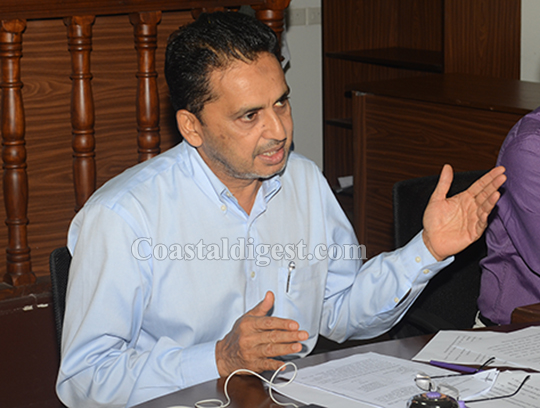
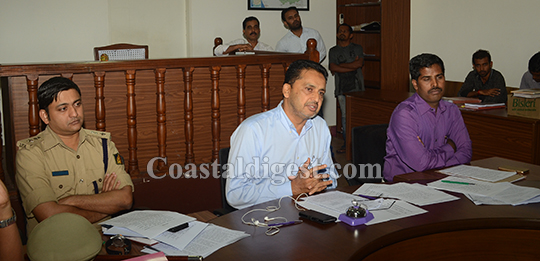
Mangaluru, Jun 23: All school vehicles, including the private vehicles transporting schoolchildren, should have a distinct highway yellow colour with a horizontal strip in green colour in the middle all around the vehicle, ruled A?B?Ibrahim, Deputy Commissioner of Dakshina Kannada.

dcO 1

Chairing a meeting on the safety of school vehicles here on Wednesday, he directed the region transport and police officials to initiate stringent action against those vehicles that are crammed with schoolchildren.

The district administration wants to ensure that all safety measures prescribed by the government and courts are strictly adhered to by June 30, he added.

The DC said, “As per the rules, the autorickshaw can accommodate six children (below 12 years) in one trip. The Maruthi Omni can accommodate only eight children. If the children are above 12 years, then the number of children should be as per the carrying capacity of the vehicles.”

“The RTO and the Education Department should act swiftly in this regard. As the safety measures are implemented in the interest of the safety of the children, the parents should cooperate with the authorities,” he added.

Earlier, Udupi Deputy Commissioner Dr Vishal R said that he would try to take stringent measures on road safety, especially on the vans carrying schoolchildren. He would try to secure maximum compensation for the families of victims.

Dr Vishal said, “I will recommend something on humanitarian ground. Regulatory measures will be introduced. There is a need for solution and it would be known in the days to come.”

dcO 3

Comments

Ahamad
 - 
Friday, 24 Jun 2016

Well done Sir..
Even if private vehicles transporting children's school management should make responsible for violations.

Add new comment

  • Coastaldigest.com reserves the right to delete or block any comments.
  • Coastaldigset.com is not responsible for its readers’ comments.
  • Comments that are abusive, incendiary or irrelevant are strictly prohibited.
  • Please use a genuine email ID and provide your name to avoid reject.
Agencies
May 8,2020

Washington D.C., May 8: The prime time for brain development in a child's life is the first year, where the infant spends most of the time asleep. It is the time when neural connections form and sensory memories are encoded.

However, when sleep is disrupted, as occurs more often among children with autism, brain development may be affected, too.

New research led by the University of Washington finds that sleep problems in a baby's first 12 months may not only precede an autism diagnosis but also may be associated with altered growth trajectory in a key part of the brain, the hippocampus.

The study, which was published in the American Journal of Psychiatry, researchers report that in a sample of more than 400 taken of 6- to 12-month-old infants, those who were later diagnosed with autism were more likely to have had difficulty falling asleep.

It also states that this sleep difficulty was associated with altered growth trajectories in the hippocampus.

"The hippocampus is critical for learning and memory, and changes in the size of the hippocampus have been associated with poor sleep in adults and older children.

As many as 80 per cent of the children with autism spectrum disorder have sleep problems," said Annette Estes, director of the UW Autism Center and senior author of the study.

"In our clinical experience, parents have a lot of concerns about their children's sleep, and in our work on early autism intervention, we observed that sleep problems were holding children and families back," added Estes, who is also a UW professor of speech and hearing sciences.

"It could be that altered sleep is part-and-parcel of autism for some children. One clue is that behavioural interventions to improve sleep don't work for all children with autism, even when their parents are doing everything just right. This suggests that there may be a biological component to sleep problems for some children with autism," said Estes.

To consider links among sleep, brain development, and autism, researchers at the IBIS Network looked at MRI scans of 432 infants, surveyed parents about sleep patterns, and measured cognitive functioning using a standardized assessment.

At the outset of the study, infants were classified according to their risk for developing autism: Those who were at higher risk of developing autism -- about two-thirds of the study sample -- had an older sibling who had already been diagnosed.

Infant siblings of children with autism have a 20 per cent chance of developing autism spectrum disorder -- a much higher risk than children in the general population.

In the current study, 127 of the 432 infants were identified as "low risk" at the time the MRI scans were taken because they had no family history of autism.

They later evaluated all the participants at 24 months of age to determine whether they had developed autism. Of the roughly 300 children originally considered "high familial risk," 71 were diagnosed with autism spectrum disorder at that age.

Problems with sleep were more common among the infants later diagnosed with an autism spectrum disorder, as were larger hippocampi. No other subcortical brain structures were affected, including the amygdala, which is responsible for certain emotions and aspects of memory, or the thalamus, a signal transmitter from the spinal cord to the cerebral cortex.

The authors note that while parents reported more sleep difficulties among infants who developed autism compared to those who did not, the differences were very subtle and only observed when looking at group averages across hundreds of infants.

Sleep patterns in the first years of life change rapidly as infants transition from sleeping around the clock to a more adult-like sleep/wake cycle. Until further research is completed, Estes said, it is not possible to interpret challenges with sleep as an early sign of increased risk for autism.


Comments

Add new comment

  • Coastaldigest.com reserves the right to delete or block any comments.
  • Coastaldigset.com is not responsible for its readers’ comments.
  • Comments that are abusive, incendiary or irrelevant are strictly prohibited.
  • Please use a genuine email ID and provide your name to avoid reject.
News Network
June 14,2020

Bengaluru, Jun 14: Karnataka's Health Department has shut down four city clinics for not reporting Influenza Like Illness (ILI) and Severe Acute Respiratory Infection (SARI) cases, which are COVID symptoms, an official said on Sunday.

"We have shut four Bengaluru clinics for not reporting ILI and SARI cases," a health official told IANS.

The clinics are Namma Clinic at Sahakaranagar, Panchamukhi Specialty Clinic at Peenya 2nd Stage, Mathru Chaya Clinic at Sudhama Nagar in Bommanahalli and Nayak Hospital in Gayathri Nagar.

"We gave notice to 17 clinics for not reporting ILI and SARI medical conditions in patients. Out of the 17, 13 reverted that they did not do and will start reporting," said the official.

However, the four named clinics did not revert leading to their shutdown.

According to the official, the clinics failed to adhere to the Epidemic Diseases Act, 1987, Disaster Management Act, 2005 and others.

All medical facilities and hospitals should report all patients with ILI and SARI symptoms as many COVID positive cases have them as underlying conditions.

Comments

Add new comment

  • Coastaldigest.com reserves the right to delete or block any comments.
  • Coastaldigset.com is not responsible for its readers’ comments.
  • Comments that are abusive, incendiary or irrelevant are strictly prohibited.
  • Please use a genuine email ID and provide your name to avoid reject.
coastaldigest.com news network
July 30,2020

Mangaluru, July 30: The Social Democratic Party of India has condemned the move by the state government to drop a lesson on legendary Mysuru rulers Hyder Ali and Tipu Sultan from the class 7 textbook.

The Department of Public Instruction has omitted the chapter from the textbooks of Class 7 in their attempt to reduce syllabus for state board schools by 30 per cent.

The department, however, has decided to retain similar chapters on Tipu Sultan in 6th and 10th Classes, though the syllabus in text books for all classes from 1 to 10th has been trimmed. 

In a media release statement, SDPI State President Ilyas Mohammed Thumbe termed the move as communally motivated. “By dropping the lesson, the BJP-led government is engaged in saffronisation of education,” he alleged.

He said that Tipu was the most prominent freedom fighter, who had given priority to irrigation, rocket technology and harmony. The BJP government is also planning to scrap lessons on the Constitution, secularism and democracy. By twisting history, the BJP is trying to mislead the younger generation, he added.

Comments

Add new comment

  • Coastaldigest.com reserves the right to delete or block any comments.
  • Coastaldigset.com is not responsible for its readers’ comments.
  • Comments that are abusive, incendiary or irrelevant are strictly prohibited.
  • Please use a genuine email ID and provide your name to avoid reject.