Yellow paint must for vehicles carrying school kids, rules AB Ibrahim

[email protected] (CD Network)
June 23, 2016

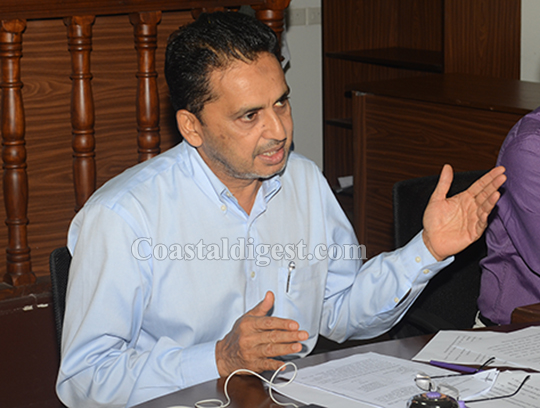
Mangaluru, Jun 23: All school vehicles, including the private vehicles transporting schoolchildren, should have a distinct highway yellow colour with a horizontal strip in green colour in the middle all around the vehicle, ruled A?B?Ibrahim, Deputy Commissioner of Dakshina Kannada.

dcO 1

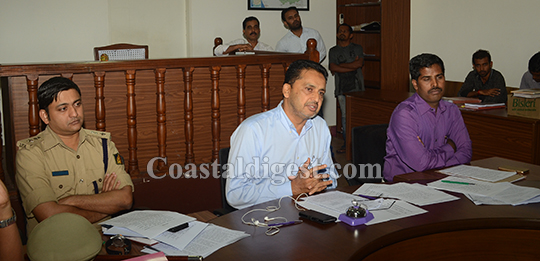
Chairing a meeting on the safety of school vehicles here on Wednesday, he directed the region transport and police officials to initiate stringent action against those vehicles that are crammed with schoolchildren.

The district administration wants to ensure that all safety measures prescribed by the government and courts are strictly adhered to by June 30, he added.

The DC said, “As per the rules, the autorickshaw can accommodate six children (below 12 years) in one trip. The Maruthi Omni can accommodate only eight children. If the children are above 12 years, then the number of children should be as per the carrying capacity of the vehicles.”

“The RTO and the Education Department should act swiftly in this regard. As the safety measures are implemented in the interest of the safety of the children, the parents should cooperate with the authorities,” he added.

Earlier, Udupi Deputy Commissioner Dr Vishal R said that he would try to take stringent measures on road safety, especially on the vans carrying schoolchildren. He would try to secure maximum compensation for the families of victims.

Dr Vishal said, “I will recommend something on humanitarian ground. Regulatory measures will be introduced. There is a need for solution and it would be known in the days to come.”

dcO 3

Comments

Ahamad
 - 
Friday, 24 Jun 2016

Well done Sir..
Even if private vehicles transporting children's school management should make responsible for violations.

Add new comment

  • Coastaldigest.com reserves the right to delete or block any comments.
  • Coastaldigset.com is not responsible for its readers’ comments.
  • Comments that are abusive, incendiary or irrelevant are strictly prohibited.
  • Please use a genuine email ID and provide your name to avoid reject.
News Network
July 17,2020

Bengaluru, Jul 17: Bruhat Bengaluru Mahanagara Palike (BBMP) Mayor, M Goutham Kumar on Friday called for an extension of lockdown in the city for one more week due to rise in the COVID-19 cases.

"It will be better if we get more time to tackle COVID-19 cases, we wish for the extension of lockdown for one more week. We have given the proposal to the government," said M Goutham Kumar, BBMP Mayor.

"After the number of cases increased in Bengaluru, BBMP started antigen test in containment and hotspot zones of Bengaluru to tackle the cases which have crossed 2,000 mark," he added.

Along with Mayor, BBMP Commissioner Anil Kumar has also proposed the state government to extend lockdown in Bengaluru for one more week.

"The number of cases in Bengaluru increasing in Bengaluru rapidly. BBMP has inaugurated more than 200 vehicles in Bengaluru for the use of the antigen test," said Anil Kumar, Commissioner BBMP.

According to the Union Health Ministry, there are 51,422 COVID-19 cases in the state.

Comments

Add new comment

  • Coastaldigest.com reserves the right to delete or block any comments.
  • Coastaldigset.com is not responsible for its readers’ comments.
  • Comments that are abusive, incendiary or irrelevant are strictly prohibited.
  • Please use a genuine email ID and provide your name to avoid reject.
News Network
May 21,2020

Bengaluru, May 21: The prestigious Bengaluru Tech Summit (BTS) on Wednesday been postponed to November 19 to 21 2020 in view of the prevailing conditions.

A decision to this effect was taken at a meeting chaired by Deputy Chief Minister C S Ashwathnarayan, who is also the Minister for IT/BT, here.

Originally, the BTS was scheduled for September 21-23 this year. However, owing to anticipated inability of international delegates to attend the summit in view of Covid-19, BTS has been postponed, informed Dr Ashwathnarayan.

Comments

Add new comment

  • Coastaldigest.com reserves the right to delete or block any comments.
  • Coastaldigset.com is not responsible for its readers’ comments.
  • Comments that are abusive, incendiary or irrelevant are strictly prohibited.
  • Please use a genuine email ID and provide your name to avoid reject.
Media Release
February 14,2020

Veteran journalist P. Sainath has said that the nation is in a crisis. And this crisis is not limited to just the rural area. It has become a national crisis at various areas such as agriculture, education, economy, job creation etc.

He was delivering the endowment lecture on the topic ‘Indian democracy at the post-liberalization and post-truth era’ at Media Manthan 2020 organized by the PG department of journalism and mass communication at St Aloysius College (Autonomous). 

Mr Sainath said that the many policies adopted in the 90s led to India becoming unusually unequal. Referring to the speech Ambedkar had made at the Constituent Assembly while handing over the draft of the Constitution, Mr Sainath said, “Ambedkar had warned about the weakness of Indian democracy that liberty without equality allows the supremacy of a few over the multitude. Liberty, equality and fraternity must be kept together as we cannot have one without the other.” 

Mr Sainath stated that the agrarian crisis was no longer about the loss of productivity, employment or about farmer suicide; it was a societal, civilizational crisis. Commenting on the lopsided policies such as cow-slaughter ban, he explained how cow slaughter ban had adversely affected many industries due to their interdependency. While Muslims who slaughtered cows were rendered helpless, the cattle traders who were mostly OBCs lost their earnings as the cattle prices crashed. An important industry like Kolhapur sandals industry in Maharashtra went bankrupt as a result of the cow slaughter ban in Maharashtra. He said the policymakers had no idea how the rural industries were interconnected. Demonetisation too devastated the rural economy as 98 percent of rural transactions happen through cash. 

Mr Sainath also spoke about the crisis of inequality which affects the Dalits and the Adivasis far more than anyone else as 90 percent of the rural households take home less than Rs 10,000/- per month. “Women are yet another group whose labour is never counted in the gross domestic product. Women and girls globally do unpaid work which amounts to about 12.5 billion working hours per year. Monetarily speaking, this is worth 10.8 trillion dollars,” Mr Sainath added. 

Speaking about the crisis of jobs Mr Sainath said that major companies were laying off employees just to create more profits for the investors and the adoption of artificial intelligence in the industry would further destroy millions of jobs.

Rector of St Aloysius College Institutions Fr Dionysius Vaz SJ, Principal Dr (Fr) Praveen Martis SJ, HOD of Journalism and Mass Communication department Dr (Fr) Melwyn Pinto SJ were present.

‘Veerappan and Vijay Mallya’s business models are interesting!’

Addressing the gathering during his endowment lecture on Friday, Mr Sainath made an interesting comment on the so called ‘revenue model’. “Whenever I visit IIMs and IITs for lectures on my PARI project, the students there ask me what my revenue model for my project is. I tell them that I do not have a revenue model. In fact, journalism does not begin with a revenue model. Gandhiji, Ambedkar, Bhagat Singh were all great journalists. But they did not have a revenue model,” Mr Sainath said.

On a lighter note, he said that the best revenue model that he liked was that of forest brigand Veerappan and liquor baron Vijay Mallya. “Veerappan ruled the forest for forty years and from the top ministers to the villagers he could dictate terms and liver royally. Similarly, Mallya’s revenue model was to steal the banks and run away abroad and live like a king,” Mr Sainath added.

Journalism is not and can never be a business. It is a calling, he opined. While newspaper can be a business, television can be a business, journalism per se cannot be reduced to a business. “Unfortunately today, journalists are recruited on a contract basis and they have no bargaining power; and there are no unions to fight for their cause. Hence, they are at the mercy of the corporate media houses for their survival and are made to write stories that cannot be called journalism,” Mr Sainath said.

Answering a question as to the pressures he faced as a journalist, he said that external pressures from the government or others could be very well handled. It is the internal pressures from once own media house that journalists find it difficult to manage.


 

Comments

Add new comment

  • Coastaldigest.com reserves the right to delete or block any comments.
  • Coastaldigset.com is not responsible for its readers’ comments.
  • Comments that are abusive, incendiary or irrelevant are strictly prohibited.
  • Please use a genuine email ID and provide your name to avoid reject.