Unscientific RUB at Padil: Activists stage novel protest of fishing in stagnant water

[email protected] (CD Network)
June 24, 2016

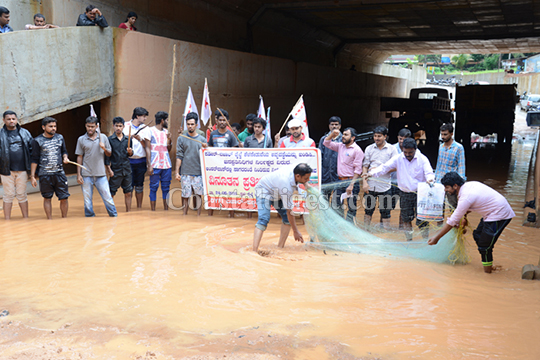
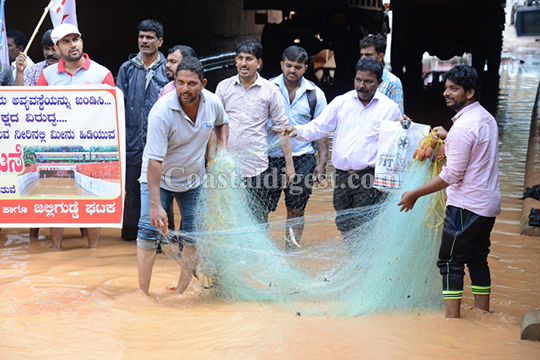
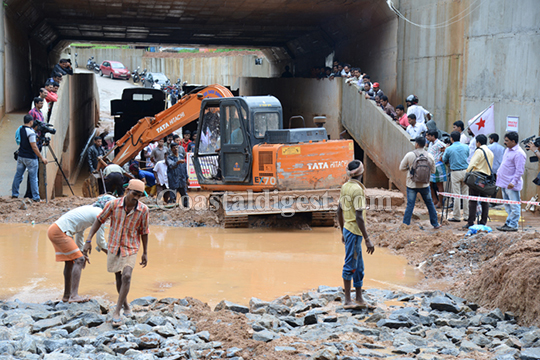
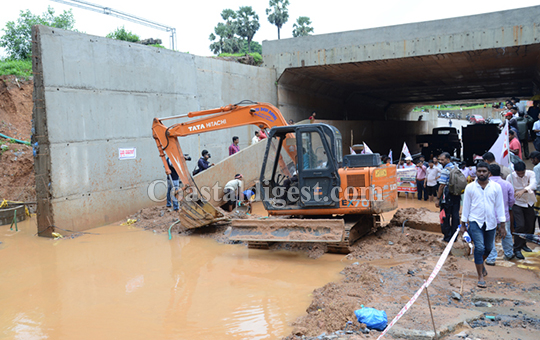
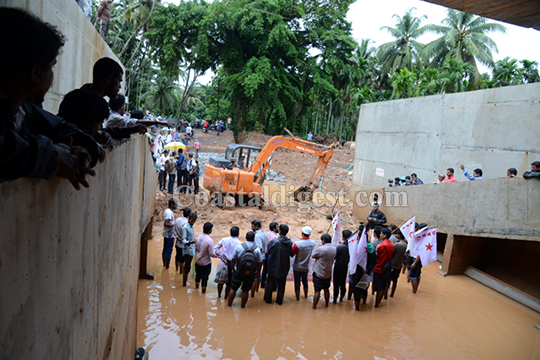
Mangaluru, Jun 24: The activists of Democratic Youth Federation of India (DYFI) on Friday staged a novel protest against the inordinate delay in commissioning the road underbridge on Padil-Bajal Main Road in the city.

APProtest 3

Members of the Bajal-Pakkaladka and Jalligudde units of DYFI as well as local residents took part in the fishing in the stagnant water' protest at the RuB at 10 a.m.

In a release issued here, DYFI district secretary Santosh Bajal said that the residents were put to hardship because of the non-completion of the project.

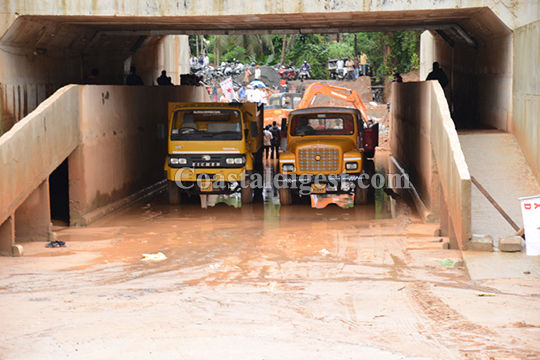
“It is almost a year since the RUB was constructed Padil-Bajal main road. However, Mangaluru City Corporation has still not been able to set right this vital road that provides access to many other adjoining areas. The construction of RUB has totally cut off the road connecting Faisalnagar and Jayanagar. People of these areas are forced to walk up to the main road at Padil for their daily needs and vocation,” he noted.

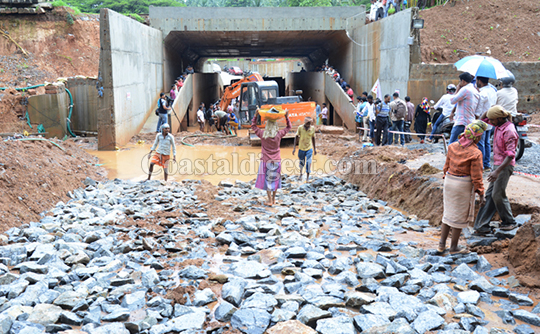
The RUB has been constructed in an unscientific manner and rain water collects there as there is no proper drainage facility. It is difficult for motorists to use this road, especially after it has rained, he said.

People are forced to use alternative and longer routes to avoid this mess in order to reach the city, he said adding the present situation has arisen squarely because of total lack of coordination between the civic body and Palakkad division of Southern Railways, he complained.

APProtest 1

APProtest 4

APProtest 2

APProtest 5

APProtest 6

APProtest 7

Comments

Mohan kumar
 - 
Friday, 24 Jun 2016

DYFI did good job by protesting it otherwise this road will be the same next year. govt always scared for media.

Pramod K
 - 
Friday, 24 Jun 2016

meenu thikhnda onji phone manpule.

Farooq
 - 
Friday, 24 Jun 2016

Mangalore will never change. clean mangalore.

Pooja shet
 - 
Friday, 24 Jun 2016

wow nice mugudu thikhnda phone manpule,

Jeevan D souza
 - 
Friday, 24 Jun 2016

what i m seeing this, crores of rupees is spent on this project and now we cant c the road only, corrupt politician has given the contract to engineer who dont know ABCD of these things.

Manish Sharma
 - 
Friday, 24 Jun 2016

Mangalore people are shocked to c this one. come to bangalore u will c this kind of ponds everywhere on roads. Indian govt.

Swetha
 - 
Friday, 24 Jun 2016

our money is getting wasted like this by the govt

Preetham
 - 
Friday, 24 Jun 2016

all the expenses further made by govt should take from engineer who planned this, what's the use of engineer here then if this happens.

Manohar
 - 
Friday, 24 Jun 2016

yava engineer madida kelsa , eddakke lakshagattale hanakottu engineer hatra kelsa madisbeka sanna mestri saku,.edu numma deshada stithi hana kottu kelsa gittiskondu madiro kelsa.

Add new comment

  • Coastaldigest.com reserves the right to delete or block any comments.
  • Coastaldigset.com is not responsible for its readers’ comments.
  • Comments that are abusive, incendiary or irrelevant are strictly prohibited.
  • Please use a genuine email ID and provide your name to avoid reject.
News Network
January 25,2020

Bengaluru, Jan 25: The Karnataka government would hold a Global Investors' Meet (GIM 2020) in Bengaluru from November 3-5 to showcase the southern state's ecosystem for attracting investments from the world over, an official said on Friday.

"Our Chief Minister B.S. Yediyurappa held the first road show on the GIM at the 50th World Economic Forum (WEF) annual meeting, being held at Davos in Switzerland and invited global firms to participate in the 3-day event for investment opportunities," additional secretary P. Ravikumar told IANS.

At a curtain-raiser on "Invest Karnataka 2020" on Thursday, the BJP Chief Minister said the theme of the GIM would be "Innovate Now. Growth Forever" as the state had one of the best natural and human resources for investing in manufacturing, services and agriculture sectors and creating jobs.

"About 100 entrepreneurs, businessmen and heads of global firms participated in the roadshow to assess the state's industrial policies, incentives, infrastructure, tax system and its ease of doing business for investment potential," Ravikumar said.

Among the participants at the event were Swiss-India parliamentary group president Niklaus-Samuel Gugger, Uber Chief Executive Dara Khosrowshahi, General Electric (GE) executive William Cowan and heads of Gemini Corporation, Coca Cola, SAP Labs, Swiss Re and Mitsubishi Heavy Industries.

"Khosrowshahi discussed Uber's expansion plans in Bengaluru and assured the Chief Minister of investing more in the state. Cowen expressed interest in the development of healthcare, renewable energy and power distribution across the state through partnership with the state government," the official noted.

The US-based transnational firm (GE) has a large presence in Bengaluru with one its largest engineering and technology centres and two production plants.

"A Coca Cola executive told Yediyurappa that the soft beverage firm would initially invest $25 million in its plants in the state and enhance it to $200 million to benefit farmers and rural people with access to clean drinking water in their villages," Ravikumar said.

The Chief Minister also sought to know the investment or expansion plans of global firms present in the state, especially Bengaluru and assured their heads of the state support in creating hundreds of jobs and wealth.

About 100 members of the Indian delegation to the WEF, led by Union Commerce and Industries Minister Piyush Goyal, Confederation of Indian Industry (CII) director-general Chandrajit Bannerjee, Bharat Forge chairman Baba Kalyani, Kirloskar Systems Managing Director Vikram Kirloskar, also participated in the state's GIM roadshow.

State Industries Minister Jagdish Shettar, chief secretary T. M. Vijaya Bhaskar, additional chief secretary E.V. Ramana Reddy and industrial department principal secretary Gurav Gupta also attended the state event.

"Emiriti Lulu Group chairman M.A. Yusuf Ali discussed plans to invest $300 million (Rs 2,160 crore) in logistics, hospitality and health/wellness sectors across the state with Yediyurappa," said Ravikumar.

Ali, an NRI (non-resident Indian) migrated to the United Arab Emirates (UAE) from Kerala two decades ago and founded the Lulu Group at Abu Dhabi to operate a chain of hypermarkets and retail firms since 2000.

"The Chief Minister assured Ali of speedy approvals and incentives for investing in the state, with ease of doing business," the official said in an e-mail to IANS from the Swiss town.

Asserting that his proactive government would work overtime to facilitate global investments in the southern state, Yediyurappa said he was committed to create more jobs across sectors.

Dassault Systems executive Florene Verzelen told the chief minister about her company's plans to set up centres of excellence in smart manufacturing and smart cities in the southern state.

"The centres will train and equip the youth with skilled jobs in large corporations the world over," Ravikumar reiterated.

Yediyurappa apprised US aerospace behemoth Lockheed Martin executive Richard Ambrose of the ecosystem for aerospace and defence industry in the state, especially Bengaluru.

"I will soon visit Bengaluru to explore the possibilities of investing more in Karnataka and taking up research and development work," said Ambrose on the occasion.

A delegation from global automotive component maker Denso also called on the chief minister and interacted with the state delegation.

The Japanese firm has an excellence and research centre in New Delhi and a manufacturing unit at Nelamangala on the outskirts of Bengaluru.

Denso executive Hiroyuki Wakabasyi said he would visit Bengaluru soon to explore further investments in the state.

"Arcelor Mittal chairman Laxmi Mittal also met the chief minister and discussed his company's investment plans in the state," the official added.

Mittal backed out of setting up a steel plant in the state's northern region over a decade ago due to delays in acquiring land and mandatory approvals.

Drug maker Novo Nordisk chief executive Lars Fruergaard expressed readiness to work with the state government in taking up educative and awareness programmes for diabetic patients.


Comments

Add new comment

  • Coastaldigest.com reserves the right to delete or block any comments.
  • Coastaldigset.com is not responsible for its readers’ comments.
  • Comments that are abusive, incendiary or irrelevant are strictly prohibited.
  • Please use a genuine email ID and provide your name to avoid reject.
coastaldigest.com web desk
May 19,2020

Mangaluru, May 19: Officials at the Karnataka State Natural Disaster Monitoring Centre (KSNDMC) said that Dakshina Kannada, Udupi and Uttara Kannada along with Kodagu, Chikkamagaluru have been alerted about possible heavy rains.

Dr GS Srinivasa Reddy, Director, KSNDMC, said, “Coastal districts have already been witnessing heavy downpour since Monday morning. This will continue for another two days depending on the cyclonic movement along the east coast.”

Until last evening, Haleyangadi and Surathkal in Dakshina Kannada district had received 83 mm and 82.5 mm of rainfall, respectively. Several other areas in Udupi also witnessed heavy rainfall of about 60 to 70 mm rainfall.

The India Meteorological Department (IMD) attributed the rain, which intensified on Monday, to a cyclonic circulation over parts of the Arabian Sea (Comorin area) off the coast of Kerala.

The weather department said the sudden convergence of wind over the peninsular region was due to Super Cyclone Amphan, which is set to barrel into the east coast. The IMD issued an Yellow Alert for coastal Karnataka and Malnad, warning of moderate to heavy rainfall in the next few days.

Comments

Add new comment

  • Coastaldigest.com reserves the right to delete or block any comments.
  • Coastaldigset.com is not responsible for its readers’ comments.
  • Comments that are abusive, incendiary or irrelevant are strictly prohibited.
  • Please use a genuine email ID and provide your name to avoid reject.
Ram Puniyani
January 14,2020

In the beginning of January 2020 two very disturbing events were reported from Pakistan. One was the attack on Nankana Sahib, the holy shrine where Sant Guru Nanak was born. While one report said that the place has been desecrated, the other stated that it was a fight between two Muslim groups. Prime Minister of Pakistan Imran Khan condemned the incident and the main accused Imran Chisti was arrested. The matter related to abduction and conversion of a Sikh girl Jagjit Kaur, daughter of Pathi (One who reads Holy Guru Granth Sahib in Gurudwara) of the Gurudwara. In another incident one Sikh youth Ravinder Singh, who was out on shopping for his marriage, was shot dead in Peshawar.

While these condemnable attacks took place on the Sikh minority in Pakistan, BJP was quick enough to jump to state that it is events like this which justify the Citizenship Amendment Act (CAA). Incidentally CAA is the Act which is discriminatory and relates to citizenship with Religion, which is not as per the norms of Indian constitution. There are constant debates and propaganda that population of Hindus has come down drastically in Pakistan and Bangla Desh. Amit Shah, the Home minister stated that in Pakistan the population of Hindus has come down from 23% at the time of partition to 3.7% at present. And in Bangla Desh it has come down from 22% to present 8%.

While not denying the fact that the religious minorities are getting a rough deal in both these countries, the figures which are presented are totally off the mark. These figures don’t take into consideration the painful migrations, which took place at the time of partition and formation of Bangla Desh later. Pakistan census figures tell a different tale. Their first census was held in 1951. As per this census the overall percentage of Non Muslim in Pakistan (East and West together) was 14.2%, of this in West Pakistan (Now Pakistan) it was 3.44 and in Eat Pakistan it was 23.2. In the census held in Pakistan 1998 it became 3.72%. As far as Bangla Desh is concerned the share of Non Muslims has gone down from 23.2 (1951) to 9.6% in 2011.

The largest minority of Pakistan is Ahmadis, (https://minorityrights.org/country/pakistan/) who are close to 4 Million and are not recognised as Muslims in Pakistan. In Bangla Desh the major migrations of Hindus from Bangla Desh took place in the backdrop of Pakistan army’s atrocities in the then East Pakistan.

As far as UN data on refugees in India it went up by 17% between 2016-2019 and largest numbers were from Tibet and Sri Lanka.  (https://www.un.org/en/development/desa/population/migration/publication…)

The state of minorities is in a way the index of strength of democracy. Most South Asian Countries have not been able to sustain democratic values properly. In Pakistan, the Republic began with Jinnah’s classic speech where secularism was to be central credo of Pakistan. This 11th August speech was in a way what the state policy should be, as per which people of all faiths are free to practice their religion. Soon enough the logic of ‘Two Nation theory” and formation of Pakistan, a separate state for Muslim took over. Army stepped in and dictatorship was to reign there intermittently. Democratic elements were suppressed and the worst came when Zia Ul Haq Islamized the state in collusion with Maulanas. The army was already a strong presence in Pakistan. The popular formulation for Pakistan was that it is ruled by three A’s, Army, America and Allah (Mullah).

Bangla Desh had a different trajectory. Its very formation was a nail in the coffin of ‘two nation theory’; that religion can be the basis of a state. Bangla Desh did begin as a secular republic but communal forces and secular forces kept struggling for their dominance and in 1988 it also became Islamic republic. At another level Myanmar, in the grip of military dictatorship, with democratic elements trying to retain their presence is also seeing a hard battle. Democracy or not, the army and Sanghas (Buddhist Sang has) are strong, in Myanmar as well. The most visible result is persecution of Rohingya Muslims.

Similar phenomenon is dominating in Sri Lanka also where Budhhist Sanghas and army have strong say in the political affairs, irrespective of which Government is ruling. Muslim and Christian minorities are a big victim there, while Tamils (Hindus, Christians etc.) suffered the biggest damage as ethnic and religious minorities. India had the best prospect of democracy, pluralism and secularism flourishing here. The secular constitution, the outcome of India’s freedom struggle, the leadership of Gandhi and Nehru did ensure the rooting of democracy and secularism in a strong way.

India so far had best democratic credentials amongst all the south Asian countries. Despite that though the population of minorities rose mainly due to poverty and illiteracy, their overall marginalisation was order of the day, it went on worsening with the rise of communal forces, with communal forces resorting to identity issues, and indulging in propaganda against minorities.

While other South Asian countries should had followed India to focus more on infrastructure and political culture of liberalism, today India is following the footsteps of Pakistan. The retrograde march of India is most visible in the issues which have dominated the political space during last few years. Issues like Ram Temple, Ghar Wapasi, Love Jihad, Beef-Cow are now finding their peak in CAA.

India’s reversal towards a polity with religion’s identity dominating the political scene was nicely presented by the late Pakistani poetess Fahmida Riaz in her poem, Tum bhi Hum Jaise Nikle (You also turned out to be like us). While trying to resist communal forces has been an arduous task, it is becoming more difficult by the day. This phenomenon has been variously called, Fundamentalism, Communalism or religious nationalism among others. Surely it has nothing to do with the religion as practiced by the great Saint and Sufi traditions of India; it resorts mainly to political mobilization by using religion as a tool.

Comments

Ashi
 - 
Tuesday, 14 Jan 2020

If Malaysia implement similar NRC/CAA, India and China are the loser.

Add new comment

  • Coastaldigest.com reserves the right to delete or block any comments.
  • Coastaldigset.com is not responsible for its readers’ comments.
  • Comments that are abusive, incendiary or irrelevant are strictly prohibited.
  • Please use a genuine email ID and provide your name to avoid reject.