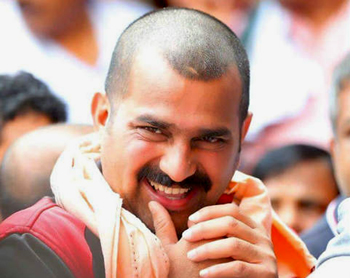
Police interrogating NaMo Naresh in undisclosed location?

[email protected] (CD Network)
June 25, 2016

Mangaluru, Jun 25: Whether police have already nabbed Naresh Shenoy, the prime accused in the murder of 51-year-old RTI activist Vinayak Baliga and interrogating him in an undisclosed location?

shenoydEven though police are calling this to be mere rumour, highly placed sources said that the police are delaying to announce the arrest as they get only 24 hours to question before producing him to court if they formally arrest him.

Sources said that Naresh was caught either in Kerala or Goa by Mangaluru police on Thursday or Friday. He had been at large since March 21, the day of the murder.

Incidentally, the police had filed a preliminary charge sheet in the case before the III Judicial Magistrate First Class in Mangaluru on Thursday, listing Naresh as Accused No. 1.

All the remaining six accused have already been arrested by the police and one of them is out on bail. Not revealing the place from where Naresh was secured, highly-placed sources in the police said that they were questioning Naresh in relation to the case.

Shenoy is the founder of Mangaluru unit of Namo Brigdae, later renamed as Yuva Brigade. Hence, he is popularly known as NaMo Naresh.

Vinayak Baliga was hacked to death by three persons near his house in Kodialbail. The police first arrested Vineet Poojary, Nishit Devadiga and Shiva alias Shivaprasad, who allegedly murdered Baliga.

Later police arrested photographer K. Manjunath Shenoy alias Manju Neereshwalya for allegedly helping Naresh in evading arrest. On June 18, police arrested Srikant, a close associate of Naresh, who was accused of hiring services of the three assailants.

The alleged inability of the Mangaluru police to nab the prime accused had led to severe discontent in Mangaluru as well as the State.

Several protests were held by activists led by rationalist Narendra Nayak and also by family members of Vinayak Baliga demanding arrest of Naresh.

They had accused elected representatives of being silent over the inordinate delay in arresting Naresh.

Naresh, who reportedly hoodwinked police by shifting his locations quite often, had filed anticipatory bail applications before the District Sessions Court and the High Court that were rejected. A complaint was filed by Naresh's family members before the Karnataka Human Rights Commission accusing the police of harassment.

Also Read : NaMo Naresh not yet arrested; we will catch him soon: Mangaluru police chief

Comments

Mohidin
 - 
Saturday, 25 Jun 2016

He may be in Kalladka and guarded by Pumpwell

Yettinahole Putra
 - 
Saturday, 25 Jun 2016

I heard that this fellow surrendered to police before police could arrest him. The Sanghis were aware of everything and they only leaked the \arrest\" news to media to exert pressure on police so that they announce the arrest and produce him before court soon. Otherwise kai kal pudi pudi.."

Satyameva jayate
 - 
Saturday, 25 Jun 2016

Ha ha...... terrorist or criminal ? Yaava jaati.....

Shivaiah
 - 
Saturday, 25 Jun 2016

some party's simply defaming nareshanna, he knows it if he ones caught by this police he will not return back, he will be charged in fake case and will be put behind bars for life time.

Saleem
 - 
Saturday, 25 Jun 2016

Ab tak chappan kar do ssaleko.....................

Kiran
 - 
Saturday, 25 Jun 2016

totally drama played by bjp govt to save him.

Mahesh Mahajan
 - 
Saturday, 25 Jun 2016

from the first investigation only i came to know that police force is protecting this criminal.

Add new comment

  • Coastaldigest.com reserves the right to delete or block any comments.
  • Coastaldigset.com is not responsible for its readers’ comments.
  • Comments that are abusive, incendiary or irrelevant are strictly prohibited.
  • Please use a genuine email ID and provide your name to avoid reject.
coastaldigest.com web desk
July 25,2020

Bengaluru, July 25: A 105-year-old person from Bengaluru’s Basaveshwar Nagar, who was under treatment for covid-19 at a hospital for past five days, breathed his last today. He was a former government account who retired in 1973. He was the oldest known covid-19 patient in the state so far.

Many members of the patient's family are said to be infected and are hospitalised at various facilities. The funeral will be overseen by two uninfected family members.

The patient 74411 died on Saturday morning at around 9 a.m., said Dr Prasanna, Managing Director of Pristine Hospital And Research Centre where the former was admitted.

“The patient was initially doing well when he admitted on July 20. He did not have significant lung changes when he was admitted. However, after three days, his blood pressure started to drop so he was put on oxygen in the ICU. Yesterday morning, with continued deterioration, he was placed on non-invasive ventilator support,” Dr Prasanna said.

“Finally, by last night, his oxygen saturation levels began to plummet abruptly and we had to intubate him for ventilator support. His condition continued to deteriorate, however. The cause of death was respiratory failure and the onset of sepsis,” he added.

Although earmarked for supplies of Remdesivir by the government, the hospital did not receive the drugs. An appeal to Dr K Sudhakar, Minister of Medical Education by the hospital staff resulted in an assurance that the medication would arrive. “However, in the end, we had to source the medication ourselves on Friday,” medical staff said.

Dr Thrilok Chandra, Head, Critical Care Support Unit (CCSU), which oversees the care of critical or vulnerable-aged Covid-19 patients, had said that Patient 74411 had been diagnosed early. “He was identified when the disease was still in the early stages in his body. He only had symptoms of Influenza-Like Illness (ILI), so the symptoms were not severe,” Dr Chandra had said.

“It’s very sad. We were rooting for him to pull through. He had no comorbidities at all. He had been bed-ridden from last year, but he was healthy. His only potential comorbidity was his advanced age,” Dr Prasanna said.

According to government data, 34% of Covid-19 fatalities in India are aged between 60 and 74 years of age. Fourteen per cent are aged above 74.

Comments

Add new comment

  • Coastaldigest.com reserves the right to delete or block any comments.
  • Coastaldigset.com is not responsible for its readers’ comments.
  • Comments that are abusive, incendiary or irrelevant are strictly prohibited.
  • Please use a genuine email ID and provide your name to avoid reject.
Ram Puniyani
January 14,2020

In the beginning of January 2020 two very disturbing events were reported from Pakistan. One was the attack on Nankana Sahib, the holy shrine where Sant Guru Nanak was born. While one report said that the place has been desecrated, the other stated that it was a fight between two Muslim groups. Prime Minister of Pakistan Imran Khan condemned the incident and the main accused Imran Chisti was arrested. The matter related to abduction and conversion of a Sikh girl Jagjit Kaur, daughter of Pathi (One who reads Holy Guru Granth Sahib in Gurudwara) of the Gurudwara. In another incident one Sikh youth Ravinder Singh, who was out on shopping for his marriage, was shot dead in Peshawar.

While these condemnable attacks took place on the Sikh minority in Pakistan, BJP was quick enough to jump to state that it is events like this which justify the Citizenship Amendment Act (CAA). Incidentally CAA is the Act which is discriminatory and relates to citizenship with Religion, which is not as per the norms of Indian constitution. There are constant debates and propaganda that population of Hindus has come down drastically in Pakistan and Bangla Desh. Amit Shah, the Home minister stated that in Pakistan the population of Hindus has come down from 23% at the time of partition to 3.7% at present. And in Bangla Desh it has come down from 22% to present 8%.

While not denying the fact that the religious minorities are getting a rough deal in both these countries, the figures which are presented are totally off the mark. These figures don’t take into consideration the painful migrations, which took place at the time of partition and formation of Bangla Desh later. Pakistan census figures tell a different tale. Their first census was held in 1951. As per this census the overall percentage of Non Muslim in Pakistan (East and West together) was 14.2%, of this in West Pakistan (Now Pakistan) it was 3.44 and in Eat Pakistan it was 23.2. In the census held in Pakistan 1998 it became 3.72%. As far as Bangla Desh is concerned the share of Non Muslims has gone down from 23.2 (1951) to 9.6% in 2011.

The largest minority of Pakistan is Ahmadis, (https://minorityrights.org/country/pakistan/) who are close to 4 Million and are not recognised as Muslims in Pakistan. In Bangla Desh the major migrations of Hindus from Bangla Desh took place in the backdrop of Pakistan army’s atrocities in the then East Pakistan.

As far as UN data on refugees in India it went up by 17% between 2016-2019 and largest numbers were from Tibet and Sri Lanka.  (https://www.un.org/en/development/desa/population/migration/publication…)

The state of minorities is in a way the index of strength of democracy. Most South Asian Countries have not been able to sustain democratic values properly. In Pakistan, the Republic began with Jinnah’s classic speech where secularism was to be central credo of Pakistan. This 11th August speech was in a way what the state policy should be, as per which people of all faiths are free to practice their religion. Soon enough the logic of ‘Two Nation theory” and formation of Pakistan, a separate state for Muslim took over. Army stepped in and dictatorship was to reign there intermittently. Democratic elements were suppressed and the worst came when Zia Ul Haq Islamized the state in collusion with Maulanas. The army was already a strong presence in Pakistan. The popular formulation for Pakistan was that it is ruled by three A’s, Army, America and Allah (Mullah).

Bangla Desh had a different trajectory. Its very formation was a nail in the coffin of ‘two nation theory’; that religion can be the basis of a state. Bangla Desh did begin as a secular republic but communal forces and secular forces kept struggling for their dominance and in 1988 it also became Islamic republic. At another level Myanmar, in the grip of military dictatorship, with democratic elements trying to retain their presence is also seeing a hard battle. Democracy or not, the army and Sanghas (Buddhist Sang has) are strong, in Myanmar as well. The most visible result is persecution of Rohingya Muslims.

Similar phenomenon is dominating in Sri Lanka also where Budhhist Sanghas and army have strong say in the political affairs, irrespective of which Government is ruling. Muslim and Christian minorities are a big victim there, while Tamils (Hindus, Christians etc.) suffered the biggest damage as ethnic and religious minorities. India had the best prospect of democracy, pluralism and secularism flourishing here. The secular constitution, the outcome of India’s freedom struggle, the leadership of Gandhi and Nehru did ensure the rooting of democracy and secularism in a strong way.

India so far had best democratic credentials amongst all the south Asian countries. Despite that though the population of minorities rose mainly due to poverty and illiteracy, their overall marginalisation was order of the day, it went on worsening with the rise of communal forces, with communal forces resorting to identity issues, and indulging in propaganda against minorities.

While other South Asian countries should had followed India to focus more on infrastructure and political culture of liberalism, today India is following the footsteps of Pakistan. The retrograde march of India is most visible in the issues which have dominated the political space during last few years. Issues like Ram Temple, Ghar Wapasi, Love Jihad, Beef-Cow are now finding their peak in CAA.

India’s reversal towards a polity with religion’s identity dominating the political scene was nicely presented by the late Pakistani poetess Fahmida Riaz in her poem, Tum bhi Hum Jaise Nikle (You also turned out to be like us). While trying to resist communal forces has been an arduous task, it is becoming more difficult by the day. This phenomenon has been variously called, Fundamentalism, Communalism or religious nationalism among others. Surely it has nothing to do with the religion as practiced by the great Saint and Sufi traditions of India; it resorts mainly to political mobilization by using religion as a tool.


Comments

Ashi
 - 
Tuesday, 14 Jan 2020

If Malaysia implement similar NRC/CAA, India and China are the loser.

Add new comment

  • Coastaldigest.com reserves the right to delete or block any comments.
  • Coastaldigset.com is not responsible for its readers’ comments.
  • Comments that are abusive, incendiary or irrelevant are strictly prohibited.
  • Please use a genuine email ID and provide your name to avoid reject.
News Network
April 18,2020

Bengaluru, Apr 18: Karnataka Congress president DK Shivakumar on Saturday appealed to Prime Minister Narendra Modi to deposit at least Rs 10,000 in bank accounts of people belonging to the unorganised sector.

"The unorganised sector comprises barbers, dhobi, cooks, carpenters, sweepers, drivers and autorickshaw drivers. Prime Minister Narendra Modi did not mention anything about giving subsistence to these people," Shivakumar, told ANI, referring to the Prime Minister's address earlier this week.

Modi had announced the extension of the ongoing nationwide lockdown till May 3 in order to curb the spread of coronavirus.

"I appeal to Prime Minister Modi to register the members of the unregistered sector under the National Rural Employment Guarantee Act (NREGA) or deposit at least Rs 10,000 to the bank accounts of each of the members of unorganised sector to help them survive the lockdown," he added.

Though the Congress party will continue the central government and state government's fight against coronavirus, he said, both the governments need to help people who are part of the unorganised sector.

"The farmers have told me that due to the lockdown they are ready to sell the vegetables, which once used to be sold at Rs 100 per kg, at even Rs 5 per kg," he said.

Speaking on the suggestions he made to Chief Minister BS Yediyurappa, Shivakumar said, "I requested the Chief Minister to send a team to do a videograph and make an assessment of the on-ground situation. However, till now, no one has gone."

Comments

Add new comment

  • Coastaldigest.com reserves the right to delete or block any comments.
  • Coastaldigset.com is not responsible for its readers’ comments.
  • Comments that are abusive, incendiary or irrelevant are strictly prohibited.
  • Please use a genuine email ID and provide your name to avoid reject.