


Sisodia, over 60 AAP MLAs detained on their way to Modi's resident

June 26, 2016

New Delhi, Jun 26: Delhi Deputy Chief Minister Manish Sisodia and over 60 Aam Aadmi Party legislators were detained by police today while they were on their way to Prime Minister Narendra Modi's residence here to protest the arrest of a party MLA.
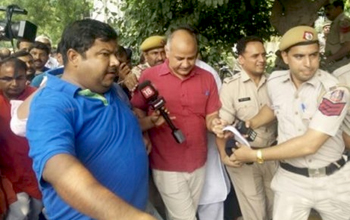
aaparrestThe MLAs were detained for violating prohibitory orders around 7 RCR. The protest march comes a day after AAP MLA Dinesh Mohaniya was arrested on charges of molestation and sexual harassment amidst high drama when he was addressing a press conference.

Mohaniya, who is also vice chairman of Delhi Jal Board, was picked up by a police team while addressing a press conference at his office in Khanpur. He was booked for allegedly misbehaving with a group of women who approached him with a complaint regarding water crisis in their locality.

Sisodia said although they were detained and taken to the Parliament Police Station, he and his partymen were ready to go to Tihar Jail.

"Modiji, you have arrested us and kept us in Parliament Street Police Station. We are ready to go to Tihar Jail. But do not stop the work of Delhi," he tweeted.

Delhi Chief Minister Arvind Kejriwal had earlier tweeted, "Complaint filed against Manish Sisodia yesterday. Manish will go to 7, RCR today to surrender himself before PM," he said.

Sisodia had yesterday tweeted, "Modiji, your enmity is with us. Arrest us. But do not stop the work of Delhi. We all are coming to surrender before you".

The Deputy CM had yesterday said when he went for a surprise inspection at Gazipur Mandi, some people who were running illegal business, registered a complaint alleging that he had threatened them.

"I am sure that Modiji will tomorrow, will convert this complaint into accusations like violence, eve teasing a girl and extortion and get me arrested," he had stated.

Referring to yesterday's incident, Special CP Law and Order North S B K Singh said the president of Gazipur Aadhti Association had given a letter at Gazipur Police Station stating that Sisodia adopted a "dictatorial attitude" on hearing their grievances during his visit to Gazipur Mandi.

"He was worried that Sisodia could get something wrong organised due to his position. No police action is made out in the matter," he said.

Comments

Rikaz
 - 
Sunday, 26 Jun 2016

Modi is trying to get AAP Government in Delhi which is not at all good....AAP is doing a good job up there...

Rikaz
 - 
Sunday, 26 Jun 2016

Modi cannot digest his loss in Delhi....stupidity...

Add new comment

  • Coastaldigest.com reserves the right to delete or block any comments.
  • Coastaldigset.com is not responsible for its readers’ comments.
  • Comments that are abusive, incendiary or irrelevant are strictly prohibited.
  • Please use a genuine email ID and provide your name to avoid reject.
coastaldigest.com web desk
June 14,2020

Bengaluru, June 14: Chief Minister B S Yediyurappa-led BJP government of Karnataka has once again urged the Prime Minister Narendra Modi-led union BJP government to release GST compensation worth Rs 10,208 crore that is due for the state.

The request was placed with Finance Minister Niramala Sitharaman during the 40th GST council meeting, in which Karnataka Home Minister and state’s representative to the council, Basavaraj Bommai, participated.

Speaking to reporters after the meeting, Bommai said that Rs 10,208 crore was due from the Centre as GST compensation for four four months - from March to May.

“We have requested the Centre to release Rs 1,460 crore - pertaining to GST compensation for the month of March - as soon as possible due to the dire financial conditions of the state,” he said.

Bommai said that the state was confident that the funds will be released soon, noting that Karnataka had recently received Rs 4,314 in GST compensation for three months, between December 2019 to February 2020.

Meanwhile, the state also proposed the Council to reduce penalty for delay in filing GST. Bommai said that while people are made to pay 18% of the tax as fine in delay in payment, Karnataka has asked the Centre to reduce the percentage by half to 9%.

Comments

Add new comment

  • Coastaldigest.com reserves the right to delete or block any comments.
  • Coastaldigset.com is not responsible for its readers’ comments.
  • Comments that are abusive, incendiary or irrelevant are strictly prohibited.
  • Please use a genuine email ID and provide your name to avoid reject.
coastaldigest.com news network
June 3,2020

Mangaluru, Jun 3: The district administrations of Dakshina Kannada and Kasaragod have issued standard operating procedures (SOP) for the movement of people between two neighbouring districts that fall under two different states.

Even though thousands of people used to commute between these two districts due to employment, education and other reasons every day, the travel has been banned for over two months due to covid lockdown.

Dakshina Kannada DC Sindhu B Rupesh has assured that travel passes will be issued for working professionals/students who have to commute every day.

Those who wish to travel to DK district from Kasargod have to register on https://bit.ly/dkdpermit for daily pass.

The pass applicant should mention the travel destinations, and the complete work address in DK. He/she should also upload Aadhaar card, proof of workplace. On receipt of the applications, the AC of Mangaluru division will issue the pass which will be valid till June 30.

The DC said that the pass details will be recorded at Talapady check post daily. Those who fail to report during the exit from Dakshina Kannada will be subjected to quarantine by the taluk administration and penal action will be initiated as per Epidemic Act, she warned.

Thermal screening of all persons entering DK will be conducted at the checkpost. Only those who are asymptomatic will be allowed to enter.

As per the SOP issued by Kasargod District Collector, those who wish to commute between these two districts have to register in COVID-19 Jagratha portal under the emergency pass category and the applicant has to mention the reason as “inter-state travel on a daily basis."

Comments

Add new comment

  • Coastaldigest.com reserves the right to delete or block any comments.
  • Coastaldigset.com is not responsible for its readers’ comments.
  • Comments that are abusive, incendiary or irrelevant are strictly prohibited.
  • Please use a genuine email ID and provide your name to avoid reject.
Media Release
February 14,2020

Veteran journalist P. Sainath has said that the nation is in a crisis. And this crisis is not limited to just the rural area. It has become a national crisis at various areas such as agriculture, education, economy, job creation etc.

He was delivering the endowment lecture on the topic ‘Indian democracy at the post-liberalization and post-truth era’ at Media Manthan 2020 organized by the PG department of journalism and mass communication at St Aloysius College (Autonomous). 

Mr Sainath said that the many policies adopted in the 90s led to India becoming unusually unequal. Referring to the speech Ambedkar had made at the Constituent Assembly while handing over the draft of the Constitution, Mr Sainath said, “Ambedkar had warned about the weakness of Indian democracy that liberty without equality allows the supremacy of a few over the multitude. Liberty, equality and fraternity must be kept together as we cannot have one without the other.” 

Mr Sainath stated that the agrarian crisis was no longer about the loss of productivity, employment or about farmer suicide; it was a societal, civilizational crisis. Commenting on the lopsided policies such as cow-slaughter ban, he explained how cow slaughter ban had adversely affected many industries due to their interdependency. While Muslims who slaughtered cows were rendered helpless, the cattle traders who were mostly OBCs lost their earnings as the cattle prices crashed. An important industry like Kolhapur sandals industry in Maharashtra went bankrupt as a result of the cow slaughter ban in Maharashtra. He said the policymakers had no idea how the rural industries were interconnected. Demonetisation too devastated the rural economy as 98 percent of rural transactions happen through cash. 

Mr Sainath also spoke about the crisis of inequality which affects the Dalits and the Adivasis far more than anyone else as 90 percent of the rural households take home less than Rs 10,000/- per month. “Women are yet another group whose labour is never counted in the gross domestic product. Women and girls globally do unpaid work which amounts to about 12.5 billion working hours per year. Monetarily speaking, this is worth 10.8 trillion dollars,” Mr Sainath added. 

Speaking about the crisis of jobs Mr Sainath said that major companies were laying off employees just to create more profits for the investors and the adoption of artificial intelligence in the industry would further destroy millions of jobs.

Rector of St Aloysius College Institutions Fr Dionysius Vaz SJ, Principal Dr (Fr) Praveen Martis SJ, HOD of Journalism and Mass Communication department Dr (Fr) Melwyn Pinto SJ were present.

‘Veerappan and Vijay Mallya’s business models are interesting!’

Addressing the gathering during his endowment lecture on Friday, Mr Sainath made an interesting comment on the so called ‘revenue model’. “Whenever I visit IIMs and IITs for lectures on my PARI project, the students there ask me what my revenue model for my project is. I tell them that I do not have a revenue model. In fact, journalism does not begin with a revenue model. Gandhiji, Ambedkar, Bhagat Singh were all great journalists. But they did not have a revenue model,” Mr Sainath said.

On a lighter note, he said that the best revenue model that he liked was that of forest brigand Veerappan and liquor baron Vijay Mallya. “Veerappan ruled the forest for forty years and from the top ministers to the villagers he could dictate terms and liver royally. Similarly, Mallya’s revenue model was to steal the banks and run away abroad and live like a king,” Mr Sainath added.

Journalism is not and can never be a business. It is a calling, he opined. While newspaper can be a business, television can be a business, journalism per se cannot be reduced to a business. “Unfortunately today, journalists are recruited on a contract basis and they have no bargaining power; and there are no unions to fight for their cause. Hence, they are at the mercy of the corporate media houses for their survival and are made to write stories that cannot be called journalism,” Mr Sainath said.

Answering a question as to the pressures he faced as a journalist, he said that external pressures from the government or others could be very well handled. It is the internal pressures from once own media house that journalists find it difficult to manage.


Comments

Add new comment

  • Coastaldigest.com reserves the right to delete or block any comments.
  • Coastaldigset.com is not responsible for its readers’ comments.
  • Comments that are abusive, incendiary or irrelevant are strictly prohibited.
  • Please use a genuine email ID and provide your name to avoid reject.