


Sisodia, over 60 AAP MLAs detained on their way to Modi's resident

June 26, 2016

New Delhi, Jun 26: Delhi Deputy Chief Minister Manish Sisodia and over 60 Aam Aadmi Party legislators were detained by police today while they were on their way to Prime Minister Narendra Modi's residence here to protest the arrest of a party MLA.
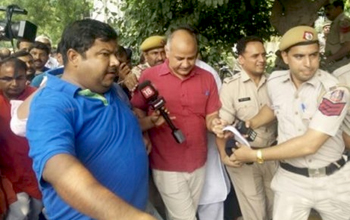
aaparrestThe MLAs were detained for violating prohibitory orders around 7 RCR. The protest march comes a day after AAP MLA Dinesh Mohaniya was arrested on charges of molestation and sexual harassment amidst high drama when he was addressing a press conference.

Mohaniya, who is also vice chairman of Delhi Jal Board, was picked up by a police team while addressing a press conference at his office in Khanpur. He was booked for allegedly misbehaving with a group of women who approached him with a complaint regarding water crisis in their locality.

Sisodia said although they were detained and taken to the Parliament Police Station, he and his partymen were ready to go to Tihar Jail.

"Modiji, you have arrested us and kept us in Parliament Street Police Station. We are ready to go to Tihar Jail. But do not stop the work of Delhi," he tweeted.

Delhi Chief Minister Arvind Kejriwal had earlier tweeted, "Complaint filed against Manish Sisodia yesterday. Manish will go to 7, RCR today to surrender himself before PM," he said.

Sisodia had yesterday tweeted, "Modiji, your enmity is with us. Arrest us. But do not stop the work of Delhi. We all are coming to surrender before you".

The Deputy CM had yesterday said when he went for a surprise inspection at Gazipur Mandi, some people who were running illegal business, registered a complaint alleging that he had threatened them.

"I am sure that Modiji will tomorrow, will convert this complaint into accusations like violence, eve teasing a girl and extortion and get me arrested," he had stated.

Referring to yesterday's incident, Special CP Law and Order North S B K Singh said the president of Gazipur Aadhti Association had given a letter at Gazipur Police Station stating that Sisodia adopted a "dictatorial attitude" on hearing their grievances during his visit to Gazipur Mandi.

"He was worried that Sisodia could get something wrong organised due to his position. No police action is made out in the matter," he said.

Comments

Rikaz
 - 
Sunday, 26 Jun 2016

Modi is trying to get AAP Government in Delhi which is not at all good....AAP is doing a good job up there...

Rikaz
 - 
Sunday, 26 Jun 2016

Modi cannot digest his loss in Delhi....stupidity...

Add new comment

  • Coastaldigest.com reserves the right to delete or block any comments.
  • Coastaldigset.com is not responsible for its readers’ comments.
  • Comments that are abusive, incendiary or irrelevant are strictly prohibited.
  • Please use a genuine email ID and provide your name to avoid reject.
News Network
April 7,2020

Bengaluru, Apr 7:  A group of Muslim philanthropists including a woman were allegedly assaulted by a group of people while they were distributing necessary food items to the needy at Dasarahalli of Amruthahalli Police Station limits in the city.

An FIR has also been registered in this regard and two people have been taken under police custody.

Twenty-three-year-old Syed Tabrez, son of Zarin Taj, secretary of Swaraj Abhiyan's local unit and his mother and friends were attacked by some unknown miscreants at Dasarahalli of Amruthahalli police station limits on Monday while they were distributing essential items to the needy amid the COVID-19 lockdown.

"The incident occurred on Monday. An FIR was filed by the woman stating that she was assaulted by some people. On receiving the information, our officers rushed to Ambedkar Hospital and spoke to one of the victims. As per the complaint, Vidyaranya Pura and Amruthahalli Police have secured two people.

The investigation is underway. It is not a case of communal hatred," said Dr Bheemashakar Guled, Deputy Commissioner of Police (DCP), North-East Bengaluru.

Tabrez has suffered minor injuries on his right hand and right leg while others have also suffered minor injuries. They have been discharged from the hospital.

The incident occurred at around 6 pm yesterday when some people came on a motorcycle, carrying bats and started thrashing Tabrez along with others, as per the FIR. Later, the injured people went to Amrutahalli Police Station and filed a complaint there.

Later they went to the Bowring Hospital which was closed. Then, they went to Dr Ambedkar Hospital in KG Halli.

Syed's mother said the accused persons threatened us, saying that "Muslims are poisoning the rations. You people will not deliver the food here. Muslims will have to leave the slum and relocate themselves somewhere else."

Comments

Add new comment

  • Coastaldigest.com reserves the right to delete or block any comments.
  • Coastaldigset.com is not responsible for its readers’ comments.
  • Comments that are abusive, incendiary or irrelevant are strictly prohibited.
  • Please use a genuine email ID and provide your name to avoid reject.
News Network
June 29,2020

Bengaluru, Jun 29: A 99-year-old woman has successfully recovered from coronavirus in Bengaluru, leaving the medical fraternity and her family elated.

The woman had contracted the pathogen after coming in contact with her grandson and was hospitalised on her 99th birthday on June 18.

The woman was taken to the government Victoria Hospital along with her 70-year-old son, daughter-in-law and grandson.

"While we three developed symptoms like cold, cough and fever, my mother remained asymptomatic," the woman's son said.

The family members are still wondering how they got infected by the virus as all except the woman's grandson, were confined to their home most of the time.

Her 29-year-old grandson was the only one who went out to buy groceries.

Initially, the family approached a private hospital nearby for treatment, but they refused to accept COVID-19 patients.

Left with no option, the family got admitted to the Victoria hospital.

"We had reservations about Victoria hospital, but it turned out be a good one.

We did not spend a penny since the day we were admitted and my mother and son fully recovered," the woman's son said.

According to Dr Asima Banu, nodal officer of the Trauma Care Centre at the Victoria hospital, the woman was reluctant to get treatment at the hospital.

"With moral support from doctors and nurses at the Trauma Care Centre, she recovered very fast. She is always positive in life," the doctor said.

Comments

Add new comment

  • Coastaldigest.com reserves the right to delete or block any comments.
  • Coastaldigset.com is not responsible for its readers’ comments.
  • Comments that are abusive, incendiary or irrelevant are strictly prohibited.
  • Please use a genuine email ID and provide your name to avoid reject.
Agencies
May 8,2020

Washington D.C., May 8: The prime time for brain development in a child's life is the first year, where the infant spends most of the time asleep. It is the time when neural connections form and sensory memories are encoded.

However, when sleep is disrupted, as occurs more often among children with autism, brain development may be affected, too.

New research led by the University of Washington finds that sleep problems in a baby's first 12 months may not only precede an autism diagnosis but also may be associated with altered growth trajectory in a key part of the brain, the hippocampus.

The study, which was published in the American Journal of Psychiatry, researchers report that in a sample of more than 400 taken of 6- to 12-month-old infants, those who were later diagnosed with autism were more likely to have had difficulty falling asleep.

It also states that this sleep difficulty was associated with altered growth trajectories in the hippocampus.

"The hippocampus is critical for learning and memory, and changes in the size of the hippocampus have been associated with poor sleep in adults and older children.

As many as 80 per cent of the children with autism spectrum disorder have sleep problems," said Annette Estes, director of the UW Autism Center and senior author of the study.

"In our clinical experience, parents have a lot of concerns about their children's sleep, and in our work on early autism intervention, we observed that sleep problems were holding children and families back," added Estes, who is also a UW professor of speech and hearing sciences.

"It could be that altered sleep is part-and-parcel of autism for some children. One clue is that behavioural interventions to improve sleep don't work for all children with autism, even when their parents are doing everything just right. This suggests that there may be a biological component to sleep problems for some children with autism," said Estes.

To consider links among sleep, brain development, and autism, researchers at the IBIS Network looked at MRI scans of 432 infants, surveyed parents about sleep patterns, and measured cognitive functioning using a standardized assessment.

At the outset of the study, infants were classified according to their risk for developing autism: Those who were at higher risk of developing autism -- about two-thirds of the study sample -- had an older sibling who had already been diagnosed.

Infant siblings of children with autism have a 20 per cent chance of developing autism spectrum disorder -- a much higher risk than children in the general population.

In the current study, 127 of the 432 infants were identified as "low risk" at the time the MRI scans were taken because they had no family history of autism.

They later evaluated all the participants at 24 months of age to determine whether they had developed autism. Of the roughly 300 children originally considered "high familial risk," 71 were diagnosed with autism spectrum disorder at that age.

Problems with sleep were more common among the infants later diagnosed with an autism spectrum disorder, as were larger hippocampi. No other subcortical brain structures were affected, including the amygdala, which is responsible for certain emotions and aspects of memory, or the thalamus, a signal transmitter from the spinal cord to the cerebral cortex.

The authors note that while parents reported more sleep difficulties among infants who developed autism compared to those who did not, the differences were very subtle and only observed when looking at group averages across hundreds of infants.

Sleep patterns in the first years of life change rapidly as infants transition from sleeping around the clock to a more adult-like sleep/wake cycle. Until further research is completed, Estes said, it is not possible to interpret challenges with sleep as an early sign of increased risk for autism.

Comments

Add new comment

  • Coastaldigest.com reserves the right to delete or block any comments.
  • Coastaldigset.com is not responsible for its readers’ comments.
  • Comments that are abusive, incendiary or irrelevant are strictly prohibited.
  • Please use a genuine email ID and provide your name to avoid reject.